CONNECTICUT COLLEGE
CONNECTICUT COLLEGE
  • Current Issue
  • Past Issues
    • 2025 Issues
    • 2024 Issues
    • 2023 Issues
    • 2022 Issues
    • 2021 Issues
    • 2020 Issues
    • 2019 Issues
    • 2018 Issues
    • 2017 Issues
    • 2016 Issues
    • 2015 Issues
    • 2014 Issues
  • Older Issues
  • Letters to the Editor
  • Update Your Address
  • Alumni Association
  • News & Media Hub
  • Make a Gift
  • College Home Page

Contact Us

Connecticut College
Office of Communications
270 Mohegan Avenue
New London, CT 06320

Amy Martin
Editor, CC Magazine
asulliva@conncoll.edu
860-439-2526

CC Magazine welcomes your Class Notes submissions. Please include your name, class year, email, and physical address for verification purposes. Please note that CC Magazine reserves the right to edit for space and clarity. Thank you.

Submit Class Notes

Into the Blue

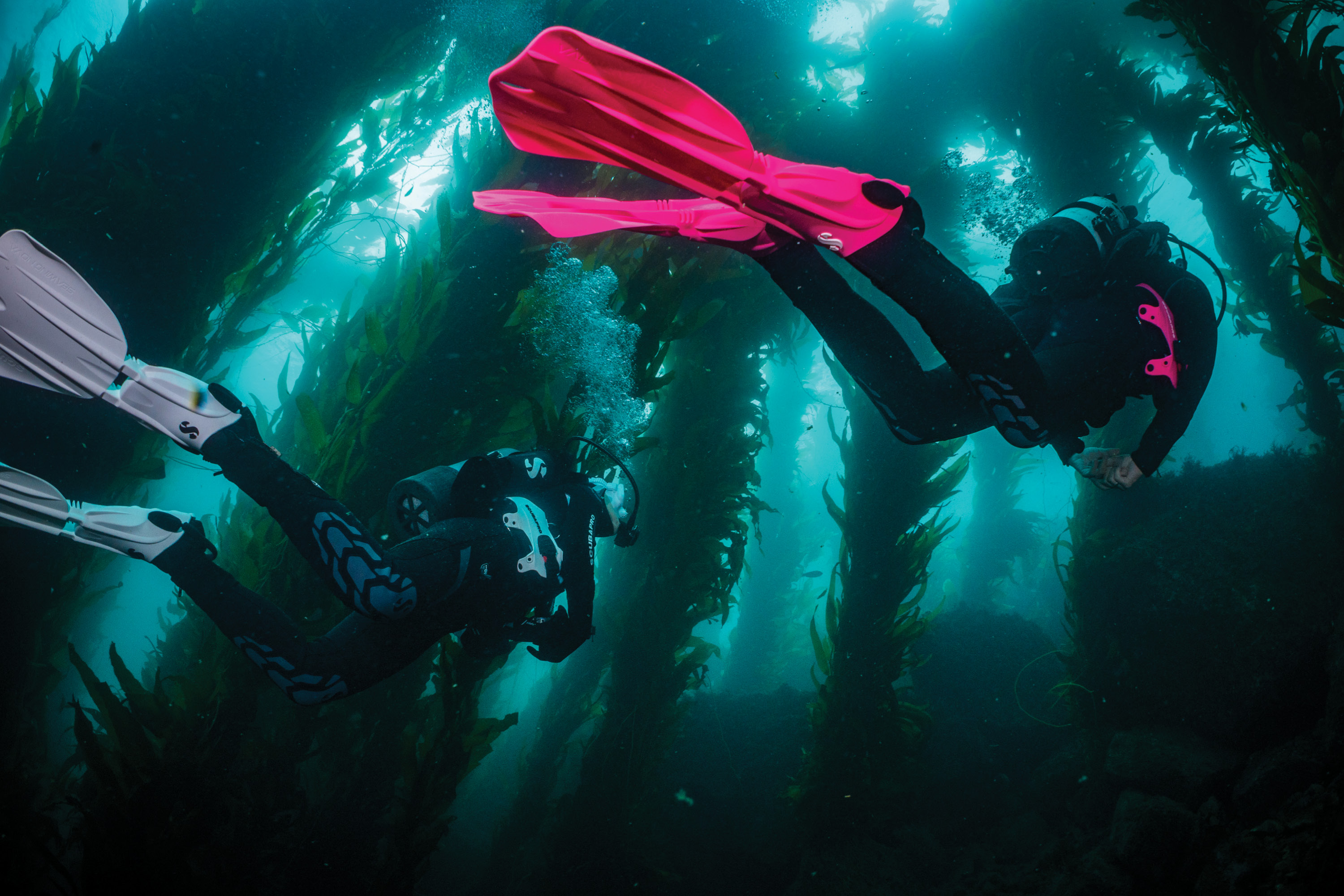
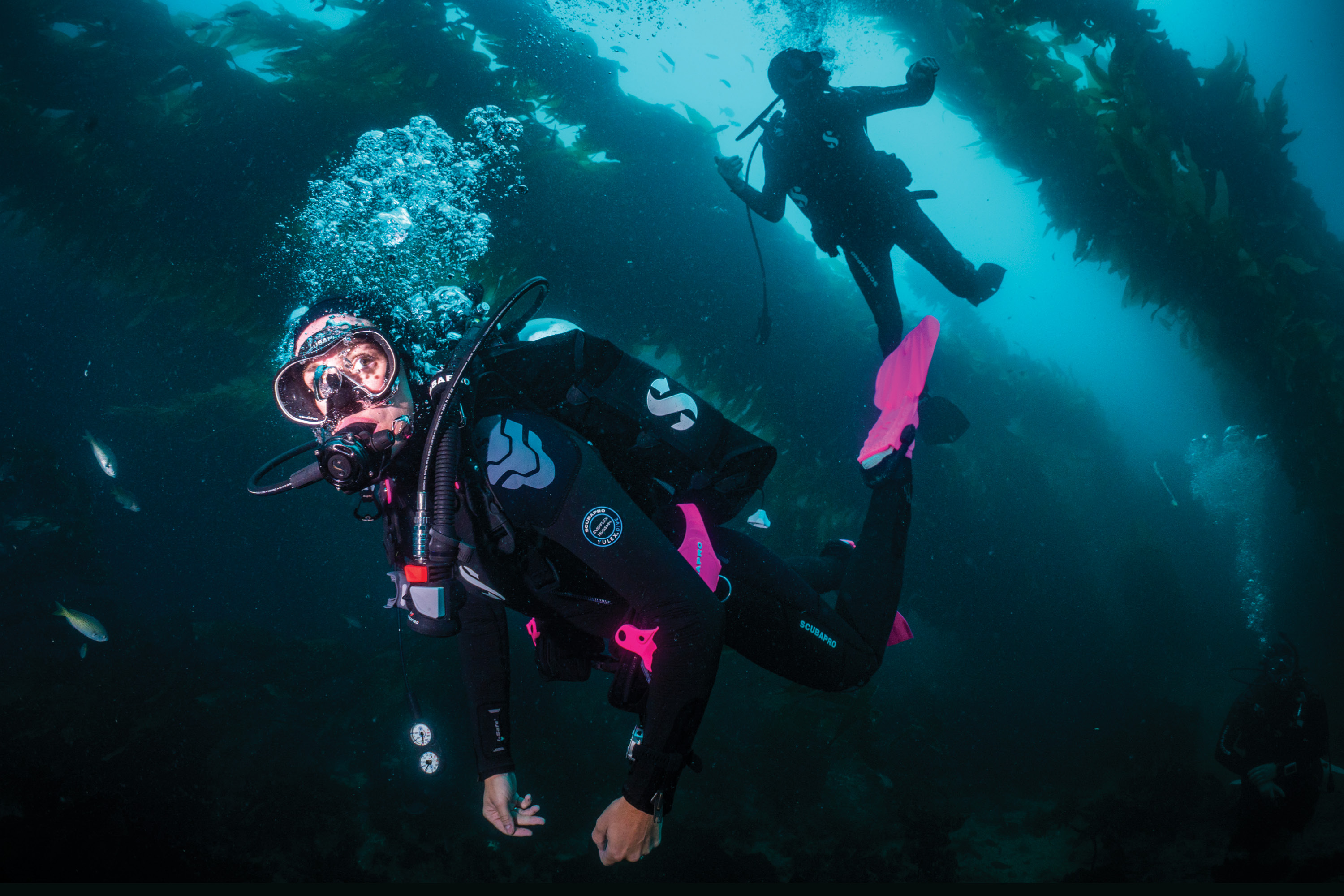
Emily Hazelwood ’11 and Jamie Sussman ’26 diving near a submerged oil rig.

Into the Blue

Emily Hazelwood ’11 and Jamie Sussman ’26 work together on sustainable solutions for offshore industries.

By Melissa Babcock Johnson

T

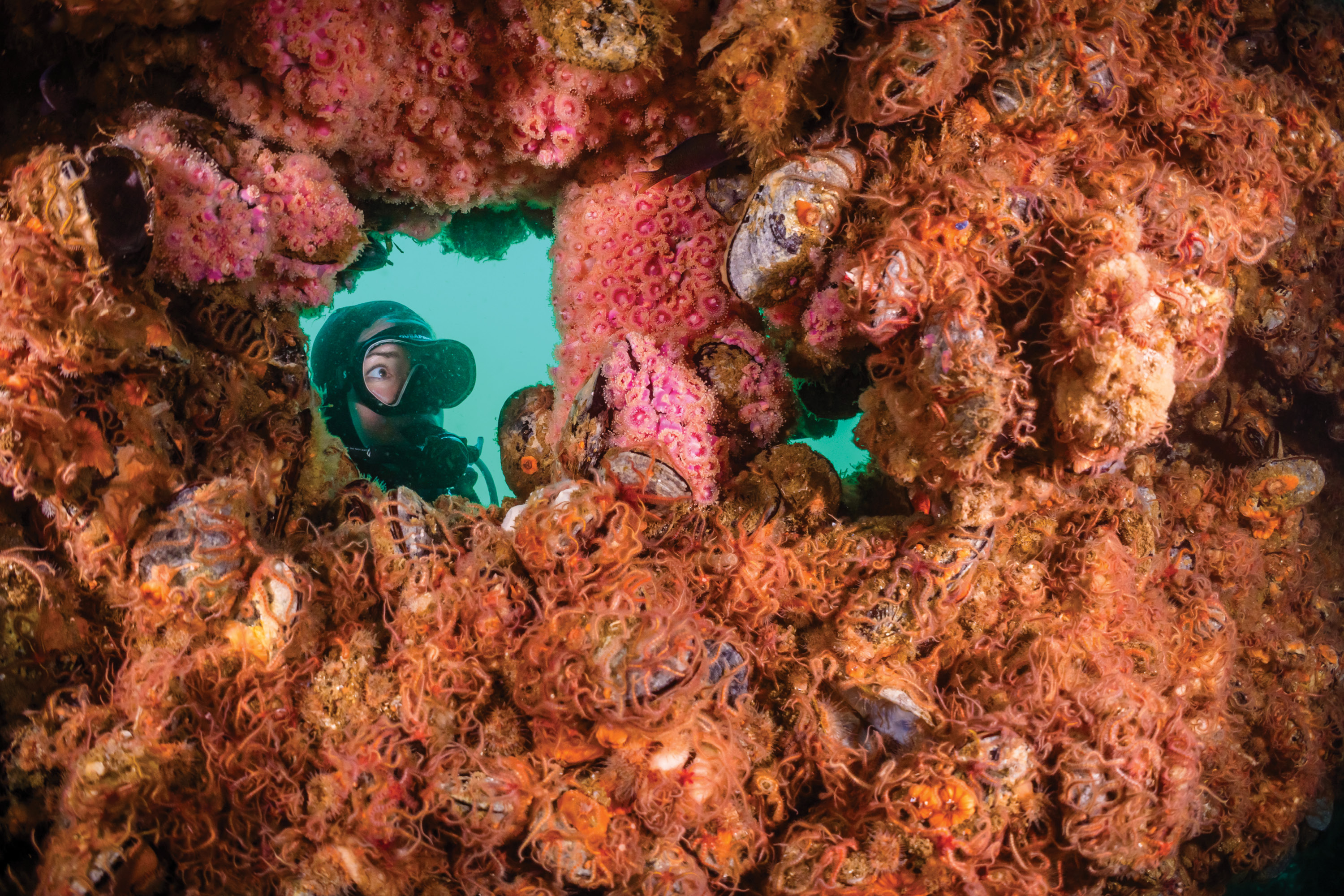
he stark twin oil platforms emerging from the calm open ocean appear small at first. But as the motorboat moves closer, the conjoined metal towers become increasingly formidable. When the boat finally docks next to a platform, about nine miles off the California coast, a few signs of life—rig workers and sea lions—appear. But the handful of visitors, most of whom don wetsuits, flippers, goggles and oxygen tanks, are here to explore the vibrant and hidden world beneath the water’s surface, where colorful fish, mussels, scallops, corals, sponges, sea anemones and other marine creatures have been flourishing on and around the structures for decades.

One of the divers about to weave between the submerged metal beams teeming with ecological colonization—and get a selfie with a particularly gregarious fish—is Jamie Sussman ’26. The biology and environmental studies double major, who also happens to be an Aquarius, spent one of the final Thursdays of summer break with two other divers on the boat: Connecticut College alumna Emily Hazelwood ’11 and her business partner, Amber Sparks, who co-founded the marine environmental consulting firm Blue Latitudes LLC in 2015. Sussman, a junior marine scientist for the firm, had joined Hazelwood and Sparks on a celebratory dive to mark Blue Latitudes’ 10th anniversary that August weekend.

“There’s no other feeling like when you’re first descending underwater and you look around in amazement,” Sussman says. “I remember thinking, ‘Wow, this is such a special experience.’ You just want it to last forever.”
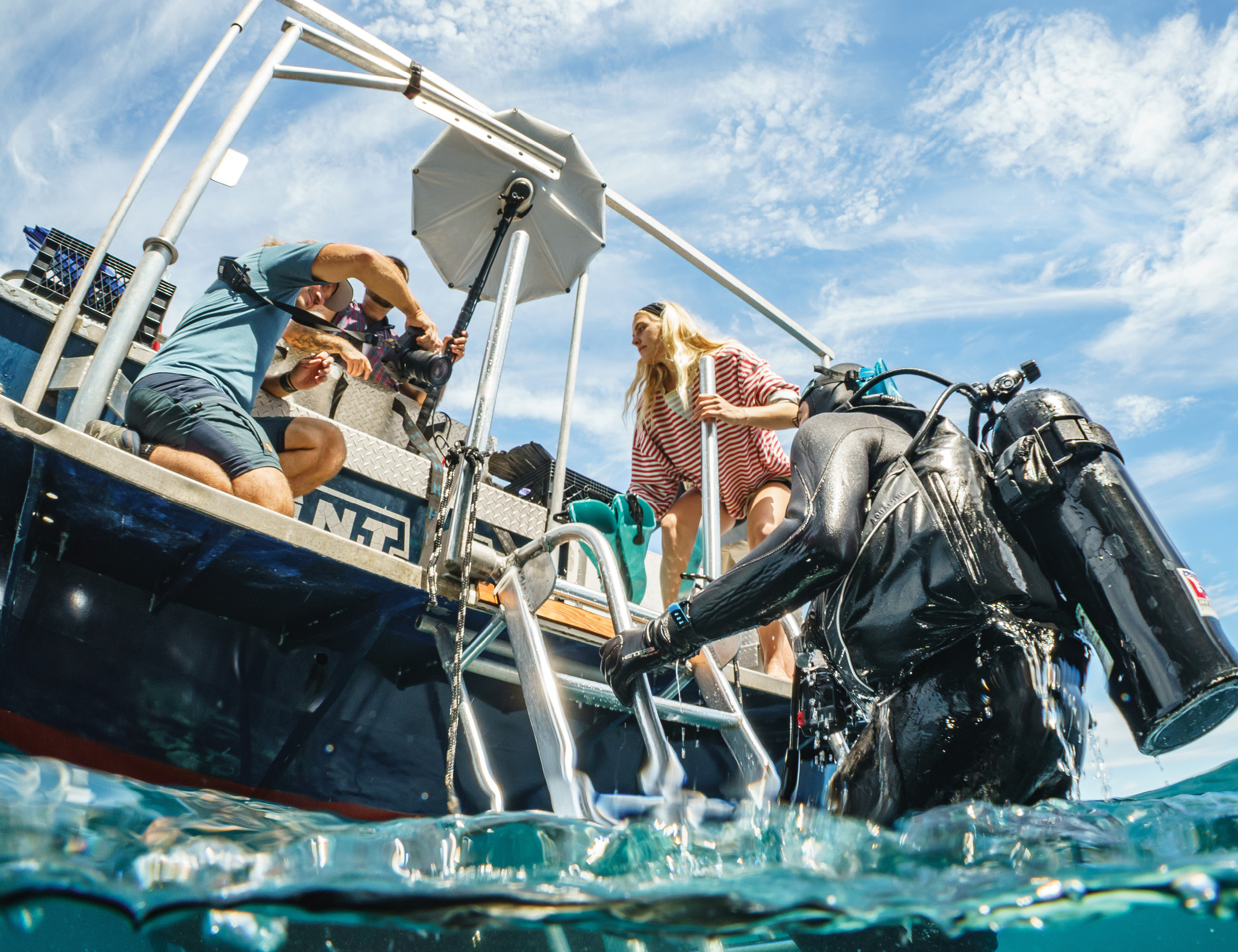
Jamie Sussman ’26 in diving gear climbing onto a boat.
All photos by Joe Platko

AT THE INTERSECTION OF INDUSTRY AND THE ENVIRONMENT

Over the past decade, Blue Latitudes has made huge waves in the Rigs-to-Reefs movement, which began in 1979 when Exxon relocated an oil rig from Louisiana waters to a permitted artificial reef site off the Florida panhandle. The program gained traction in 1984 with the passage of the National Fishing Enhancement Act, which required artificial reefs in U.S. waters to be built and placed in a way that enhances fishery resources. The bill also called for a long-term artificial reef plan.

It can cost millions of dollars more to scrap and remove a decommissioned oil platform than it would to allow a suitable one to remain a thriving environment for the sea life that has accumulated on it over the decades. In California, for example, 23 of the state’s 27 platforms are in federal waters and are good candidates to be reefed once they’re decommissioned, which would result in over a billion dollars in saved costs. And the benefits don’t stop there: California’s Rigs-to-Reefs law passed in 2010 mandates that 80% of that savings, or about $800 million, go back to the state into an endowment fund for marine preservation and conservation.

“Having these opportunities for win-wins, where scientists can work with industry to protect our environment, is the future of conservation,” says Sparks, who was honored with Hazelwood on the 2018 Forbes 30 Under 30 list in the energy sector category.

As part of its ongoing Rigs-to-Reefs involvement, Blue Latitudes used a National Science Foundation grant it won in 2021 to develop its proprietary Fisheries Location Assessment Technology (FishLAT), a patent-pending rapid assessment tool that uses machine learning to predict how the removal, reefing or installation of offshore infrastructure will impact the environment and fisheries. 

There’s no other feeling like when you’re first descending underwater and you look around in amazement.

— Jamie Sussman ’26

Last year, FishLAT helped the Coastal Conservation Association, the United States’ largest fisheries NGO, select 40 future artificial reef sites out of a pool of 900 candidates in Louisiana’s coastal waters. Hazelwood, a New Hampshire resident, and Sparks, who lives in California, hope to expand FishLAT’s capabilities to new regions off both U.S. coasts.

While most of their work so far has focused on California’s coastal waters and the Gulf of Mexico, where more than 600 retired oil rigs have found a new purpose as artificial reefs, Blue Latitudes has gone international. In 2017, the firm provided technical assistance for a rig decommissioning in the Chinguetti oil field off the coast of Mauritania in Africa. In 2020, they designed, developed and executed ROV-based marine life surveys on PETRONAS’ oil platforms in Malaysia to assess species richness and the abundance of corals, fish and invertebrates. These surveys were among the first comprehensive ecological assessments to use ROVs to describe the marine life assemblages found on platforms in the South China Sea.

“New regions mean new regulations and new marine life,” Sparks says. “We’re still working on a big research project in Gabon off of West Africa, and we also just got our first project in Alaska, so we’re moving up to look at those platforms. With these new areas, we need to bring new types of services, because different marine ecosystems have to be assessed in different ways.”

Emily Hazelwood ’11 looks through a coral reef under water.

‘SEEING IS BELIEVING'

Hazelwood and Sparks have also started to change the way the world thinks about offshore resource management, ocean energy and structure recycling, through their work with their nonprofit organization, the Blue Latitudes Foundation. Part of the battle is convincing people that human-made structures make good artificial reefs. 

“When you tell people an oil platform is a good candidate for an artificial reef, nobody believes you, because they’re going to look up images of the Deepwater Horizon oil spill or only see what it looks like above the surface,” says Hazelwood, who majored in environmental studies at Conn and went on to earn a Master of Applied Science in marine biodiversity and conservation from UC San Diego’s Scripps Institution of Oceanography.

Blue Latitudes is eyeing the increasing number of offshore wind turbines as the next set of artificial reef candidates, and Hazelwood says the same perception challenges exist—people can’t imagine a thriving marine environment beneath wind turbines and instead see them as eyesores. “When you Google, ‘What does it look like under a wind turbine?,’ it’s really hard to find any images.”

Hazelwood hopes to change that. “We have always known that seeing is believing. We understand the power of media when it comes to communicating these challenging topics. Words can only go so far. Scientific studies can only go so far.”

That’s why communication is a key part of the Blue Latitudes Foundation’s work. And as the old saying goes, ‘A picture is worth a thousand words,’ so the foundation has formed fruitful relationships with various photographers and videographers. Felix Kunze, whose portfolio includes the September 2024 cover of Vogue, and Joe Platko, a BBC Blue Planet II contributor, shot their recent dives. 

The images are shared on social media and with news outlets to spread awareness. The team has also made two award-winning documentary films, they present at conferences and speak at schools, and they have launched a Virtual Ocean Expedition project, where they use 360 video to take students underwater to explore various habitats virtually. 

“Sharing scientific information effectively is something that I’ve been really proud of,” Hazelwood says.

We understand the power of media when it comes to communicating these challenging topics.

— Emily Hazelwood ’11

HOPE FOR THE OCEANS

On Aug. 22, the day after the platform dives with Sussman, Blue Latitudes celebrated its 10th anniversary in Laguna Beach, California. The sold-out event kicked off with a keynote address by pioneering marine biologist and oceanographer Sylvia Earle, Ph.D., a National Geographic Explorer at Large who was the first woman to lead the National Oceanographic and Atmospheric Administration. Earle, who recently celebrated her 90th birthday, helped a nascent Blue Latitudes get off the ground a decade ago with fiscal sponsorships through her nonprofit initiative, Mission Blue. 

She concluded her speech with praise for Hazelwood and Sparks. “We need to think differently about the ocean. We need to take action, and my scientific partners here are taking action.”

More event highlights included a screening of the film Transecting Borneo, which is available on Matador Network and chronicled a visit in 2017 to the Seaventures Dive Rig oil platform in Malaysia. In just 37 minutes, the film captures a vibrant snippet of Blue Latitudes’ research. In the 37 transects Hazelwood and Sparks analyzed in Borneo, they noted over 1,500 individual fish and over 126 different species of fish. 

Most surprising was that the natural reefs in the area only yielded a median of 23 fish per transect while the artificial reef under the rig averaged 83. Hazelwood says in the film, “What this tells us is that the habitat provided by the rig is successful and it is attracting fish, it’s producing fish, and it means that fish are choosing that habitat more often than the natural reef habitat. They’re working.”

Meanwhile, Sussman—who holds an Advanced Open Water Diver certification from the Professional Association of Diving Instructors  and a Scientific Diver certification from the American Academy of Underwater Scientists—joined Hazelwood and Sparks on a few recreational dives during the anniversary weekend. Two days after the excursion to the conjoined oil platforms Elly and Ellen, they visited a kelp forest near Catalina, an island located 22 miles off the coast of Huntington Beach. Sussman had a plane to catch, so he didn’t have time to suit up, but he did a little snorkeling.

“There are these giant black sea bass that look like dragons, and there’s a lot more fish diversity in these near-shore kelp forests, which provide really cool imagery as tons and tons of kelp block out the sun,” Sussman explains. “It’s like you’re swimming through a forest.”

Emily Hazelwood ’11 and Jamie Sussman ’26 diving near a submerged oil rig.

I think the biggest crisis we’re facing right now is a lack of hope for the oceans. But I do think there’s a lot to be hopeful for.

— Emily Hazelwood ’11

CONNECTIONS

Sussman first connected with Hazelwood through “Conservation Biology” with Associate Professor of Biology Maria Rosa, a Career-Informed Learning course in which students work to solve real-world problems brought by alumni working in related fields. Sussman visited California with Hazelwood and Sparks for the first time in October 2024 to study Pacific Coast sea star populations threatened by an epidemic of sea star wasting disease that has killed more than five billion of the creatures, commonly known as starfish, since 2013. (A team of international scientists just identified a strain of the bacterium Vibrio pectenicida as the cause in August.)

Now, Sussman reviews ROV footage, uses his minor in statistics to analyze data, and helps prepare reports and proposals for Blue Latitudes LLC’s worldwide clients. “It’s been super exciting, and it’s really affirmed that marine biology and maybe marine consulting is what I want to go into one day,” he says. “I am so thankful that Conn has this great alumni network and fosters a very good campus feel so that even after people have graduated, they want to help another Conn student.”

For Hazelwood, it’s a full-circle moment. “It’s really cool to share the oil platforms and artificial reefs and this big problem of decommissioning with another student from Connecticut College,” she says. 

“I feel like we are leaving the planet in a better place each year that goes by. I think the biggest crisis we’re facing right now is a lack of hope for the oceans. But I do think there’s a lot to be hopeful for.” 


  • Make a Gift
  • Contact Us
  • Alumni Association
  • News & Media Hub
  • Update Your Address