Lessons from Latvia
Aspiring journalist Ellis Iurilli-Hough ’27 shares how he was inspired by the Baltic people’s fight for truth.
As a nascent journalist, I am faced with the harsh reality that I may be out of a job before I even start. At the hands of artificial intelligence, social media influence and politicians who wish to silence the press, my future career could become obsolete.
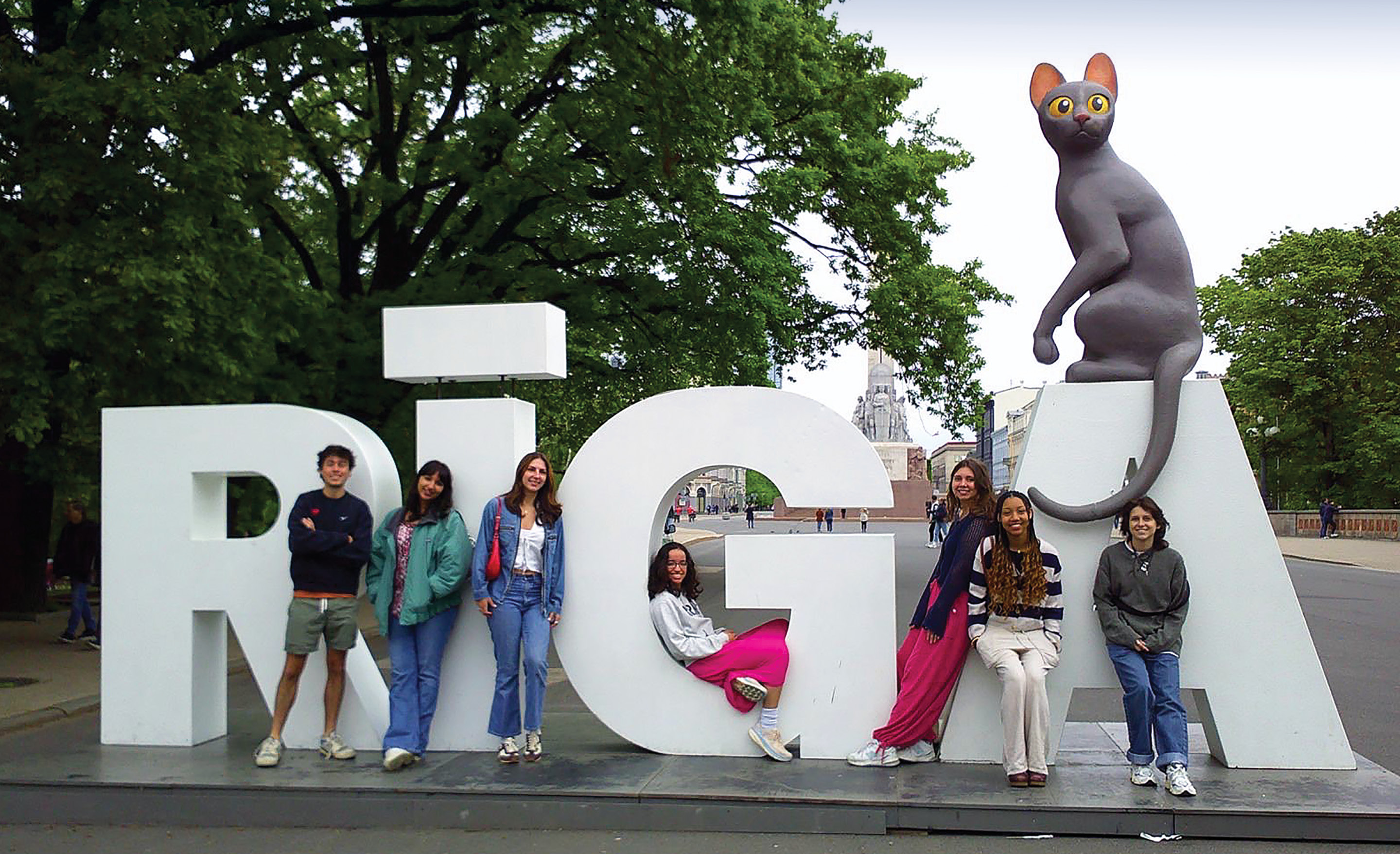
In the midst of this shifting journalistic landscape, I spent the month of June on the other side of the world. Our Conn-funded Summer Global Travel Program, “Media and AI in the Baltics,” was centered in Riga, Latvia, and was designed to deepen our understanding of global media infrastructures. Our nine-person group, led by Associate Teaching Professor of Slavic Studies Laura Little and Associate Professor of English Jeff Strabone, traveled from the Baltic Sea to the border of Russia to hear from experts and tour independent media organizations.
We learned of the many occupations of Latvia, from the German Teutonic Knights to Nazi oppression and Soviet expansion. We watched films produced by local documentarians highlighting the everyday life of citizens living in the former Latvian Soviet Socialist Republic. And we did the touristy stuff too, like perusing the historic old town and wandering museum halls.
For four weeks, I got a glimpse into how Latvians live and consume news on a daily basis, and how journalists are fighting to keep democracy alive in a country that has only been independent since 1991. Those stories—the stories of real reporters—have irrevocably shaped my understanding of media around the world.
The Latvian Perspective
Our first introduction to Eastern European media was with a reporter who made his career in the heart of the former Soviet Union. Born in St. Petersburg in its final year as Leningrad, Grigor Atanesian became a freelance writer in Moscow and now works for BBC Russian in London.
All media in the Soviet Union was controlled by the state, but when the empire collapsed in 1991, independent journalism began to emerge. Today, Atanesian told us, Russia’s leadership continues to pose threats to media, but he works diligently to avoid the country’s censors.
“Trying to reach an audience from which you have been physically separated—I cannot visit the country—requires thinking hard about your audience: What do they care about, what do they read and watch in their spare time, and what is the right framing, angle and tone of voice to tell the story you are trying to tell?” he said.
It’s important work, he added, because “BBC Russian is consumed by millions of Russian readers every day.”
Atanesian, who studied journalism in the United States at the University of Missouri, left this aspiring American journalist with some guarded optimism.
“American publications and newsrooms have more resources than their colleagues in any other country, and perhaps more freedom than anywhere else,” he said. “Journalism as an industry will keep shrinking. But no profession or trade ever fully disappears.
“So why not try to do what you love and be among the very best in your profession—and hope to stay afloat even if all the boats around you capsize?”
Russian Influence
We eventually neared the Russian border, journeying in the Latgale region to Daugavpils, the second largest city in Latvia. More than 80% of Daugavpils’ population speaks Russian, and the influence from Russia and Belarus in the media is clear. Anzelika Litvinovica, a young journalist and activist native to Daugavpils, was quick to warn us about the dangers of Russian propaganda and the effect it has had on regional media in the area.
“The Daugavpils case is really interesting to study. … Media outlets have always been in the hands of politicians. Media has always been a tool to make money, not actually inform the citizens of Daugavpils. It’s a completely biased business model supporting different political players,” she explained.
As an activist, Litvinovica has spoken at rallies supporting Ukraine. She primarily works in media literacy training, traveling throughout Daugavpils and Riga to educate the population about disinformation. At the same time, she works as an intern for Re:Baltica, a nonprofit media organization that produces free and accurate news.
“I became an activist as a reaction to Russia’s full-scale invasion of Ukraine,” she said. “I think it gave me the feeling that I am brave enough. Activism strengthened my longing for justice, which is also essential for journalism.”
My Future in Journalism
We were in Latvia on June 8, 2025, when U.S. President Donald Trump deployed National Guard and active-duty Marines into Los Angeles to respond to immigration crackdown protests. Every day during the protests, our group, nearly 6,000 miles from the action, diligently followed the headlines.
As I watched members of the press being arrested, shot by rubber bullets, tear-gassed, and intimidated by guns and riot shields, I realized what it took to be a reporter—to put your life on the line for the sake of the truth.
It reminded me of something that Joosep Värk, an editor at Estonian Public Broadcasting (ERR), had told us during our tour of their newsroom in Tallinn, the capital of Latvia’s neighboring country, Estonia.
“During times of war,” he said, “it is never asked, ‘Why do I have to work today?’”
He was referring to ERR’s coverage of the war in Ukraine, and how reporters at the station are eager to be assigned to a new story or to come into work on their day off.
The pieces were suddenly coming together. The media organizations, activists and journalists we met during this trip are all fighting to report the truth by any means necessary. In that moment, I realized that real journalism is a universal phenomenon, and real reporters are ubiquitous no matter where you are in the world.
Hopefully, one day, I will join them in their mission.
Ellis Iurilli-Hough ’27 is a civic literacy and philosophy double major and Media, Rhetoric and Communications Pathway scholar from Melrose, Massachusetts. All opinions and observations in this piece are his own.