Playhouses and Privilege
Professor Emeritus Abigail Van Slyck and Daniel De Sousa ’07 team up to chronicle the architecture of elite childhood.
It’s a familiar sight to anyone who has spent some time around children: small plastic playhouses made by companies like Little Tykes or Backyard Discovery. They sit in backyards and side yards, providing the families’ kids with entertainment for a year or two. Perhaps as many as three. They’re cute, simple and easy to get rid of once the kids grow bored, grow up, or both.
The predecessors/inspirations for these ubiquitous objects of childhood, on the other hand, were built by the likes of the Fords and Vanderbilts for their children. Elaborate examples of the privilege enjoyed by the children of the elite, they were anything but cute, simple or easy to get rid of.
“They’re on an entirely different level,” enthuses Daniel De Sousa ’07.
It is these early examples of children’s playhouses that fascinate Dayton Professor Emeritus of Art History Abigail Van Slyck and inspired her latest book, the 2025 Fred B. Kniffen Book Award-winning Playhouses and Privilege: The Architecture of Elite Childhood, which features drawings by De Sousa, Van Slyck’s former student.
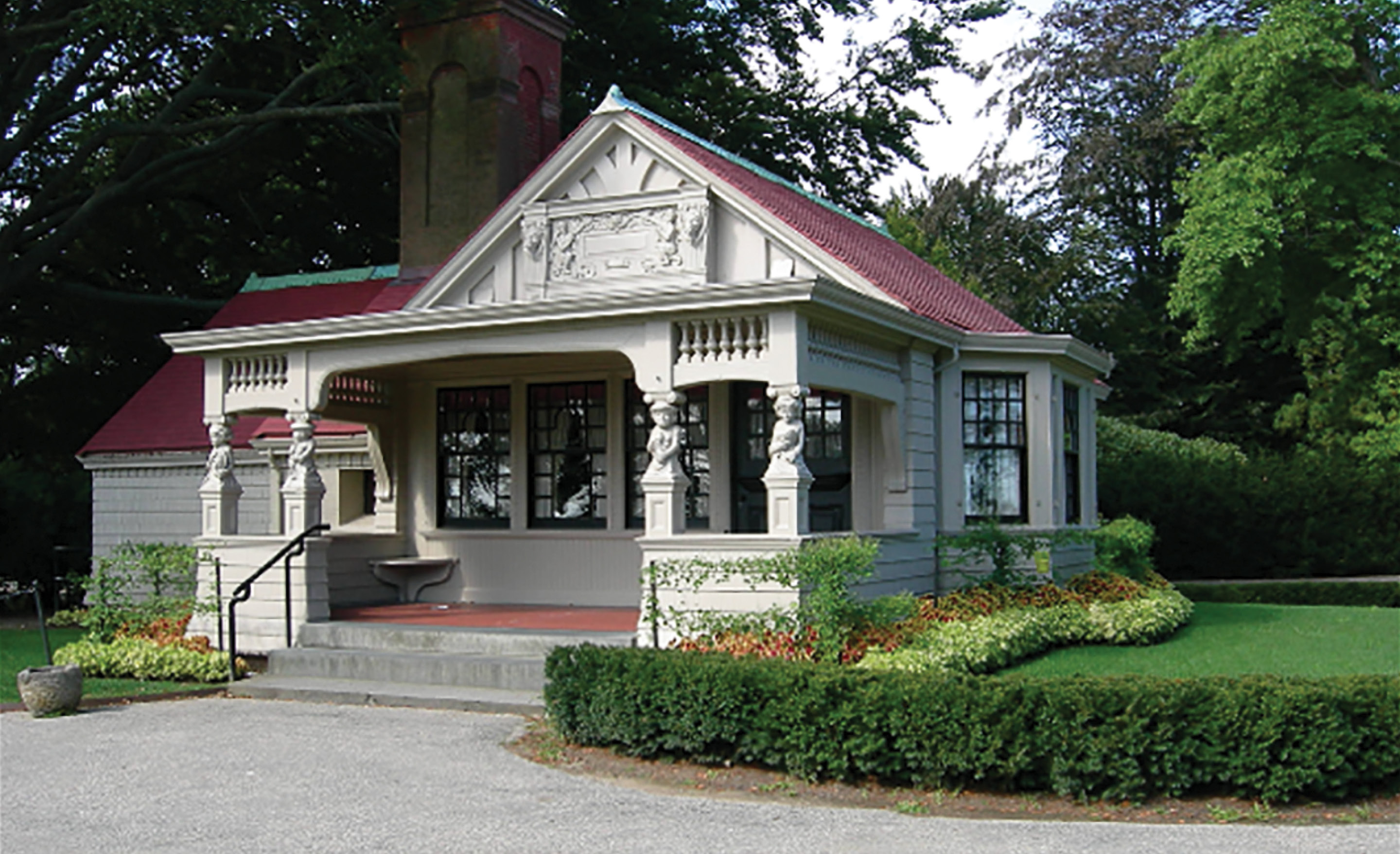
It was all the way back in 2006, when De Sousa was still studying architecture at Conn, that Van Slyck was initially interested in chronicling the creation and style of the playhouse at the Breakers, a Gilded-Age mansion in Newport, Rhode Island.
“I was assuming that because [the Breakers] was designed for the Vanderbilts by Peabody & Stearns, the most prominent architects of their time in the U.S., that there would be an enormous paper trail,” she recalls.
Unfortunately, that was not the case—the Newport Preservation Society, which now owns and operates the mansion, was instead “so excited for me to take on the project because they had nothing,” Van Slyck remembers. “So, I needed a scale drawing, and that’s where Dan came in.”
De Sousa had impressed Van Slyck with his knowledge of and interest in architecture and art history, and he quickly agreed to take on the task.
“We measured it by hand with tape measures and graph paper and field sketching,” De Sousa recalls. “It was a lot of fun. It has all the frilly details of a full-size building, just at two-thirds size. It has a stove! I had never seen anything like it.”
At that time, Van Slyck became aware of a Swiss Cottage playhouse built for Queen Victoria’s nine children at Osborne on the Isle of Wight. She quickly came to see it as a progenitor of an entire generation of playhouses for the children of the elite. Enabled by a Fulbright U.S. Scholar award to live in the United Kingdom for four months to study it, she returned to America with an idea for a new book. In working with Pieter Martin, her editor at the University of Minnesota Press, the idea really began to take shape.
“He said to me, ‘Why did they stop making them? They were a real phenomenon for a certain period, but they don’t seem to be so now. Why?’” says Van Slyck.
In digging, she found that public acceptance spelled their doom.
“When built by movie stars, these houses became fodder for fan magazines,” she explains. “Fans can’t have it exactly, but can have their own version. But that means they lose their effectiveness, their appeal, as a tool for the superelite. So, the book is really about the rise and fall of these exquisite playhouses and cottages.”
Van Slyck’s rich research is illustrated by the drawings created by De Sousa, who now works at the Historic American Buildings Survey, where he produces high-quality documentation of historic buildings.
“He brings this level of expertise, helping me to understand these buildings in ways I couldn’t have on my own,” Van Slyck says of the partnership.
De Sousa calls the experience— and the end result—“fascinating.”
“My drawings end up public for my job, but this was the first time they were part of a synthesis. The whole is better than the sum of the parts.”
Above: Children’s cottage, the Breakers, Newport, Rhode Island. Peabody & Stearns, architects, 1886. Photo by Abigail Van Slyck