CONNECTICUT COLLEGE
CONNECTICUT COLLEGE
  • Current Issue
  • Past Issues
    • 2025 Issues
    • 2024 Issues
    • 2023 Issues
    • 2022 Issues
    • 2021 Issues
    • 2020 Issues
    • 2019 Issues
    • 2018 Issues
    • 2017 Issues
    • 2016 Issues
    • 2015 Issues
    • 2014 Issues
  • Older Issues
  • Letters to the Editor
  • Update Your Address
  • Alumni Association
  • News & Media Hub
  • Make a Gift
  • College Home Page

Contact Us

Connecticut College
Office of Communications
270 Mohegan Avenue
New London, CT 06320

Amy Martin
Editor, CC Magazine
asulliva@conncoll.edu
860-439-2526

CC Magazine welcomes your Class Notes submissions. Please include your name, class year, email, and physical address for verification purposes. Please note that CC Magazine reserves the right to edit for space and clarity. Thank you.

Submit Class Notes

Delicious Designs

Image of quick scallion pancakes on a table

Delicious Designs

Renowned fashion designer Peter Som ’93 has expanded his brand, and now he’d like to expand your palate.
M

ost childhood dreams never come true. Even the word “dream” implies a separation from reality—a delusion of sorts—and most of us never do become the professional athletes or ballerinas or astronauts or marine biologists we once dreamed of being. 

Peter Som ’93 remembers being in fifth grade when he confidently declared to his parents that he was going to be a world-famous fashion designer someday. His dream did come true; by just 30 years old, he had watched his very own fashion line strut down the runway in Bryant Park. He scored a Rising Young Talent nomination with the Councils of Fashion Designers of America Scholarship and an Isaac Mizrahi Gold Thimble Award upon graduating from Parsons School of Design. New York Times fashion critic Cathy Horyn labeled Som as “one of the best young designers working today,” while Vogue’s Andre Leon Talley called him “the head of your generational class.” Over the next few decades, his designs would sell at top retailers worldwide and be worn by the likes of Beyoncé, Scarlett Johansson and Michelle Obama.

When you’ve realized all of your lofty goals before age 50, what do you do for an encore? 

“When you’re 10, when you’re 15, you think, ‘30. That’s an adult. That’s when you have it all figured out,’” Som says with a laugh. “But then, years later, things are changing, and I start thinking, ‘Oh my God. Is this a sign? Should I jump?’”

Som did make the leap recently, expanding his design business into a lifestyle brand focused on food, fashion and home decor. His debut cookbook, Family Style, featuring more than 100 “elegant everyday recipes,” hit shelves on March 18. 

“Since the day I could pick up a pen—my mom says I was 2—I drew women and their clothes. My parents were not surprised; as architects, their love of modern 20th-century design ran deep. But when I wasn’t drawing and poring over Vogue issues, I was most often in the kitchen helping my mom make her Five Spice Roast Chicken, or whip up the egg whites for a spinach soufflé,” Som says. 
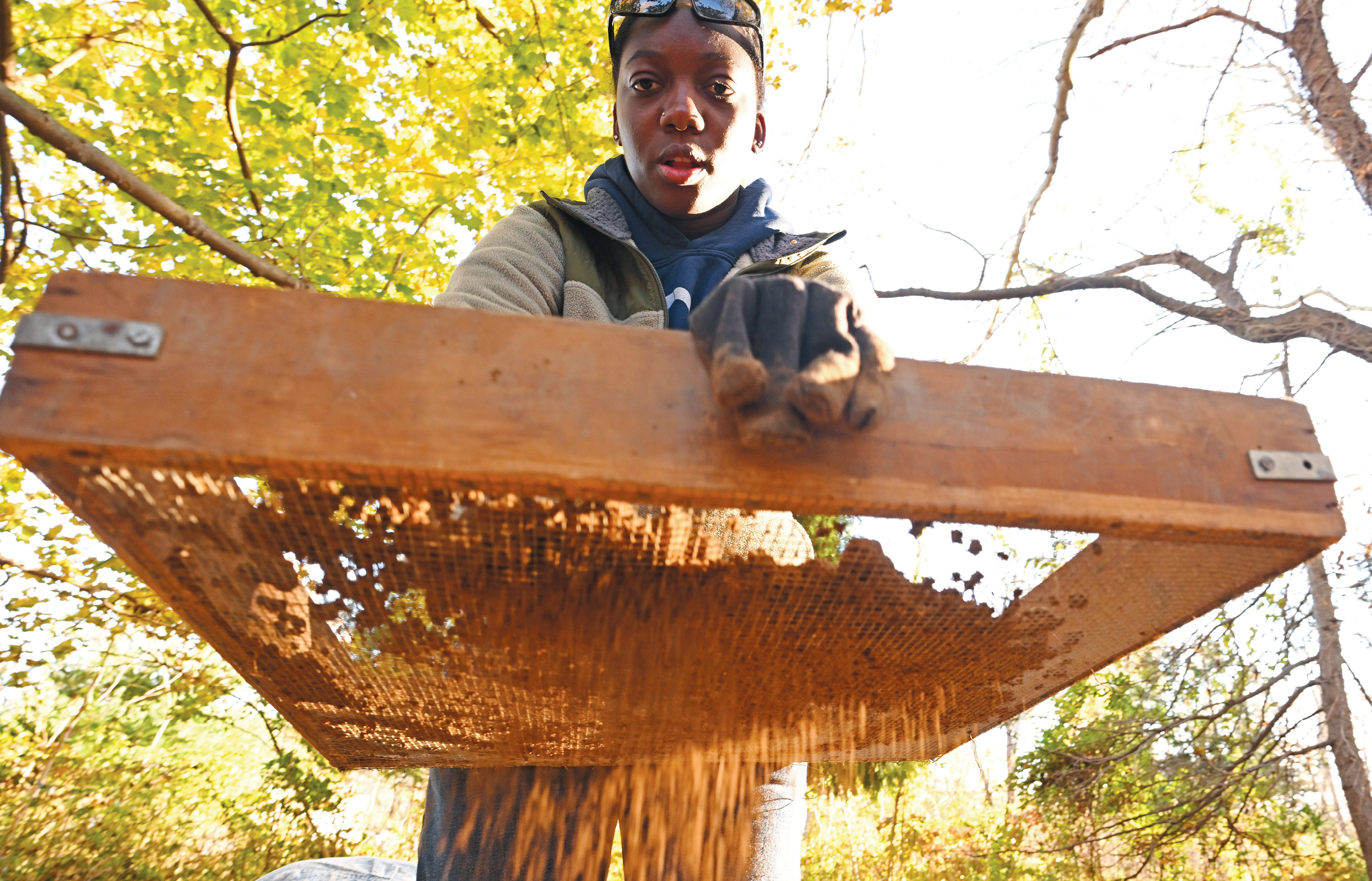
Francis Sesenaya ’24 sifts soil from a test pit during an archeological site survey.
Francis Sesenaya ’24 sifts soil from a test pit. Conn students regularly participate in formal archaeological site surveys and data collection.

National Reckoning 

Across the United States, Indigenous remains and artifacts were historically treated as objects to collect, study and even display. Descendants of native people have long pushed back, arguing tribes should be consulted on the care of their unearthed ancestors and remains should be repatriated whenever possible. Yet for most of U.S. history, there weren’t any laws protecting Indigenous remains or established protocols for returning them to their tribes. 

That changed in 1990, when Congress created a roadmap to navigate these emotionally fraught situations with the passing of the Native American Graves Protection and Repatriation Act (NAGPRA). The law states that human remains, funerary objects, sacred objects or objects of cultural patrimony determined to be of Native American or Native Hawaiian origin must be returned to the tribe or organization from which they originate, if that can be determined. The law also established procedures that institutions receiving federal funding must follow if Indigenous remains are unearthed on their property, or if a federally funded institution takes control of the remains, and called for all remains and associated funerary objects to be inventoried in consultation with potentially affiliated tribes by 1995.

But adherence has been slow, hindered by lack of funding and staffing, poor historic record keeping and the general difficulty of establishing a link to a specific tribe. In September 2023, the United States Department of the Interior’s NAGPRA Review Committee reported to Congress that just 54.8% of the 213,466 Indigenous remains reported had been repatriated in the 33 years since NAGPRA’s passing. 

Some institutions had attempted to skirt the law by designating much or all of their related collections as “culturally unidentifiable.” A January 2024 amendment to NAGPRA does away with this designation option, stating institutions and federal agencies must defer to the Native American traditional knowledge of lineal descendants, tribes and Native Hawaiian organizations when attempting to determine the origin of unearthed bones or artifacts. Under the amendment, institutions must also obtain “free, prior and informed consent” from these groups before displaying objects or conducting research on human remains and cultural items.

The independent, nonprofit newsroom ProPublica reported in 2023 in its Repatriation Project that just 10 institutions hold about half of the reported Native American remains in the U.S. that have not been made available for return to tribes. In March of 2023, nearly 90% of the approximately 204 unreturned remains taken from sites across Connecticut were located at the Yale Peabody Museum of Natural History in New Haven. On its website, the museum states it has increased staff and funding to support its extensive and ongoing repatriation efforts.

Once the repatriation process started, one of the more immediate tasks I set out to address was whether there were more ancestors needing care.

— Professor and College Archaeologist Anthony Graesch
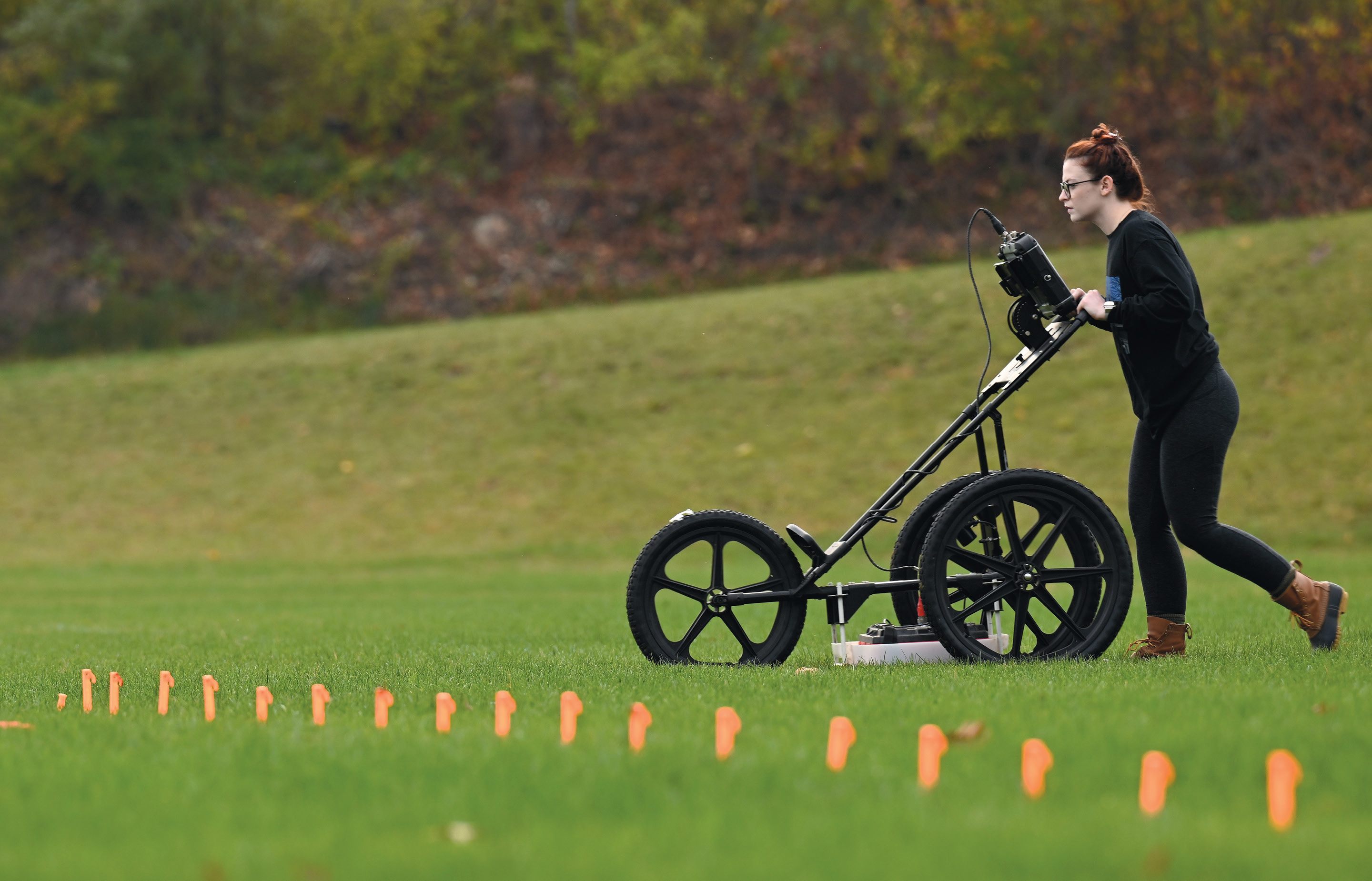
A TerraSearch Geophysical employee surveys the athletic fields near Conn’s waterfront.

A Rightful Return

For years, no one knew what had become of the ancestor unearthed at Connecticut College. Juli and Kelley both died in 2007, and knowledge of the ancestor’s whereabouts disappeared with them. 

But in November of 2022, Fiona Jones, then the NAGPRA coordinator at URI, came upon a box of remains in an archaeological repository. The only external label read “CC7,” and there wasn’t much else to go on. Yet Jones, who had previously assessed some of Juli’s work at a different institution, thought she recognized Juli’s labeling method. Another clue was a small piece of paper that noted a date from March of 1981 and an identified quadrant, which archaeologists use as a measurement of excavation. 

“This led me to believe that this was most likely the work of a professional archaeologist in March of 1981 and Harold Juli—and therefore, Connecticut College—could have been involved,” said Jones.

She contacted Conn’s Associate Professor of Anthropology and College Archaeologist Anthony Graesch, and the two compared the description of the box’s contents with Juli’s lab notes about the remains unearthed on Conn grounds to officially confirm Jones’s hunch.

“It was definitely a feeling of relief,” said Jones, who recently left URI to pursue a Ph.D. in anthropology at Syracuse University. “Unfortunately, it can happen that human remains become unidentifiable and end up staying at the institution. When I first started inventorying CC7, I really thought that might be the case.”

Graesch, who had long hoped the ancestor might someday be found, immediately contacted Mashantucket Pequot Tribal Historic Preservation Officer Michael Kickingbear Johnson and Mohegan Tribal Historic Preservation Officer James Quinn to inform them that their tribes could begin the process of repatriation. At long last, the ancestor was repatriated and laid to rest in November 2023.

“Sadly, it’s pretty common where an ancestor who was unearthed ends up miles and miles away from their original homeland. The goal is to have these ancestors returned,” Johnson said. “Through the process of repatriation, we eventually know our ancestors are home, safe and respectfully at rest as originally intended.”

We’re not necessarily trying to stop development, but many tribes look out for their interests in these culturally sensitive areas.

—Mashantucket Pequot Tribal Historic Preservation Officer Michael Kickingbear Johnson

A New Way Forward

In the summer of 2022, shortly before the ancestor was rediscovered at URI, dead ash trees were removed from Conn’s waterfront. During the process, no human remains were uncovered, but an archaeological site was unintentionally disturbed.

That incident spurred Conn to create the college archaeologist position and institute new processes to protect important archaeological sites and cultural heritage resources, including several dozen known Indigenous and settler-colonist burials near the Thames River waterfront.

As the inaugural college archaeologist, Graesch serves as a consultant to help minimize the likelihood of damaging or destroying archaeological resources, works to build ongoing heritage-related curriculum and education at Conn, and develops and deepens relationships with tribal historic preservation officers. 

Interim Vice President for Administration Justin Wolfradt says his team now works with Graesch and Arboretum Director Maggie Redfern at the outset of campus projects.

“Through this collaboration, we were able to identify and preserve the majority of a historically significant rock wall while designing the new East Lot, which relocates faculty and staff parking to enable the Crozier Boulevard Pedestrian Promenade and Crozier-Plex Pedestrian Connector projects,” Wolfradt said. “This partnership allows us to work together to find ways to make campus improvements, while at the same time mitigating the impacts to important cultural and natural resources wherever possible.”

Advances in technology are also helping to usher in a new era of non-invasive archaeological study. For example, one of Graesch’s first actions as college archaeologist was to apply for a Connecticut State Historic Preservation Office grant in early 2023 to help fund a geophysical survey of the area where the ancestor was discovered in 1981. 

“Once the repatriation process started, one of the more immediate tasks I set out to address was whether there were more ancestors needing care,” Graesch explained.

To complete the study, the College partnered with TerraSearch Geophysical, a company known for their expertise and training in ethical archaeological practice.

“They used non-invasive ground-penetrating radar and magnetometry to determine the presence or absence of subsurface cultural features, including human burials,” Graesch said. “Conn students from multiple classes had the opportunity to visit the site and were introduced to the methods of geophysical survey, and several students participated in data collection.” 

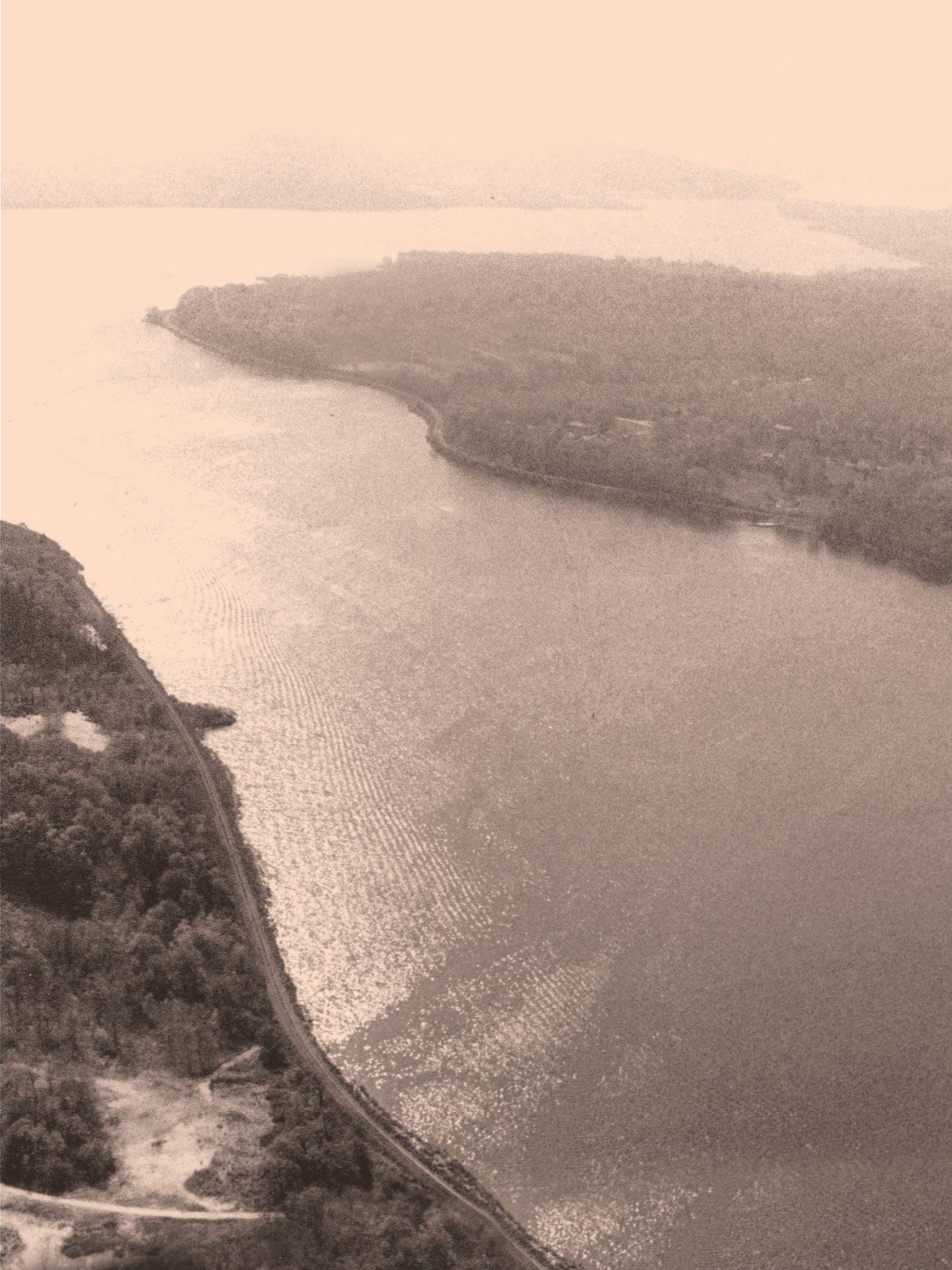
Aerial shot of the Thames River
The Thames River region is the ancestral home of several Connecticut tribes. Nationally, the remains of 96,488 Native Americans had yet to be repatriated as of September 2023. Photo courtesy the U.S. Army Corps of Engineers.

As we talk, I ask Som if success feels different at 54 than it did at 30. He mulls the question for a moment before answering, “In New York, there’s so much going on, so many people doing things, it is easy to compare and contrast. But with age comes perspective, and you start to get into ‘How do you define success? How do I define success?’

“And you know what? I’m happy, I have amazing friends, a chosen family, blood family, all these people who support me. I still do things in fashion, my first dream, and I’ve been able to widen my focus. I wake up every day and I love what I do, and I can make a living with it. So that feels like success. Every time I file a piece, every time I make anything, I can exhale. They’re all successes.

Find Peter Som’s recipes online at The Extra Taste.

Charred Cabbage Caesar Salad
Charred Cabbage Caesar


  • Make a Gift
  • Contact Us
  • Alumni Association
  • News & Media Hub
  • Update Your Address