CONNECTICUT COLLEGE
CONNECTICUT COLLEGE
  • Current Issue
  • Past Issues
    • 2026 Issues
    • 2025 Issues
    • 2024 Issues
    • 2023 Issues
    • 2022 Issues
    • 2021 Issues
    • 2020 Issues
    • 2019 Issues
    • 2018 Issues
    • 2017 Issues
    • 2016 Issues
    • 2015 Issues
    • 2014 Issues
  • Older Issues
  • Letters to the Editor
  • Update Your Address
  • Alumni Association
  • News & Media Hub
  • Make a Gift
  • College Home Page

Contact Us

Connecticut College
Office of Communications
270 Mohegan Avenue
New London, CT 06320

Amy Martin
Editor, CC Magazine
asulliva@conncoll.edu
860-439-2526

CC Magazine welcomes your Class Notes submissions. Please include your name, class year, email, and physical address for verification purposes. Please note that CC Magazine reserves the right to edit for space and clarity. Thank you.

Submit Class Notes

New Digs: Coming Soon

Image of gold shovel digging in the dirt
  • Fall 2026 
  • New Digs Coming Soon

New Digs: Coming Soon

Connecticut College is building its first new student housing since the 1960s.   

By Amy Martin

I

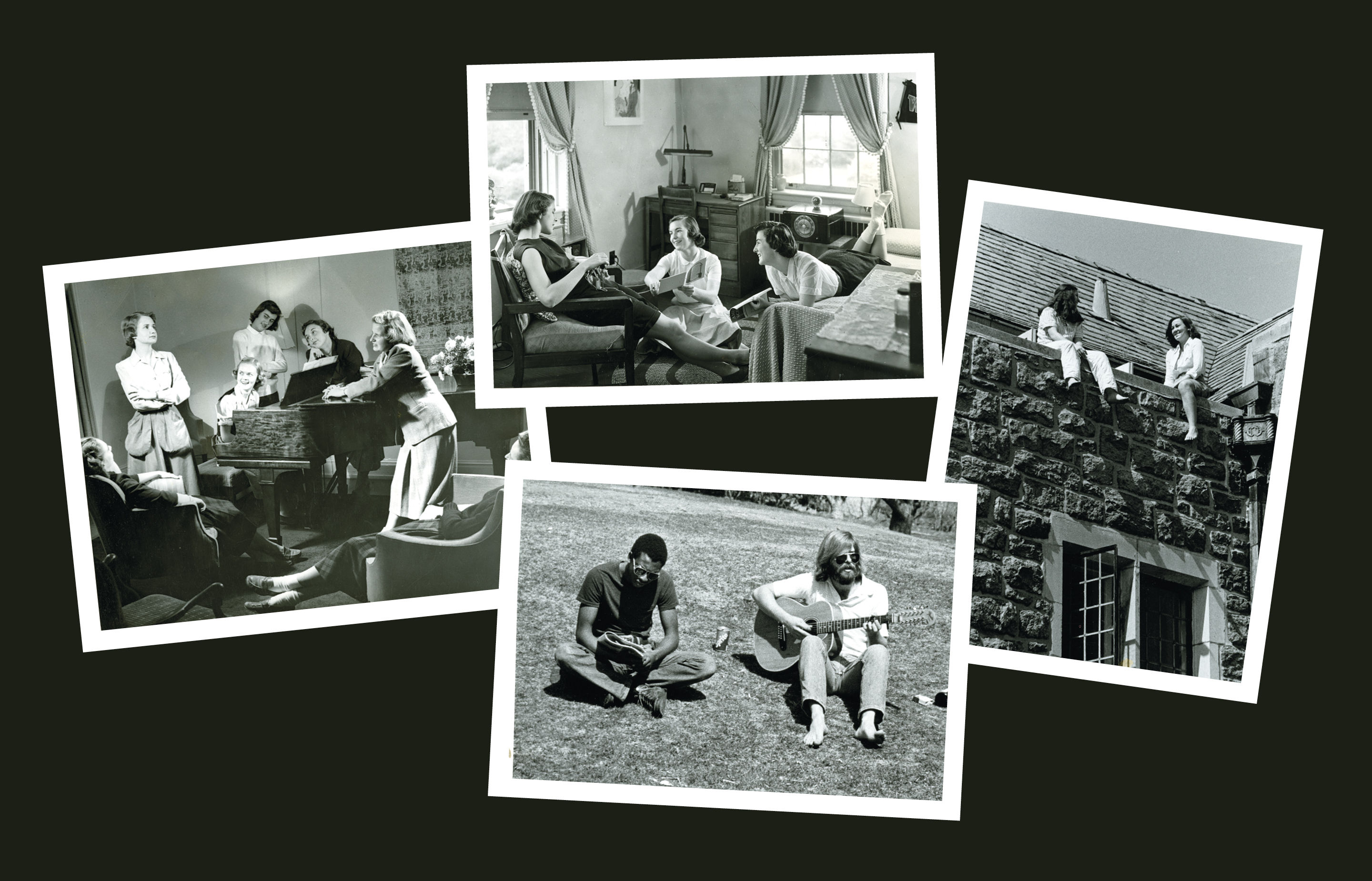
n 1915, the very first Connecticut College students moved trunks of belongings into the Blackstone and Plant residence houses, two of a set of three newly constructed stone buildings with ornate curved wooden doors on the brand-new campus. They offered rooms for 78 of the pioneering young women who made up Conn’s very first class, “complete with running water, comfortable wicker furniture, and bright bedspreads and draperies.” There were strict rules about visitors and appropriate dress (bloomers could be worn to and from physical education classes, but were not permitted in New London Hall or the dining hall), and “absolutely nothing” was to be tacked on the walls or woodwork except by special permission from the director of residence or the president. 

Things were a bit different in the mid-1960s, when Conn opened its most recently constructed student residences—the four buildings that make up “the Plex,” including Lambdin and Hamilton, which welcomed their first residents on a snowy evening in February of 1962, and Lazrus House, which opened in 1964. Those students brought radios and record players to sing along to Shelley Fabares’s Johnny Angel or let loose to Dee Dee Sharp’s Mashed Potato Time, and they were allowed to wear slacks or jeans to dinner—on Fridays. Times were changing, yet humans had yet to land on the moon, there was no such thing as the internet and Conn’s first male students wouldn’t arrive for a few more years. 

Today’s students arrive on campus looking for a more modern living experience. While much has changed—they wear whatever they want to the dining halls; bring laptops, cell phones, TVs and minifridges; and are welcome to decorate their walls (with removable adhesives)—the residence hall options have remained largely unchanged. 

Until now. 

“I am thrilled to announce that Connecticut College will be building its first new student housing in more than six decades,” President Andrea E. Chapdelaine recently announced to the campus community. “This is a very long period of time in which our peers were modernizing their housing and providing options for more independent living for their upper-level students. I am so excited for Conn to do the same.” 

In May, the Board of Trustees unanimously voted to move forward with a plan to build townhome/apartment-style residences for approximately 240 students. The new housing will provide upper-level students with flexible independent living options and create a cohesive, accessible, neighborhood-style residential environment that fosters community and connection.

“As our students enter their junior and senior years, they are ready for greater autonomy and the opportunity to create a housing cluster with their friend groups,” Chapdelaine said. 

“By providing that opportunity on campus, our students will be able to continue to grow in independence and self-reliance, while still immersing themselves fully in the Conn community. This will not only enhance their time at Conn and deepen their relationships with their peers, but also better prepare them for life after graduation.”
I’m really glad the College is thinking about this and making plans. It’s really exciting.

— Kaitlyn Lubega ’29

Evolution of Campus Living 

With the exception of those studying abroad, 98% of Conn students live on campus. And almost all of them (a full 94%) live in traditional dorm-style housing, best described as the classic long hallway of single, double or triple rooms with a communal bathroom at one end of the hall. Conn has no suite-style housing, which usually consists of several individual rooms connected by a shared bathroom and living space, and the only existing apartment and townhome options are the Winchester Road and River Ridge apartments and houses, which were built in the 1950s as temporary faculty housing and haven’t been significantly updated. 

“These buildings were meant to house families. They were not intentionally designed for students,” explained Dean of Students Victor Arcelus. 

A 2024 facilities assessment found student housing to be the highest area of need, and in 2025, Conn partnered with CREDO, a higher-education consulting firm that specializes in campus plans to enhance the student experience, to conduct on-campus focus groups, interviews and working sessions with faculty, staff and students and an analysis of qualitative and quantitative institutional data. CREDO found that limitations in housing design and available “organic” social spaces are “constraining the kind of spontaneous community-building that students increasingly seek,” and recommended the College “intentionally reframe the residential experience as a developmental journey that supports students’ social, intellectual and personal growth from the first year through graduation.” 

The idea, Arcelus explained, is that as students move through their four-year academic career, their residential learning experience evolves with them. First-years and sophomores would still have the traditional dorm experience, but upper-level students would transition to independent living, where they can cook their own meals, are collectively responsible for cleaning and general upkeep, and have the space to host their own gatherings and events. 

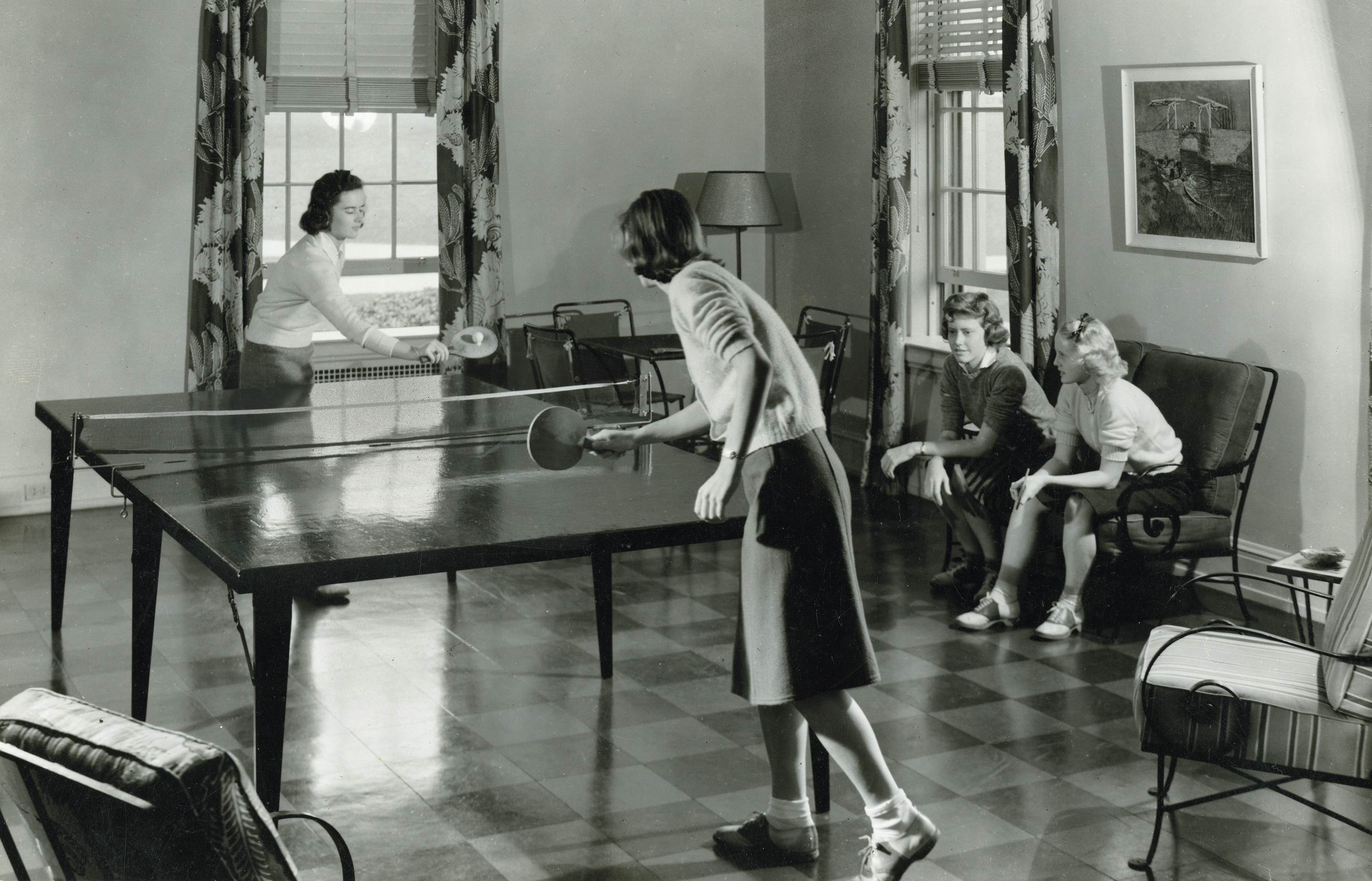
Vintage black and white image of students playing ping pong in a dorm
Students play table tennis in Freeman House in 1937. Photo by William M. Rittase. All archival photos courtesy of the Linda Lear Center for Special Collections and Archives.

“Students want to curate their own social lives, and we want to give them the indoor and outdoor space and flexibility to do that,” he said. 

This shift from traditional housing into a purposeful four-year development model reflects broader trends in the industry, and many of Conn’s peers have been investing heavily in flexible housing options. Since 1995, 66% of the housing built by Conn’s 13 closest peer institutions has been townhouse- or apartment-style. Independent living or suite-style options now make up 83% of total housing at Skidmore, 56% at Franklin & Marshall and 53% at Muhlenberg, for example, compared to just 6% at Conn. 

And while graduating seniors continuously report high satisfaction with their Conn education and overall experience, housing options and quality consistently rank at the top of students’ concerns. 

Conn’s planned 240-bed development will bring the percentage of independent living up to 14% of total housing and completely replace existing outdated options. Additionally, once completed, it will provide enough space to allow the College to systematically take other residence houses offline in order to renovate and modernize the remainder of student housing.  

The potential impact of the new housing on recruitment, retention and student satisfaction made it clear to the Board of Trustees that this is the right investment for Conn’s future, Board of Trustees Chair Seth W. Alvord ’93 said.

“Today’s students are looking for a different style of living. They want opportunities to live a life that’s closer to what they will experience after they graduate. We are listening to our students, and we are listening to our prospective students,” he said. 

“By making this decision to go forward with this project, we’re strengthening Conn’s competitive position at a time when there are fewer students to attract. This is an investment that will benefit all students for generations to come.” 

Students want to curate their own social lives, and we want to give them the space and flexibility to do that.

— Dean of Students Victor Arcelus

Big Plans for the Future

The project is now in the early planning stages. Associate Vice President for Facilities Management and Campus Planning Justin Wolfradt said the College is exploring several potential locations for the new housing and expects to select an architect this winter. “We hope to start construction in early 2028, with a target completion date of Fall 2029,” he said. 

Key priorities include ensuring full accessibility compliance and inclusive design, meeting sustainability and energy efficiency goals, and integrating indoor and outdoor community spaces that support student engagement and informal interaction. The project is expected to cost $51.5 million and will be paid for using debt financing, which allows the College to align a long-term investment with an increased and continual revenue stream provided by the new facility.

As the process unfolds, members of the Conn community will have ample opportunities to participate. 

“We are now forming a committee, a collaboration of  faculty, staff and students, to begin the design work on the new residence hall,” Chapdelaine said. “I’m excited to invite Conn students to participate in designing a residence hall that will meet the needs of today’s and tomorrow’s students.”

Students—even those who will graduate before the project is completed—are equally excited. 

Collection of vintage images of student life on campus

Today’s students are looking for a different style of living. They want opportunities to live a life that’s closer to what they will experience after they graduate. We are listening to our students, and we are listening to our prospective students.

— Seth W. Alvord ’93, Board of Trustees Chair

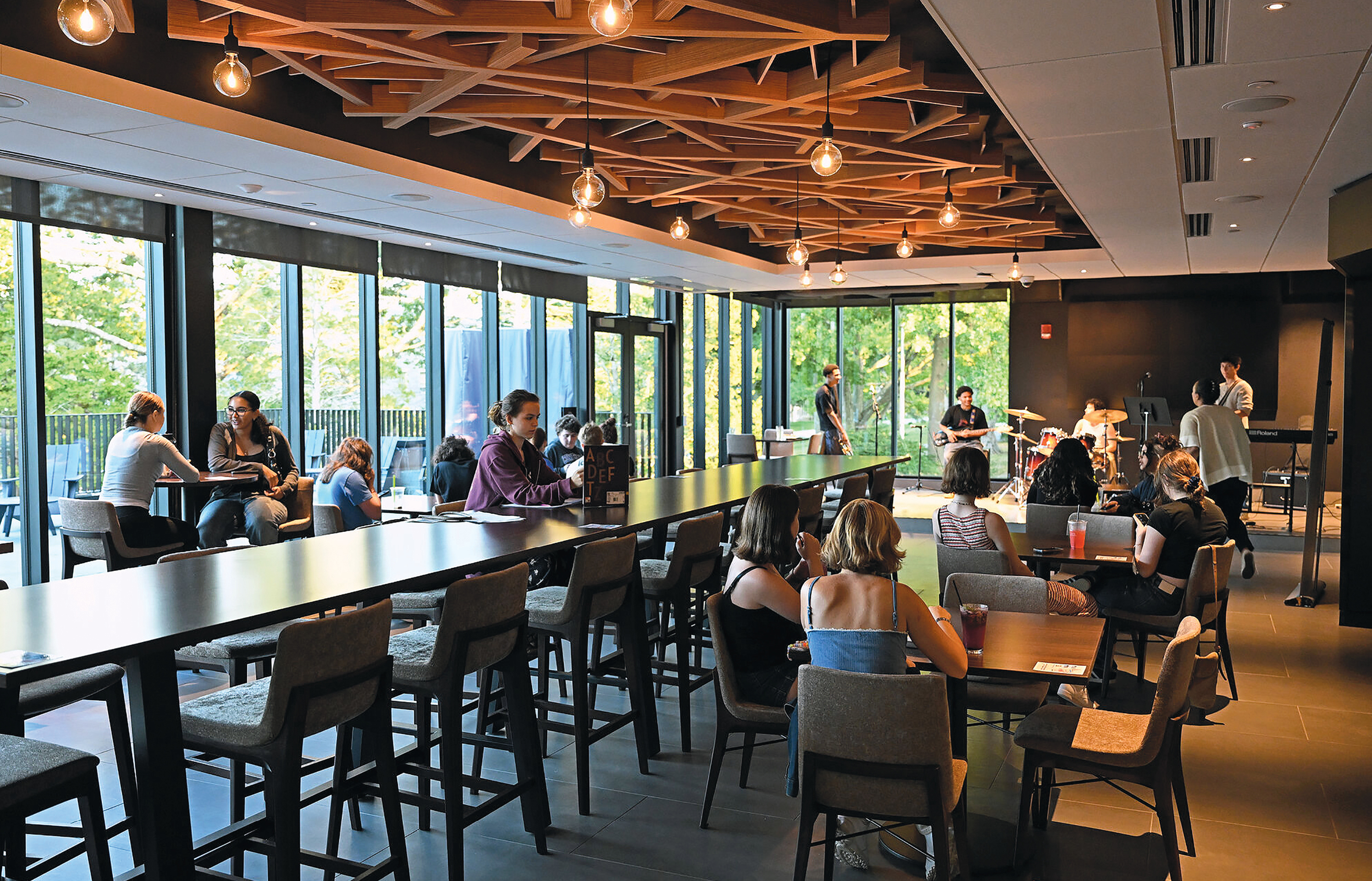
Tenzin Choedek ’27, a neuroscience and East Asian studies double major and Mellon Mays Undergraduate Fellow from Austin, Texas, serves as the Student Government Association’s Chair of Residential Affairs. He sees the planned new housing development as an extension of the improvements he and his fellow seniors have benefited from during their time at Conn, including upgrades to athletic facilities, the addition of the Cro Promenade and Cro-Plex Connector, and the renovation of the Crozier-Williams student center. 

“People love the new Oasis. Senior nights are amazing!” he said. “Improvements like this are a universally good thing, and we’ve had a lot of conversation around the importance of third spaces. At a smaller school, we move in smaller circles, and we need more space options to be able to host those kinds of gatherings.” 

Kitchens are a high priority, he added, as is the ability to live with others in small, chosen groups.

“Sports teams will love this. People with food allergies will love this. Clubs and student organizations will love this,” he said. 

Kaitlyn Lubega ’29, a sociology and Africana studies double major, Davis UWC Scholar, and Media, Rhetoric and Communication Pathway scholar from West Orange, New Jersey, serves as an RA in Larrabee House. She agrees that kitchens, as well as private bathrooms and outdoor spaces, will be greatly appreciated by future Camels.  

“Especially on those really nice weather days in the beginning of the year, it would be really cool to have a lawn space to host gatherings with friends,” she said. “I’m just really glad the College is thinking about this and making plans. It’s really exciting.”

Image of the recently redone Cro's Nest

Improvements like this are a universally good thing, and we’ve had a lot of conversation around the importance of third spaces.

— Tenzin Choedek ’27


  • Make a Gift
  • Contact Us
  • Alumni Association
  • News & Media Hub
  • Update Your Address