What’s in the Greenhouse?
Professor Manuel Lizarralde gives readers the inside scoop on some of the most interesting plants in Conn’s historic greenhouse.
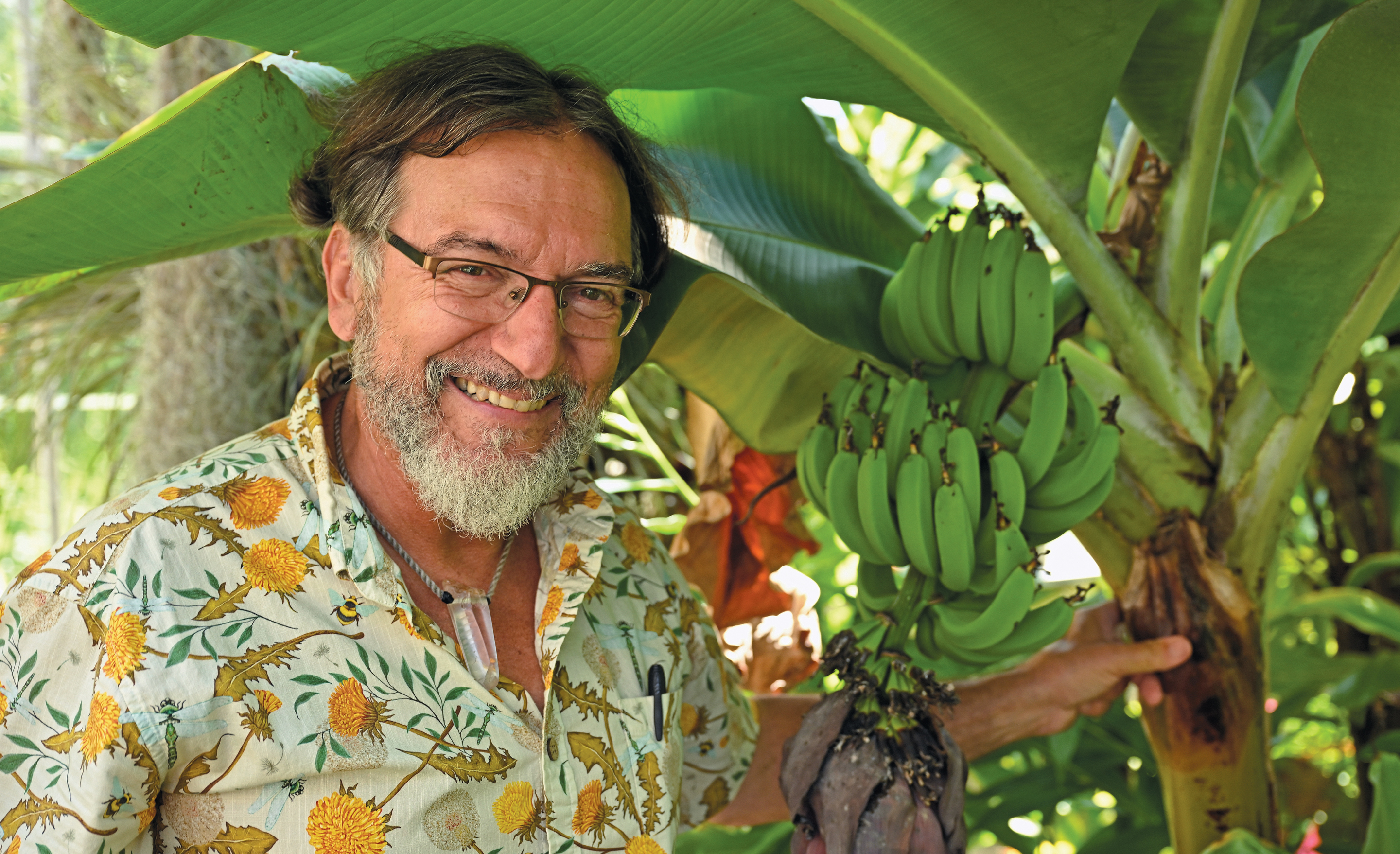
On a humid mid-August morning, Manuel Lizarralde, the Charles and Sarah P. Becker ’27 Professor of Botany and Environmental Studies, explained the stories of several specimens in Connecticut College’s 3,000-square-foot greenhouse (pausing only briefly to take photos of some especially colorful flowers to send to his 96-year-old mother).
The collection comprises around 433 individual plants representing 328 unique taxa, 83 families and more than 70 countries. Built in 1935 and extensively renovated in 2012, the greenhouse is used as a teaching and research facility for Conn’s botany and ecology classes.
A native of Venezuela, Lizarralde has focused much of his work on the relationship between indigenous Latin Americans and the environment. He specializes in ethnobotany—the study of how people use plants—because the indigenous knowledge of local plants is very rich.
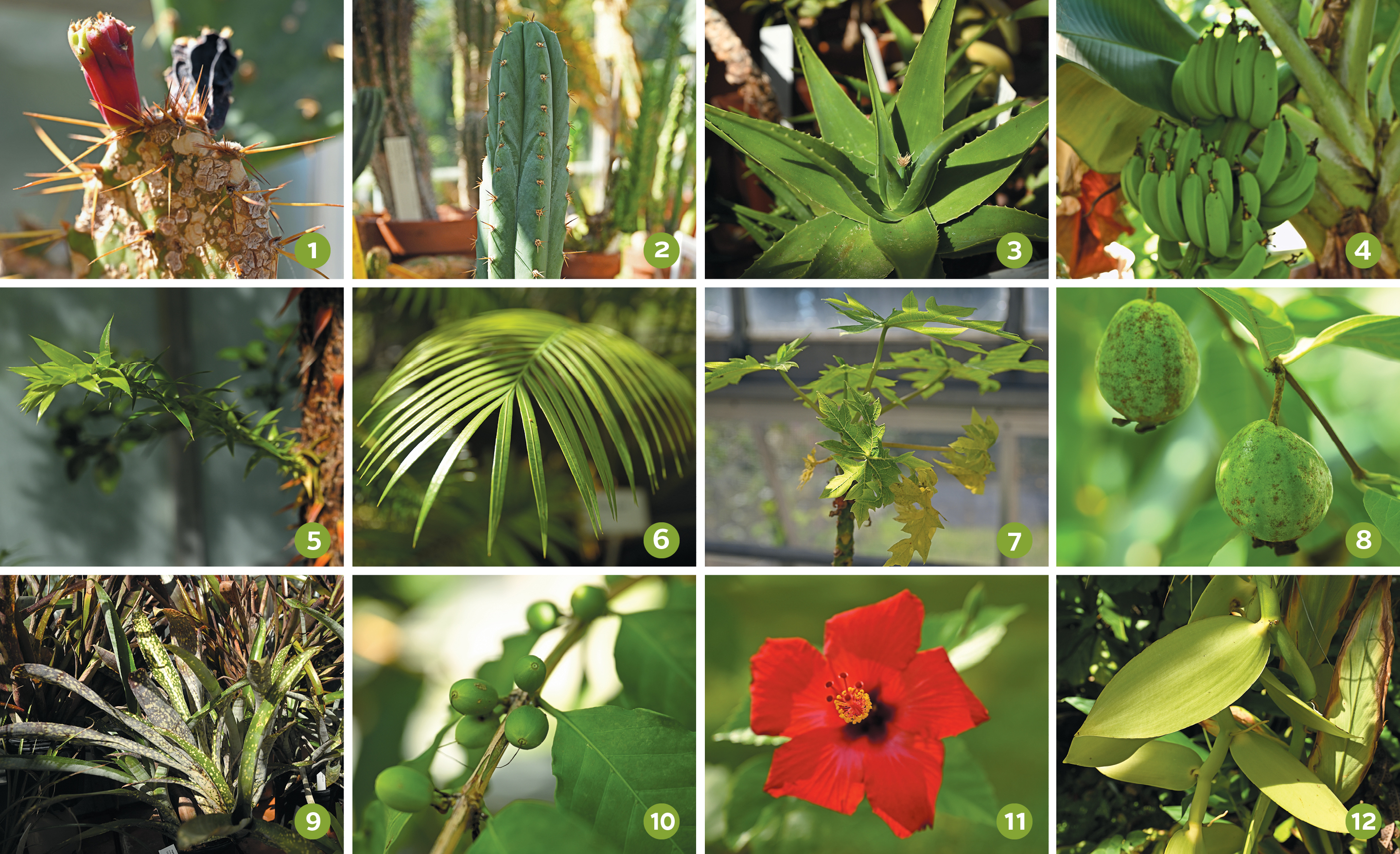
1. Opuntia/prickly pear “I got this from Peru. They’re edible. There are many different kinds. They’re all over the world; they are the most abundant cactus. There’s native Opuntia even in Connecticut. That one was developed by a German botanist in 1914 so people can eat it without having to deal with the thorns. In the desert, like in Utah, the thorns are much denser and prickly.”
2. Cactus San Pedro “This is a hallucinogenic cactus, which was given to me in Peru by an ethnobotanist. This cactus has been used for more than 7,000 years and is found mentioned on archaeological materials like ceramics and petroglyphs. It is still used by shamans of Indigenous peoples to cure physical and mental illnesses.”
3. Agave “This is from the Sahara Desert. It’s widely used for medicine all over the world. In fact, the sap is used for sunburn as well as for cough. When you peel the skin, you can get the soft flesh and mix it up with lemon and honey for cough medicine.”
4. Banana “Bananas were domesticated in Papua New Guinea about 9,000 years ago. These fruits here are still growing. They have to grow to probably eight to 10 inches. The flowers turn into bananas when they’re fertilized by a bat or a hummingbird. This greenhouse banana produces fruit in late fall or early winter.”
5. Klinki pine “This is from New Guinea. It’s the tallest and the fastest-growing conifer. This tree probably was here when [then-Professor of Botany] Bill Niering got a project in 1999 in his last year of life. He and his students bought several hectares of land to plant 10,000 klinki saplings to offset CO2 produced by Cro. It’s a very ancient plant that existed at the time of dinosaurs.”
6. Sago palm “These grow in Australia and South India. In Australia, it’s an important source of food for the Aborigines. It’s a very primitive plant that existed probably 400 million years ago. The Aborigines manage their semi-arid forests by burning them every year to promote their growth.”
7. Carica papaya “This is originally from South America. It’s a domesticated plant with several varieties, and they are dioecious, meaning there’s a male plant and female plant. So to produce a fruit, you have to have both of them. They are modified to grow fast and depend on more nutrients and water, and they don’t tolerate competition at all. They can grow about 20-25 feet tall. Some of them produce enormous fruit.”
8. Guava “This is one of my favorite fruits from the American tropics. You can see the fruits here. The wood of this invasive species is very hard and has multiple uses. It grows quite easily in cow pastures because of seed dispersion.”
9. Bromelia “These are epiphytes, plants that grow on some trees in the tropics, and they collect a lot of water. The leaves can grow up to three feet tall and two feet wide, but the flowers can grow up to double that size. There are many species. You can see they capture water in the pools. Many frogs breed inside of them, including poison frogs.”
10. Coffee “These plants are all native to Ethiopia, but most coffee today is produced in Latin America, mostly in Brazil and Colombia. Much of the Venezuelan coffee is sold as Colombian. The original blend from Ethiopia is called Moka, and Moka Java is from Indonesia.
“The myth is that it was discovered in Neolithic times by a shepherd. He fell asleep, and his goats were eating these red fruits. He woke up and his goats were jumping and running everywhere like crazy, and then he collected a bunch and took it to an imam. The imam consumed it and was able to pray all night long.
“It got to Europe around 1400 in Rome, Italy, and then it spread very quickly because people discovered it was a stimulant. But it also became a plant that rulers didn’t like because people began to gather in cafes, and that’s where the rebels and intellectuals were developing their ideas because they were talking on and on, fueled by the coffee.”
11. Hibiscus “Hibiscus is a very medicinal plant, also from the Americas. You can make medicinal tea out of the petals. The base of the stigma is very sweet like honey; that’s where the nectar is. As a kid in Venezuela, I used to eat it. Iguanas love the petals, too.”
12. Vanilla orchid “This plant produces the vanilla bean. It looks like a green bean, but it’s dark. It has been pollinized by hand. It grows in Madagascar and the Pacific Islands, and it’s originally from South America and Mexico. It’s the most diverse orchid because the Vanilla genus has about 500 species. Orchids are modern plants that can crossbreed.”