Supercentenarian
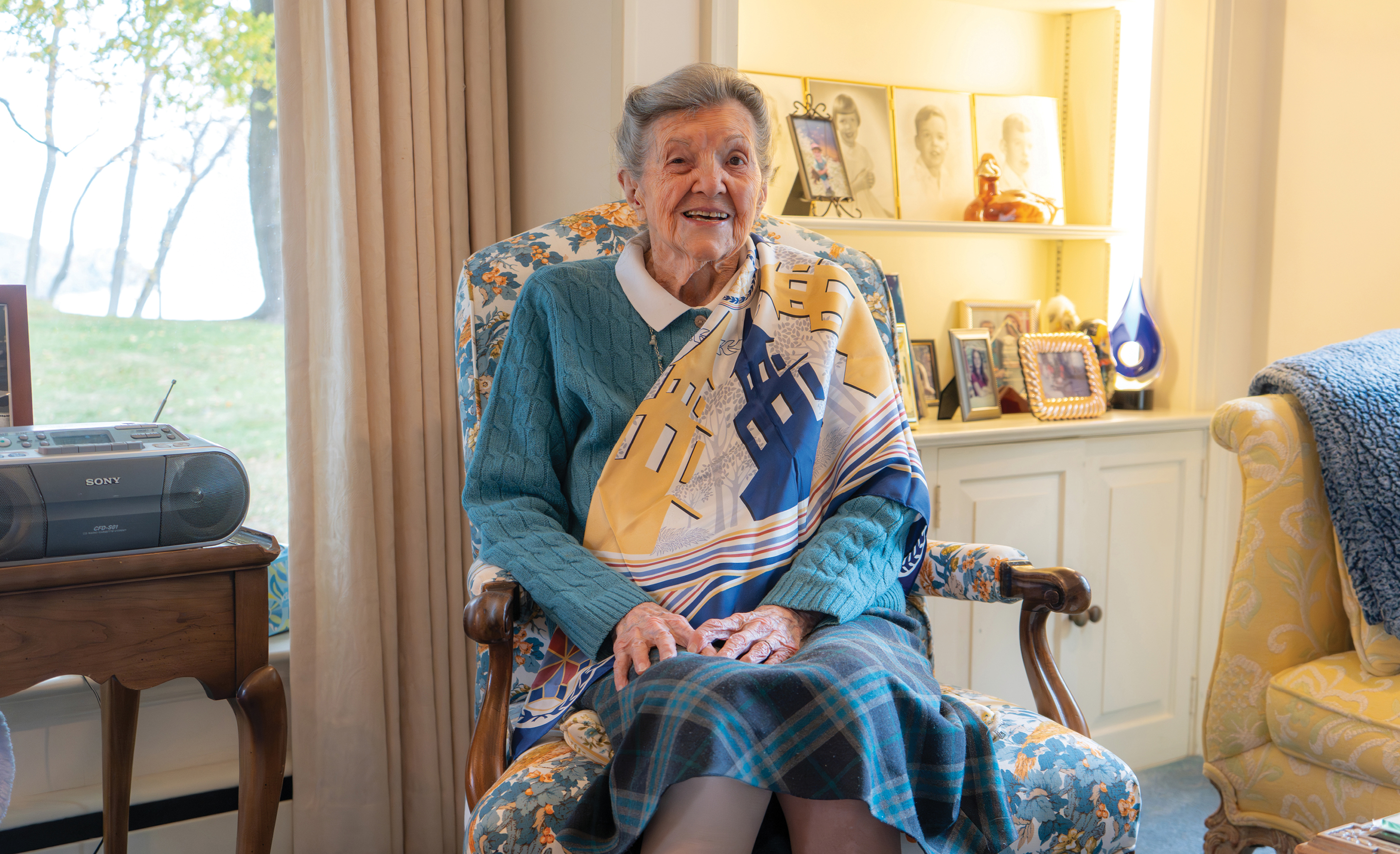
Conn’s eldest alumna shares memories of campus, her secret to longevity and advice for current Camels.
The year Joan Roberts Robertson ’38 graduated, the Fair Labor Standards Act took effect, giving workers a federal minimum wage and an official 40-hour workweek; the Hurricane of ’38 struck New England, killing nearly 700 people and destroying thousands of buildings; and Orson Welles broadcast his radio adaptation of H.G. Wells’ The War of the Worlds, causing panic when some listeners thought aliens had really landed in New Jersey.
In addition to surviving the fictional alien invasion, Conn’s eldest living alumna—who is 110—has lived through historic change in her 11 decades on Earth. And she stays connected to her alma mater 88 years after her final class. She established (in 1998) and still contributes to the Robertson Endowed International Studies Fund, which supports the Toor Cummings Center for International Studies and the Liberal Arts’ annual budget, a summer internship and visits to the United Nations for CISLA scholars.
A lifelong leader in promoting peace and global education, Robertson has dedicated more than 80 years to the Women’s International League for Peace and Freedom and helped establish peace education programs that continue to impact thousands of students in Milwaukee today. In 2024, she was awarded the Rotary Agent of Peace Award for Decades of Peace Advocacy and Education.
Still as lively as ever, Robertson recently answered some questions for CC Magazine from her home in Milwaukee, Wisconsin.
CC Magazine: What are some favorite memories from your time at Connecticut College?
Joan Roberts Robertson: Playing the piano for the tap-dancing classes, under the auspices of the National Youth Administration, which paid me $1.50 an hour by the New Deal Administration. My senior year, I wrote the music for our annual song festival with the words written by Wilhelmina (Billie) Foster Reynolds ’38. We won first prize. The song leader was Jeanette (Jeddie) Dawless Kinney ’38.
CC: Were there any classes and/or professors that made an impact on you?
JRR: [Assistant Professor of English] Catherine Oakes. I remember her more as a history instructor. She was completely my top professor and I loved her dearly. She inspired a lifelong curiosity about history. I also remember that Dr. Smyser was an English professor, Dr. Welles was the head of the English department and Dr. Sanchez taught Spanish. I also took Physics with Dr. Daghlian, German with Rosemary Parks, and Continental Literature, Economics and Psychology.
CC: What prompted you to attend college during a time when many people, especially women, did not?
JRR: At that time, most of my friends went to college if their families could afford the total cost of room, board and tuition. So, I went because it was expected of me. My acceptance into Connecticut College for Women was because one close friend had to refuse her acceptance, so I took her place.
CC: You have lived a long and impressive life. What would you say is your greatest accomplishment?
JRR: Raising a family of five children and surviving! And, with my daughter Annette, establishing the United Nations Schools of International Learning, a curriculum featuring the United Nations in the Milwaukee public school system. It is taught in grades 4-8 and encourages students to join Model UN upon matriculating to high school.
CC: You have witnessed a lot of change in the world, more than most people. What are some of the best?
JRR: The advances of film production, air travel and the foresight of Franklin D. Roosevelt to create social and cultural changes that set the standards for other nations through the establishment of the United Nations, Works Progress Administration, Civilian Conservation Corps, National Youth Administration and many more.
CC: I’m sure everyone asks you this, but what would you say has enabled you to live so long? What keeps you going?
JRR: Family and social relationships and a lively curiosity and hope for the betterment of mankind.
CC: If you could live your life over, what would you do differently, if anything?
JRR: I would have chosen to mature faster, and to change my major in college from English to music, religion, philosophy, international affairs or history. These were subjects I didn’t realize could be majors.
CC: What is something people might be surprised to learn about you?
JRR: That I’m very shy. I never could make small talk among people in social gatherings unless they were very close friends.
CC: How do you stay connected to the Conn community?
JRR: One of the great benefits of my fund in support of CISLA has been association with several interns, most notably Asa Waterworth ’18. Since her first summer internship, we have kept a lively, informative and social relationship that I am most grateful for.
CC: What advice do you have for Connecticut College students and other young people?
JRR: Remain hopeful. Realize that most people are good and do the best they can according to their abilities. If they’re given the chance through education and security, they will do great things.