Byline on the Rise
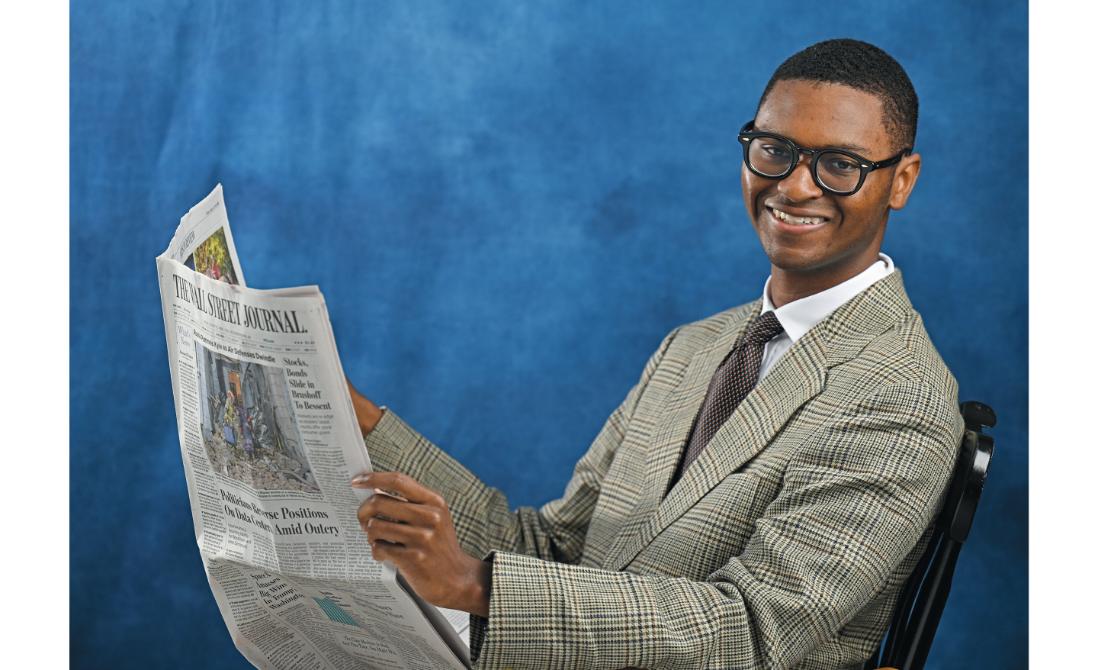
The Wall Street Journal’s Terell Wright ’25 takes the pulse of American politics.
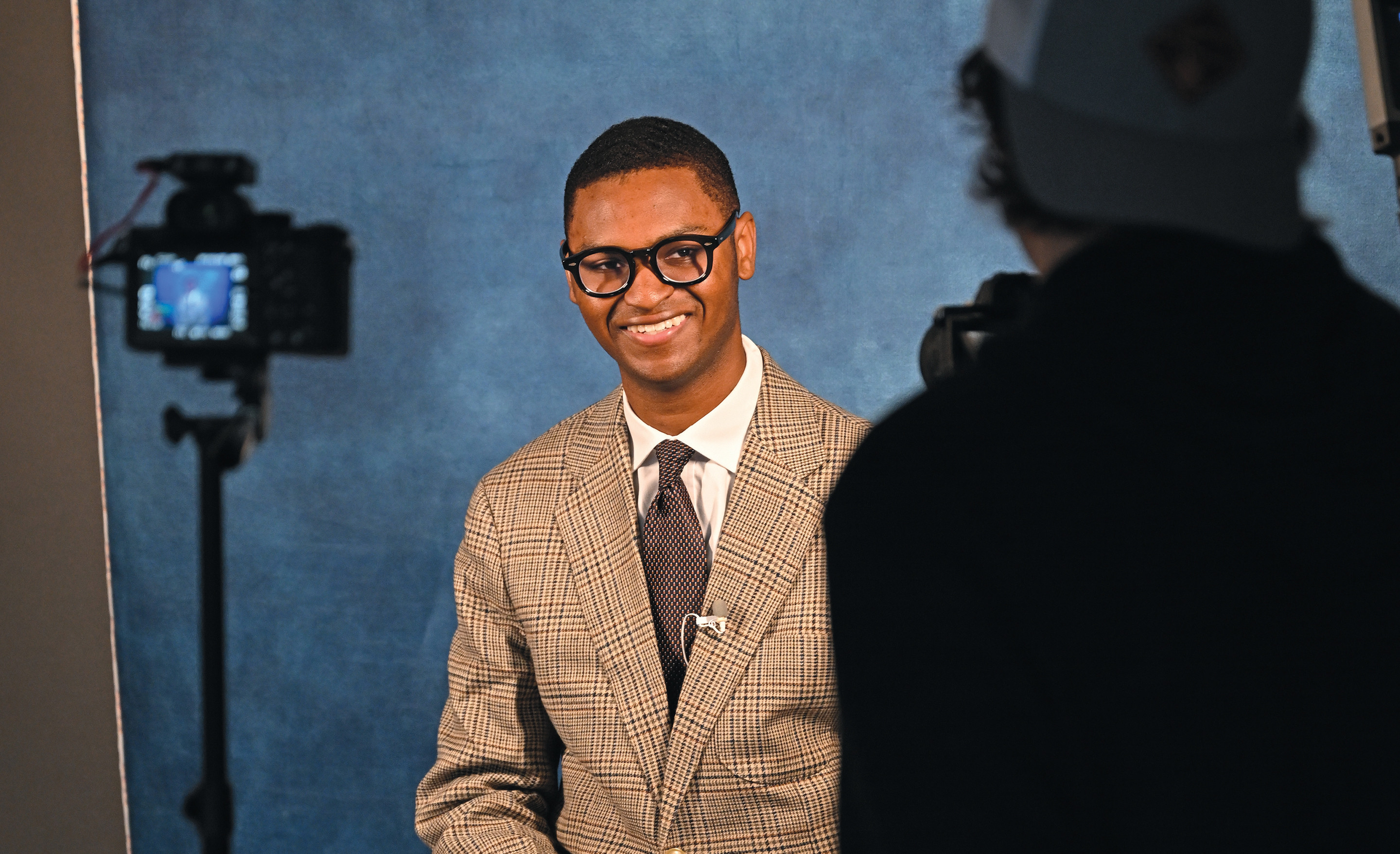
Sharply dressed in a suit and tie, Terell Wright ’25 appears remarkably calm as he speaks directly into the camera. “I’m inside the Hilton Hotel in Washington, D.C., where there were just shots fired not too far from me,” he explains. He then recounts how he had been exiting the restroom on the mezzanine level when, just behind him, a suspected shooter tried to gain access to the April 25 White House Correspondents’ Association Dinner, with President Donald Trump and First Lady Melania Trump in attendance.
“I ducked and I jumped over the staircase trying to make my way down, crawling onto the ballroom floor until I felt like I was in safety,” he reports, as other attendees move cautiously behind him. “I hid underneath a table. There was a woman next to me and we just held each other’s hands. … It was quite an emotional moment,” he continues. “I’m still in the hotel now, and I’m not sure if I’m able to go, but fortunately, I am safe.”
It was supposed to be a rare day off from reporting for Wright, a news associate for The Wall Street Journal who has covered some of the biggest stories in American politics over the last year.
“I was pretty shaken up at the moment, and I had no desire to write,” he recalled when CC Magazine caught up with him in August as he crisscrossed the country covering midterm primaries. “But what I did feel comfortable doing in that moment is talking about it.”
By that point, Wright had made a series of videos to accompany his print pieces in an effort to reach a younger audience—the TikTok generation, if you will—providing them with vital news and insight. He sent his Correspondents’ Dinner video to his editors in the newsroom and it was quickly released, providing the public with one of the earliest first-person accounts of the event.
“It really helped exemplify the power of video journalism. I’ve been very fortunate—and sometimes unfortunate—to be party to some of the biggest moments here in Washington, and it is so rewarding to find new ways to tell those stories.”
Journalists are known for having a “front row seat to history,” and Wright isn’t kidding that the old adage has proved quite true in his experience. The young D.C.-based reporter has covered multiple major White House events, including the “Rededicate 250” prayer event on the National Mall, the 250th anniversary celebration on July 4 and the “UFC Freedom 250” cage fight on the South Lawn, each time capturing the dichotomy of the enthusiastic attendees and passionate protesters.
He was also in attendance when Trump became the first sitting U.S. president to attend oral arguments at the Supreme Court as the justices considered his executive order to end birthright citizenship.
“No one who is 23 years old gets to sit in The Wall Street Journal’s front row seat in the Supreme Court press box when the president of the United States is attending a hearing for the first time in modern history,” he marvels.
But Wright has earned his seat at the proverbial table. In a highly divisive political climate, he takes a nuanced approach to understanding national trends and shifting party dynamics, and his work is marked by a genuine curiosity about political motivation. As an on-the-ground reporter, he digs deep into the “what” and the “why” driving voters’ choices to reveal how everyday Americans are interpreting politics through their own experiences, communities and cultures.
In June, for example, Wright traveled to Darke County, Ohio, where Trump won approximately 82% of the vote in 2024, to gain crucial insight into why the president still enjoyed significant support from his base despite tanking national approval ratings. He spoke to a 46-year-old mother and teacher’s aide who told him she was glad Trump had restored Christianity to American politics, and to a 22-year-old college student who was “a little scared” of rising home prices but was happy with Trump’s approach to illegal immigration because he’d “rather have safer streets and maybe a little bit higher prices than the reciprocal.”
Wright led the story with a 54-year-old third-generation farmer who said that even though rising fuel and fertilizer prices had hurt his business, Trump still had his full support. “We took it on the chin, but we’re fine,” the farmer told Wright. “He’s restoring pride in America.”
“He was telling me, ‘Yes, I lost money, but I trust him. He’s got a plan, and what matters to me more is culture,’” Wright explains. “What I found was that Trump wasn’t maintaining this support because of economic or other quantifiable metrics, but because people felt culturally reinvigorated.”
In July, Wright visited Black churches in Mobile and Montgomery, Alabama, to talk to voters after a Supreme Court ruling allowed the state to proceed with a congressional map that eliminated their majority-minority district.
“In one of the cradles of the Civil Rights movement, where the Black church has immense power, I wanted to know, ‘What do these voters do now? How do they maintain any semblance of political power?’” Wright explains.
In Montgomery, Wright found voters and political organizers had some hope Rep. Shomari C. Figures could hold onto his seat. Figures won by nine percentage points in 2024 under the old map; the new district would have voted for Trump by 14 percentage points. Farther south in Mobile, Democrats were realistic about their slim-to-none chances in a district that would have voted for Trump by 36 percentage points. But in both cities, Wright found motivated and committed Black voters of all ages.
“I’ve seen it all. I’ve been through the Vietnam War, through segregation. I’m used to a fight,” one 81-year-old Montgomery resident told Wright, while a 38-year-old business owner in Mobile said she’s expecting a Republican victory in November and has already spoken with Republican policymakers.
“Even though the representatives they want are unlikely to win, they’re talking about mobilizing and strategizing in other ways so that they can preserve political power within the state of Alabama,” Wright says.
“It was such a privilege to take this national issue and bring it home to these communities in Alabama. There aren’t many jobs where you get to be out in the world talking to people and do it in a way that has such a large impact.”
Wright’s interest in journalism began early. Originally from Atlanta, he spent five years of his childhood in Abu Dhabi, where he would regularly watch CNN. “It was one of the few American channels, and they would broadcast out of Atlanta, so it was a way to connect with home,” he says. “I started to realize, ‘They are telling people information that changes the world, and I want to do that.’”
When Wright’s family returned to the states, his mother enrolled him in what he calls a “two-week journalism bootcamp.” In high school, he began covering student and youth affairs for the Walton Tribune, a local newspaper out of Monroe, Georgia.
When it came time for college, Wright knew he wanted to pursue a career in journalism, but he also knew he did not want to go to journalism school. “I didn’t want my whole scholastic experience to be centered on my vocation—I wanted to get an education that could be supplementary to my career,” he explains. “And I wanted to see a part of the country I hadn’t been to before. Conn was the perfect fit.”
At Conn, Wright took full advantage of the liberal arts and the small-college opportunities. In his first year, he took “Capitalism and Slavery” with Associate Professor of Economics Mark Stelzner—“a 400-level econ class I had no business being in,” Wright says with a laugh. “But he took a chance on me and I just had this passion for what he was teaching. I had never studied history like that before. I had never studied economics like that before.”
With Stelzner’s encouragement, Wright designed his own political economy major and joined the Media, Rhetoric and Communication Pathway. “I got to tie together economics, history and government, and it really shaped why I love learning. It was challenging, but I was so enthusiastic and passionate and I had the ability to focus on my career at the same time.”
Wright spent the summer after his first year researching housing and the impact of urban renewal in New London as part of the Holleran Center for Community Action’s Summer Civic Leaders program. “It was incredible. We were digging deep in the archives, just sitting inside City Hall, going through records, really understanding the history and the stories of the people,” he says.
Wright used that experience to land a reporting position with New London’s daily newspaper, The Day, and a congressional internship with Rep. Joe Courtney’s office. During the summer after his sophomore year, Wright completed a Dow Jones News Fund internship covering housing and Black business for the Atlanta Business Chronicle with career funding support from the Hale Center for Career Development.
The following summer, Wright had his eye on a Dow Jones News Fund internship with a different paper: The Wall Street Journal. “I knew I wanted to work at the Journal, because I admire so many of the reporters here, and this is the kind of reporting I want to do,” he says. “They saw my enthusiasm, they saw my passion and my ability to enterprise stories, and they selected me for the 2024 economic summer internship in New York City. I was covering the economy through the 2024 election, at a time when the economy was the No. 1 issue with voters. It was incredibly rewarding.”
After graduation, Wright worked at The Washington Post as a national reporting intern before joining the Journal full time as a news associate in September of 2025. “It’s been such a privilege,” he says. “This is a place where world-class journalism is produced, and your ambition is always rewarded.”
Now, Wright has his sights set on the midterms and the looming 2028 presidential election. “The Journal has allowed me to cover the midterms in a way that is more ambitions and exciting than I ever would have thought,” he says. “When everyone’s going one direction, I’m thinking, ‘How do I go in the opposite direction and make sure it’s correct and smart and approachable for a multitude of readers?’”
No matter where his career takes him, Wright plans to continue telling stories that make an impact.
“This is so much more than my vocation; it’s my calling,” he says.
“I want every day to have that feeling of, ‘We don’t know something, or we think we know something, but we need to prove it, and we need to talk to the people, figure out the data, figure out the information, and then deliver it in a way that readers actually want to engage with it.’ Every day I’m chasing that, and when I finally get it, it’s the best feeling ever.”