Timeless Tunes, Innovative Instruments
Alfred Goodrich ’98 is remixing the music industry with 3D-printed violins and cellos.
It’s September 2025 and Alfred Goodrich ’98 is due on the set of Shark Tank in five minutes. There’s just one problem: He’s not wearing pants.
“I had placed a water bottle on my leg and it leaked a bit on my khakis,” he explained in a recent interview. “They were like, ‘Oh, we can’t air you. This isn’t going to work.’”
The professional musician and entrepreneur was visiting Sony Pictures Studios in California with Yale engineering student Elijah Lee and Grammy Award-winning cellist Mike Block. They were there to pitch their start-up, Forte3D, which produces 3D-printed violins and cellos, to the show’s investors, known as sharks, and hope for a bite.
Luckily, Goodrich, the company’s co-founder and CEO, had packed a spare pair of khakis. “They had to drive the little golf cart across the Sony lot and get my other pants from the dressing room,” he said, laughing. “I put them on and they pushed me down the hallway.”
Remaking a Classic
For centuries, Antonio Stradivari’s violins, crafted between 1666 and 1737 from spruce and maple trees that grew during Europe’s Little Ice Age, were lauded as the world’s finest. The era’s cooler summers caused tighter and more uniform growth rings, and Stradivari shaped this denser wood into instruments that, for reasons science still hasn’t fully explained, played especially crisp, brilliant and resonant tones.
The legendary Italian luthier also made cellos, violas and a handful of other instruments, but violins composed nearly 90% of his oeuvre. Less than 600 of them survive today. They sell for millions of dollars, and many are in museums or private collections. Those considered “concert ready” are occasionally loaned out to only the best virtuosos.
No need to “fret”—the 17th century is long gone, and more-recent double-blind tests have shown that even professional musicians often can’t distinguish between the sounds of a Stradivarius and a high-quality modern violin. And after years of experimentation, creativity and work, Goodrich’s carbon-fiber instruments are on the cutting edge—at a fraction of the price of their traditional wooden counterparts.
“Forte3D was designed to increase access to a professional-grade instrument that is virtually indestructible, plays wonderfully all the time, is low-maintenance for the life of the instrument, and takes the difficulty out of owning a fine violin or cello that will never hold them back as a player,” Goodrich said.
The instruments are printed and assembled at the company’s production facility six miles outside of Philadelphia. While a traditional wooden violin takes 150 to 250 hours to make and a wooden cello can take 200 to 500 hours, Forte3D’s violins are printed and assembled in two to three hours and its cellos in about five. There’s currently about a two-week wait for an instrument to ship, because a lot more are heading out into the world these days.
Founded in 2022, Forte3D expanded exponentially after 1.4 million people tuned in to their episode of Shark Tank on ABC the evening of Nov. 12, 2025. But the countdown to Goodrich’s musical journey began in 1981 when his surgeon father, who had begun playing the cello the year his son was born, suffered a massive stroke. Goodrich was 5.
“His cello was hanging on the wall in our living room,” Goodrich recalled, apologizing for the background noise as he took a break from building instruments alongside a few of his employees. “When it came time for me to choose an instrument in fourth grade, I thought, ‘I’m sure he’d love to hear his cello being played again.’”
Half Analytical Artist, Half Creative Scientist
Imagining Goodrich’s mind evokes one of those brain hemisphere illustrations in which stark equations dot the logical gray left while vivid colors swirl wildly from the creative right. Goodrich seems to be ruled by both sides in equal measure.
From an early age, he has had to find creative ways to succeed. His father’s stroke severely reduced the family’s income, and then his mother died when he was 15 after battling leukemia. He struggled in school. “I went in for lunch and orchestra, and then I went home,” Goodrich admitted. Eventually he found his rhythm again, and Connecticut College accepted him in 1994.
The chemistry major enjoyed a prolific four years. He founded the ConnArtists a capella group, served as principal cellist in the College orchestra his entire time there, joined the Men’s Rowing team, and graduated with an A average. His time in New London is the soundtrack to his current success, he said.
“I had [Margaret W. Kelly Professor of Chemistry] Dean Lewis my junior year. He was by far the best mentor I’ve ever encountered. There was something about him that just made me want to excel; I didn’t get anything less than perfect on every single exam for his class.”
The hard work paid off. “I won an analytical chemistry award that year, which fits because studying chemistry taught me to think analytically and to persevere,” Goodrich said. “If I didn’t have that background from Conn, I would be toast right now.”
After graduation, Goodrich became his father’s full-time caregiver, earned a master’s degree in music theory and composition, and managed to become a rock star.
The Alfred James Band (AJB)—with Goodrich on vocals and cello, Avery Coffee on electric and acoustic guitar, Patrick Brennan on bass and Valerie Vuolo on violin—has played at The White House, the Vatican, Carnegie Hall, the United Nations headquarters, the Kimmel Center for the Performing Arts, and the Academy of Music in New York City, and has appeared on The Today Show and Good Morning America.
In 2005, they released their debut album, Lucky if Easy. In 2016, they released their second, Up Up Down Down, produced by Ian Cross, who has also worked with Janet Jackson, Usher and Gwen Stefani. AJB has toured in Greece, Turkey, Cuba and Italy. They’ve performed for two Grammy showcases and have opened for Rufus Wainwright, Bruce Hornsby, The Philadelphia Orchestra, Marc Cohn, They Might Be Giants, and Suzanne Vega. But in March 2020, everything came to a full stop.
Idle Bow Leads to Breakthrough
When the pandemic hit, the music fell silent. “I had to shut down my recording studio and my band couldn’t tour, so I had nothing but time,” Goodrich said. Neurons fired across the hemispheres of his brain.
Analytical chemistry is “the science of obtaining … information about the composition and structure of matter,” according to the American Chemical Society. With his mind full of science and song, Goodrich set his sights on reinventing the string instrument, starting with the cello. First, he needed to know exactly how it was built. So, that’s how his father’s cello ended up in the hospital for a CT scan.
“I was looking at carbon-fiber-infused filaments and comparing the flexural modulus and the weight to wood. I was like, ‘This stuff is getting really good, and I think we have a shot here.’ I knew that with the capabilities of 3D printing, I would be able to make many, many different iterations and slowly work on the sound.”
He turns his head and calls out to the employees building instruments behind him. “Hey guys, what cello rib number are we on?” Someone responds, “124!” As science demands, Goodrich is patient and precise. Professor Lewis would be proud.
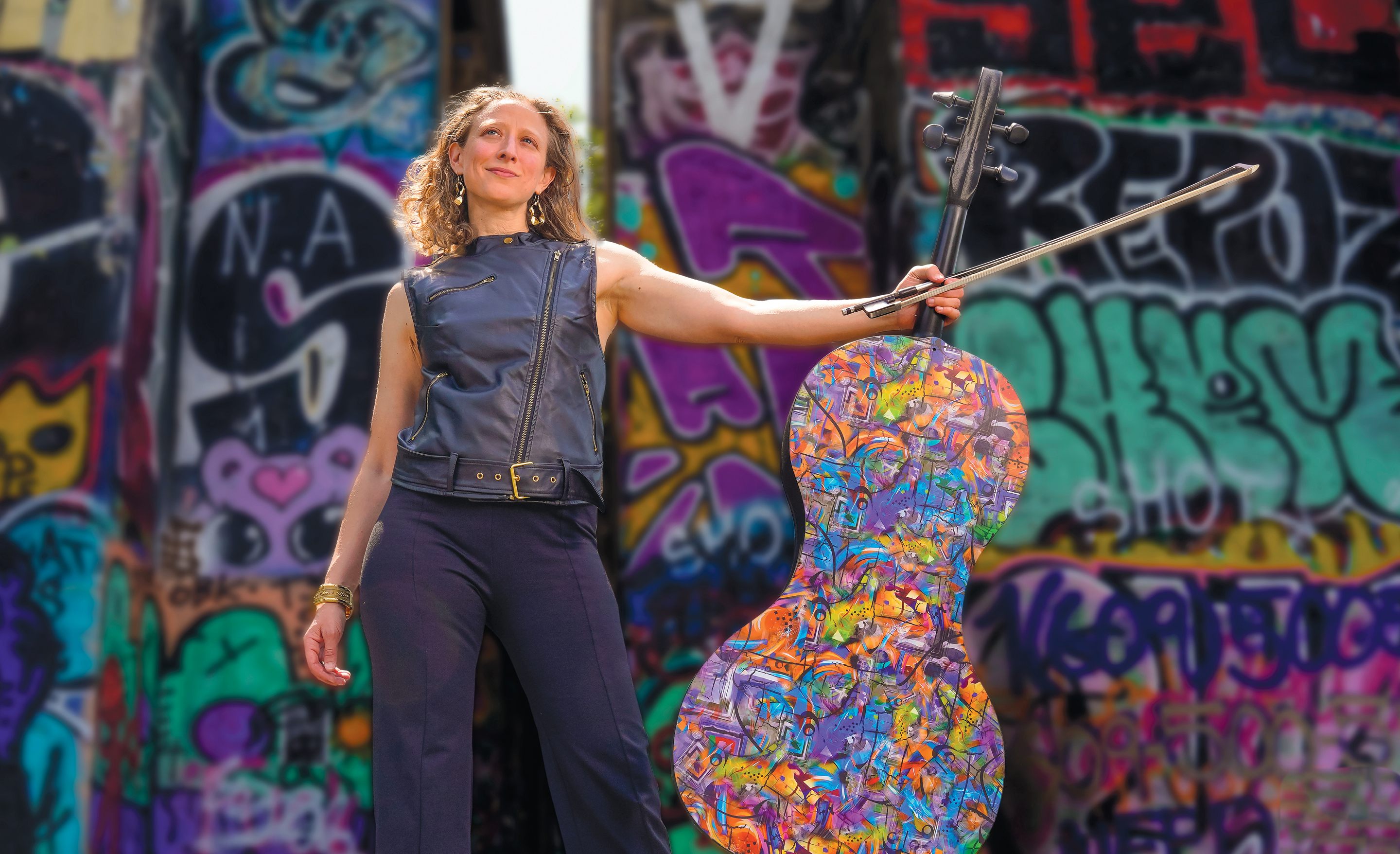
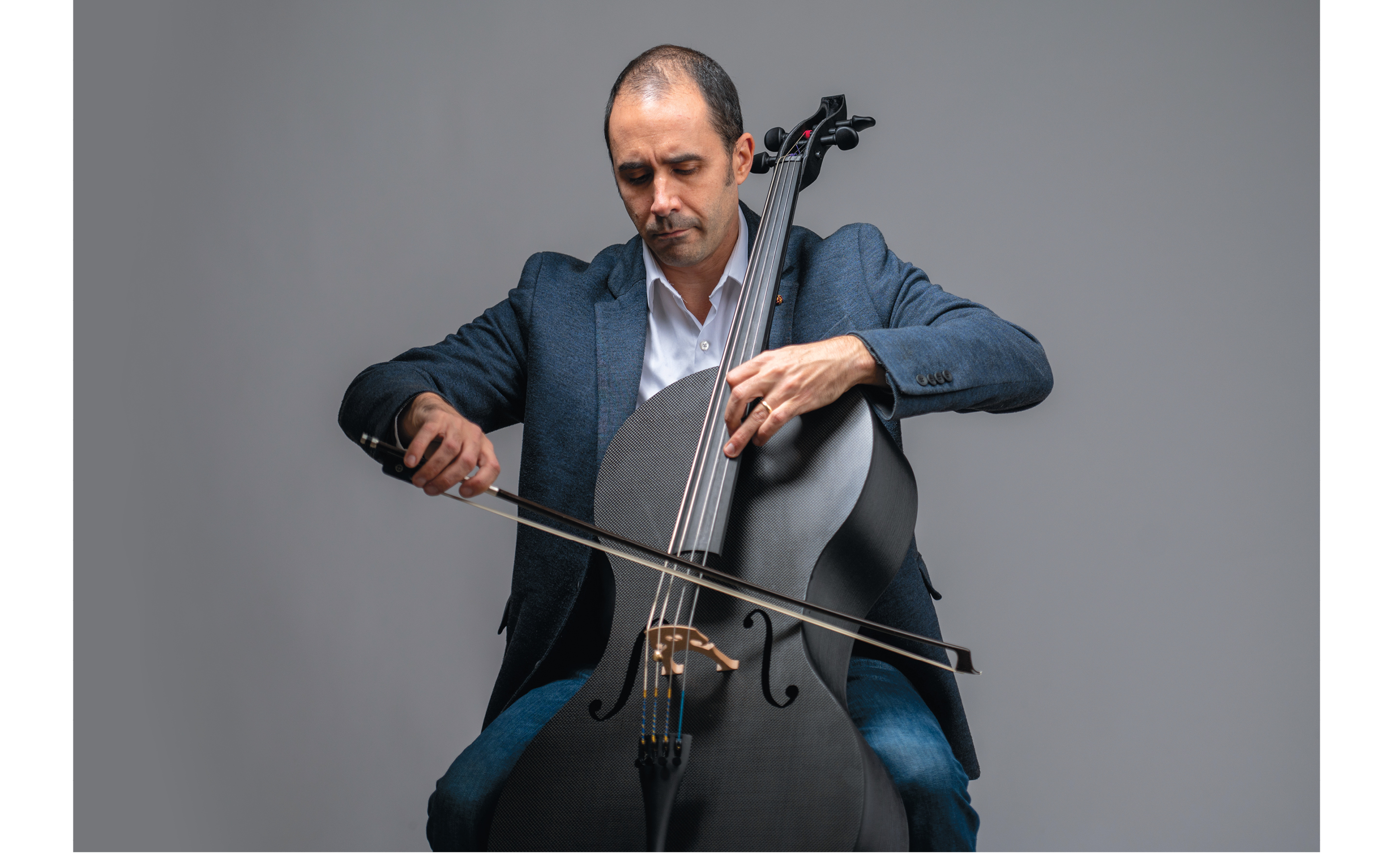
The ribs, neck and scroll of every one of Forte3D’s carefully designed instruments are 3D-printed with a proprietary, aerospace-grade filament of polymer infused with carbon fiber. The top and back plates consist of flat carbon-fiber sheets, and geared tuning pegs keep the strings taut and in tune. The instruments do contain some natural materials—the fingerboards, soundposts and bridges are carved from wood, and the violins have an ebony chin rest.
Goodrich isn’t the first to think outside the (wooden) box to create a different kind of commercially available acoustic instrument, but he’s the first to do it this well. “Until now, carbon-fiber instruments were very expensive,” he explained. “They had to make them very thick so that they didn’t collapse under the tremendous pressure of the bridge pushing down on the strings, so you ended up with a much more brittle, aggressive sound that people tend not to like. But ours have the warmth and tone that most people associate with wooden instruments.”
His key invention was to use flat sheets of carbon fiber for the top and back. The bridge pushes downward on the top of the instrument, causing it to become concave rather than convex like the top of a traditional violin or cello. This puts the carbon fiber primarily in tension, taking advantage of its exceptionally high tensile strength, rather than relying on its comparatively weaker bending stiffness, Goodrich explained. “All that reduction in mass is converted into power and beauty and warmth, which nobody’s really heard before in a carbon-fiber instrument.”
And you don’t need to be a millionaire to own one. The standard Forte3D violin retails for $1,495 and the standard cello for $2,950. “Old Italian Wood” versions with realistic UV-painted wood finishes run a bit more, and versions featuring fine art and custom printing are also available. “Our instruments are pennies on the dollar compared to equivalent wooden instruments,” Goodrich said.
More musicians are getting the message. The day Goodrich spoke to CC Magazine, the largest online distributor of instruments in the United States, Sweetwater, began releasing Forte3D’s violins and cellos.
You’re Gonna Need a Bigger Note
At an open casting call in Philadelphia a couple of months before they filmed their life-changing episode of Shark Tank, the Forte3D founders created a captive audience. Goodrich and Lee pitched the producers, and then two professional cellists they had talked into accompanying them balanced their rosined bows on the strings. Music filled the air.
“There were like four groups all pitching to different people at the same time,” Goodrich recalled. “We played, and it stopped the room. So we were fast-tracked through the casting process, and we didn’t even have the violin released yet! They were playing prototypes.”
Their showdown with the sharks arrived quickly. “It was so rushed that we almost didn’t get the instruments out to L.A. in time for filming because they were literally still being made. And then, we only had half an hour in the hotel room the night before to practice our pitch.”
Finally—after Goodrich’s wardrobe malfunction was remedied—it was showtime. “It was terrifying. I didn’t know if one of the violins was going to explode, because they were such early prototypes,” he joked. “We were in there for about 90 minutes, and they grilled us. We had to push back on some answers. We thought we were losing the room halfway through our pitch.” Following a tense negotiation, investor Lori Greiner offered $250,000 in exchange for 16% equity.
After a suspenseful pause, Goodrich gleefully exclaimed, “You have a deal!”
Shark Tank changed the tune for Forte3D. Daily visits to their website skyrocketed from a couple hundred to 3,000, and their weekly revenue multiplied by 20. The influx of cash allowed them to go from building one instrument at a time to producing them en masse. Orders started rolling in from cellists in The Philadelphia Orchestra.
That’s because taking the time to fine-tune Forte3D’s designs has rewarded Goodrich with a sound he says rivals that of a fine wooden instrument. Many professional musicians agree, including world-renowned cellist Yo-Yo Ma, the Grammy Award-winning cellist and educator Mike Block, Boston Symphony Orchestra Concertmaster Nathan Cole, Adam Young of Owl City, and section members of the Los Angeles Philharmonic, Virginia Symphony and Kansas City Symphony orchestras. Philip Sheegog, half of the string duo ARKAI, which won a Grammy this year for Best Contemporary Instrumental Album, plays a cello made by Forte3D.
And it all started in a living room nearly 50 years ago. “I like to think there’s a little piece of the soul of my dad’s cello in every instrument we make,” Goodrich said.