What’s in Your Office?
A new, occasional CC Magazine series explores the close quarters of some of our most expansive minds.
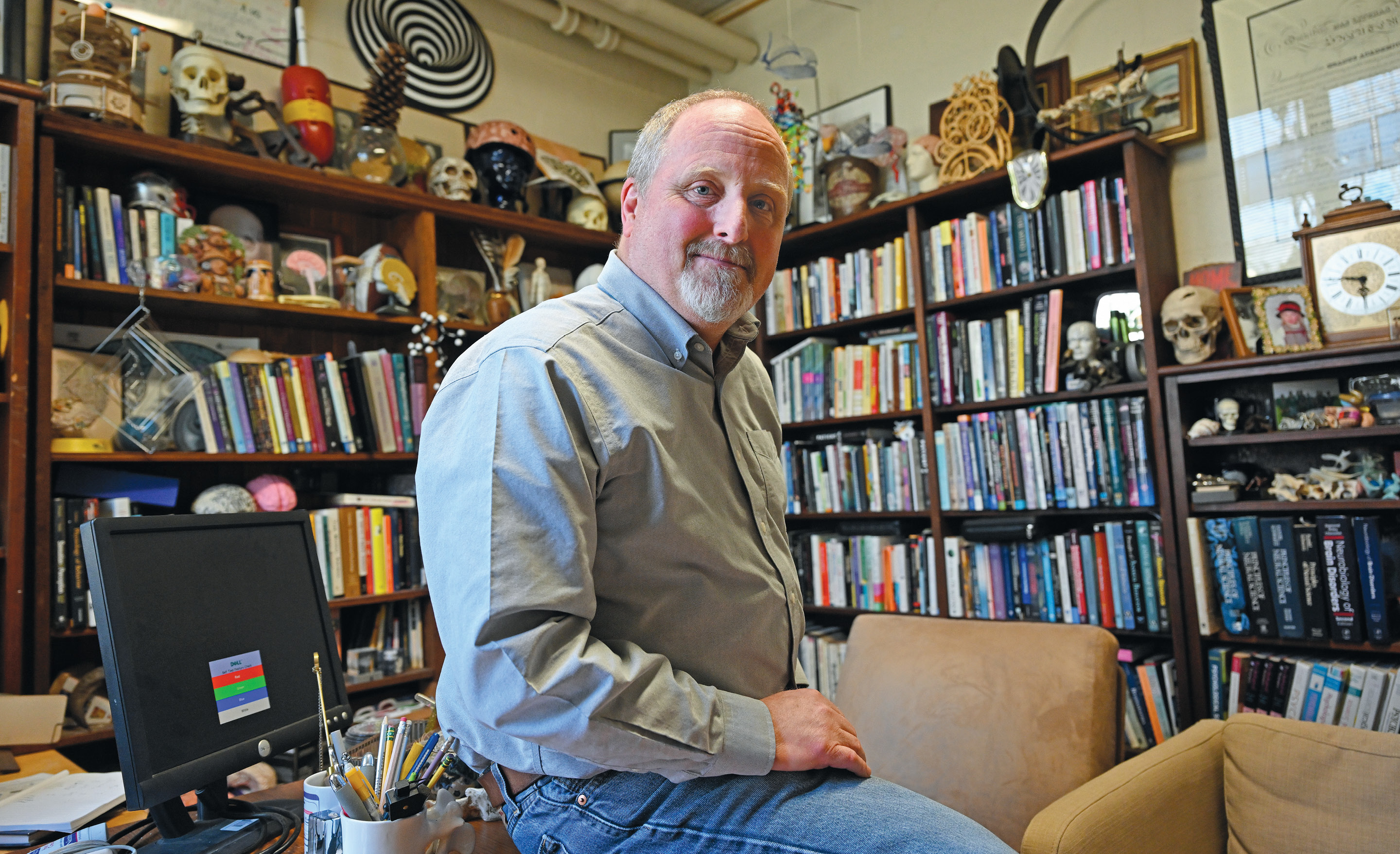
Professor of Psychology Joe Schroeder, who teaches neuroscience courses, has occupied his third-floor office in Bill Hall since he joined the faculty of Connecticut College in 2004. That means he’s had 22 years to accumulate an array of artifacts and decorations reflecting his professional and personal lives.
“I’ve gradually been collecting things over the years to make my office in 86-year-old Bill Hall more visually appealing, since I’m in here a lot. I use many of them in my classes. Some models are used in my ‘Systems Neuroscience’ course, where students learn about brain anatomy, blood supply, internal structures, bones of the skull. Most of it has a utilitarian purpose, and some of it is gifts. I could probably tell you the personal or professional connection to virtually everything in this office.”
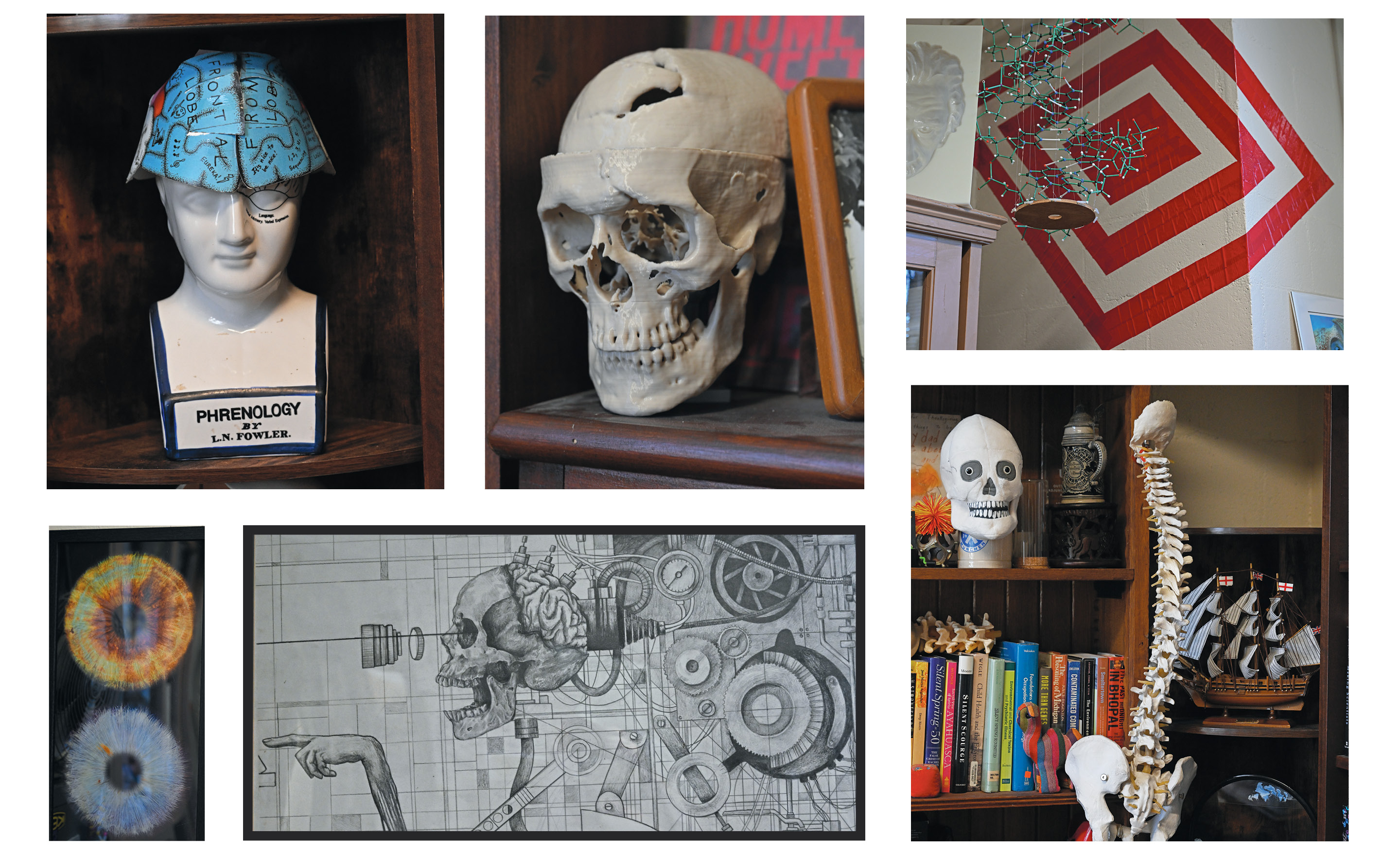
PENCIL DRAWING: “That piece was done by Jax Perry ’22 a few years ago. She was an art and neuroscience double major, and I ended up purchasing that from her portfolio. (See more at www.jaxartist.com.)
PHRENOLOGY SKULL: “A phrenologist would basically feel the bumps on your head and predict your future. ‘You’ll be a fine, upstanding citizen,’ or ‘You’re destined for unemployment and the gutter.’ Now we know that the frontal lobe is for decision making, and the hippocampus is for memory, and a certain part of your brain is for vision, and so forth. So they were on the right track in terms of the relationship between structure and function, but on the wrong track in terms of mapping personality to the brain based on the bumps on your head.”
3D PRINTED SKULL: “Oh, this is one of my favorite things. This is a 3D model from an MRI of the skull of a notorious individual in psychology named Phineas Gage. He survived an accident in the 1800s when he was dynamiting rock for a railroad bed and the tamping iron went through his cheek and out of the top of his head. They took his actual skull out of the case at Harvard Medical School, scanned it and made a 3D-printer file so that anybody can make a model. The reason he’s important in psychology is that before his accident, which destroyed his frontal lobe, he was a responsible, well-liked guy. The frontal lobe is the rational, decision-making part of your brain that allows you to act appropriately in social situations. So afterward, he was unable to hold a job and became irascible and profane. He overreacted to negative situations and started lots of fights with people because of that injury.”
RED TAPE: “I did that. Have you seen those artworks that look distorted because they go around a corner? If you view this from the exact right spot, it’s supposed to look like uniform concentric boxes. I teach a course on sensation and perception, and we use a lot of visual illusion. The DNA double helix model hanging next to it was a gift from my son Allen, a chemical biologist.”
IRISES: “That’s my daughter’s eye and my eye. We had it done at Concrete Iris in Mystic. You can see my iris is all blue and she has a little bit of blue. We should have had my wife do it, too.”
SHIP: “That’s the HMS Beagle, which Charles Darwin sailed on during a surveying trip around South America from 1831 to 1836. That trip played a big role in helping him develop his theory of evolution. I teach ‘Evolutionary Psychology: Origins of Mind and Behavior,’ and we talk a lot about what made us who we are today and what primal instincts are based on our evolutionary history.”