Space Talk
Astronomy Professor Alex Gianninas is on a mission to debunk common misconceptions about space.
In addition to his work in the classroom, Associate Teaching Professor of Astronomy and Campus Director of the Connecticut Space Grant Consortium Alex Gianninas educates the public on social media, through a YouTube series called Celestial Happenings, and as an expert regularly quoted in traditional media. He sat down with astronomy enthusiast and Senior Writer Melissa Johnson to answer some of CC Magazine’s most pressing questions.
Melissa Johnson: What are some of the most common misconceptions people have about space?
Alex Gianninas: Meteors are often referred to as shooting stars, but they’re not actually stars. Stars are huge balls of gas very far away that last billions of years, like our own sun. “Shooting stars” are basically small hunks of rock that have entered the Earth’s atmosphere at very high speed and get extremely hot from friction with our atmosphere. If they’re small enough, they’ll completely burn up, which is the trail of light that you see.
And certain “constellations” are actually asterisms, or parts of larger constellations. The most classic example is the Big Dipper, which is the hind quarter and tail of Ursa Major, the Big Bear. Another common asterism is the Summer Triangle, which is made up of three very bright stars, Altair, Vega and Deneb, that each belong to different constellations but form a bright triangle visible in the summer in the Northern Hemisphere.
MJ: And aren’t half of the “single” stars we see actually double stars orbiting each other?
AG: Yes. We love to show our astronomy students a very well-known star called Albireo, because when you see it through a telescope or binoculars, you see the two stars. It’s visually striking, because one is bluish and one is reddish. And one of the stars is itself a triple star system. So it gets funky, but half or more of the stars people see when they look out at night are multiple stars together, which actually makes sense because stars tend form in groups. The closest star to us besides the sun, Proxima Centauri, is part of a triple star system a little over four light-years away.
MJ: The Northern Lights have been visible from campus multiple times in the last few years. Is there a reason for the uptick in visibility this far south?
AG: Aurora, or Northern Lights, are more frequent and intense during the peak of the 11-year solar cycle, which happened last summer. During this peak, more powerful eruptions at the surface of the sun, called coronal mass ejections, can produce aurora that are visible farther south than usual because they hurl a greater quantity of charged particles toward the Earth that colorfully interact with the planet’s magnetic field and its atmospheric gases. The next solar cycle is expected to peak in 2035.
MJ: What do you see as the biggest mystery or problem to solve in the field right now?
AG: Only about 5% of the universe is the regular matter that we can see. The nature of dark matter and dark energy, which together make up about 95% of the matter and energy budget of the universe, is still unknown a hundred years after we discovered it. Right now, all we know is that dark matter is sort of the glue holding galaxies and galaxy clusters together, and dark energy is the same stuff that is causing the universe to expand at an ever-increasing rate. It’s tricky to study because we can’t see dark matter or dark energy directly; we can only see their effects on the light and objects around them. We have some ideas of what they could be, but we haven’t been able to confirm anything so far.
MJ: Isn’t it crazy how so much of what we know about astronomy has only been discovered in recent decades? I don’t think we even knew about any planets beyond Pluto (RIP) until the 1990s.
AG: That’s right, the first exoplanet, or planet outside of our solar system, was discovered in the mid-’90s. The observation that exoplanets and exoplanetary systems are common is, I think, the most exciting discovery in recent decades. The Kepler Space Telescope and now TESS (Transiting Exoplanet Survey Satellite) have completely transformed our understanding of how planets form and the great diversity of planets that exist.
MJ: What do you see as the next big development?
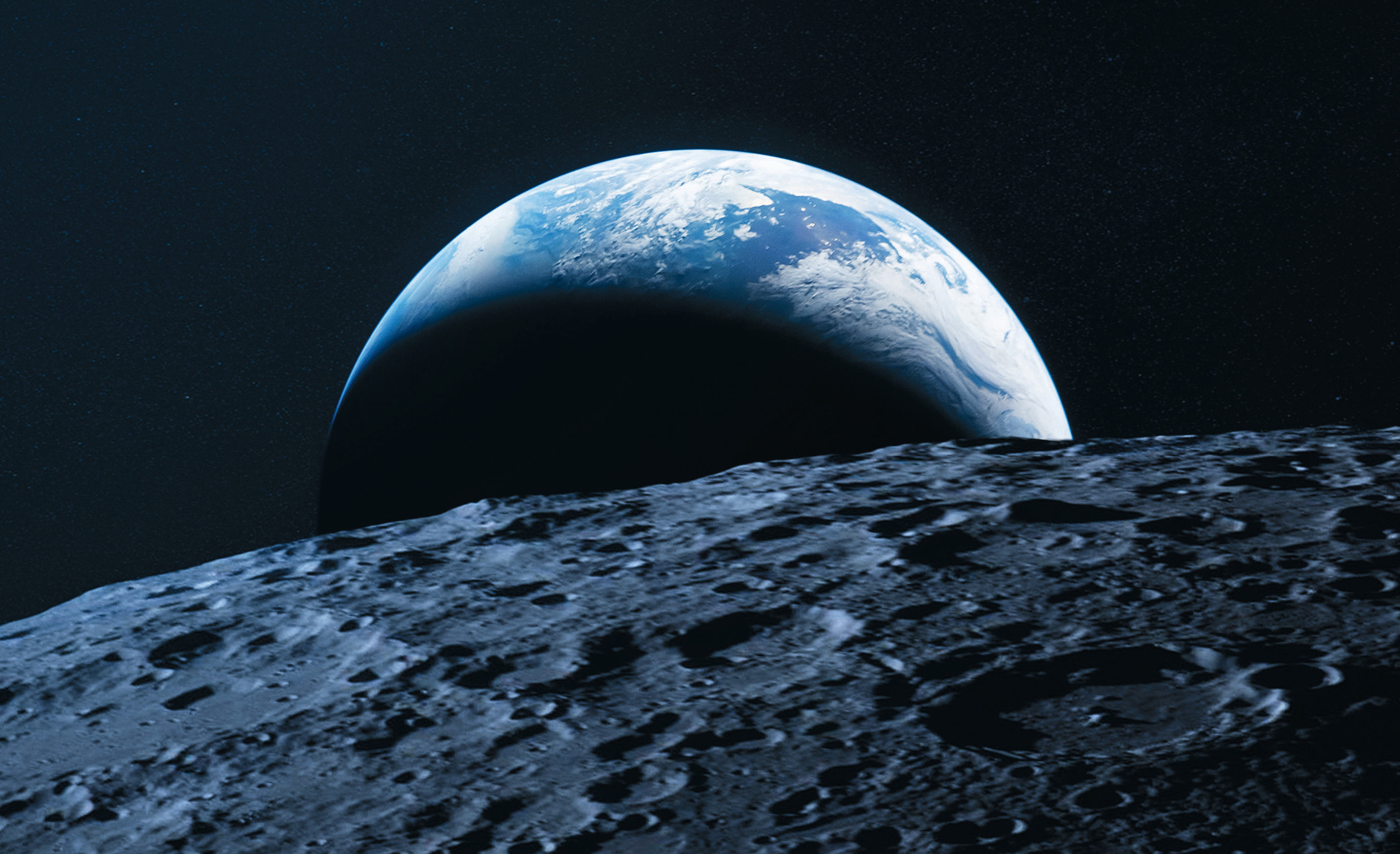
AG: To me, one of the next logical steps is to establish a permanent presence on the moon. The far side of the moon is a phenomenal place to set up a remote telescope. It’s in the dark for 14 days straight and has no weather or atmosphere. I’m not saying it would be simple or cheap, but if we can figure out how to pull it off, the benefit would be incredible.
MJ: Your research has focused on white dwarf stars. What are they?
AG: White dwarf stars are the dense, cooling remnants sun-like stars leave behind after they exhaust their nuclear fuel. My most cited work involves large-scale spectroscopic surveys, or light-spectrum analysis, of white dwarfs. Arguably, my most significant work involved obtaining and analyzing data from the visible light waves of over a thousand white dwarfs as part of my Ph.D. thesis. It was an important study that produced refined measurements of effective temperature (T_eff) and surface gravity (log g) for hundreds of DA white dwarfs, which have hydrogen-dominated atmospheres. And it helped clarify the so-called “log g problem” where the hydrogen warps the measurements we take of this type of star based on the light it emits, making its gravity appear stronger than it is. That was a puzzle in the field for years.
MJ: That’s exciting. Now, I would be remiss if I didn’t take this opportunity to ask you about aliens. So … are they out there?
AG: I believe that, yes, at some point we will find some form of alien life. What will that look like? I have no idea. We have exactly one example of a place where life developed in a specific way under specific conditions. Right now, people are looking for what they know based on our planet, which is that you need water and oxygen for life. That doesn’t mean life can’t develop somewhere else under different conditions using different chemistry. The last 20 years of research have revealed that most stars have planets, and those planets are really diverse. And we’ve only surveyed a small portion of our own galaxy, never mind beyond. Statistically, I don’t see how there isn’t any other life form out there. Space is big—really big.
Professor Gianninas’s Space Favorites:
Movie: Interstellar
TV show: Star Trek: Deep Space Nine
Book: Dune (the entire series!)
Song: Figli Delle Stelle (Children of the Stars) by Allan Sorrenti