'We Are Still Here'
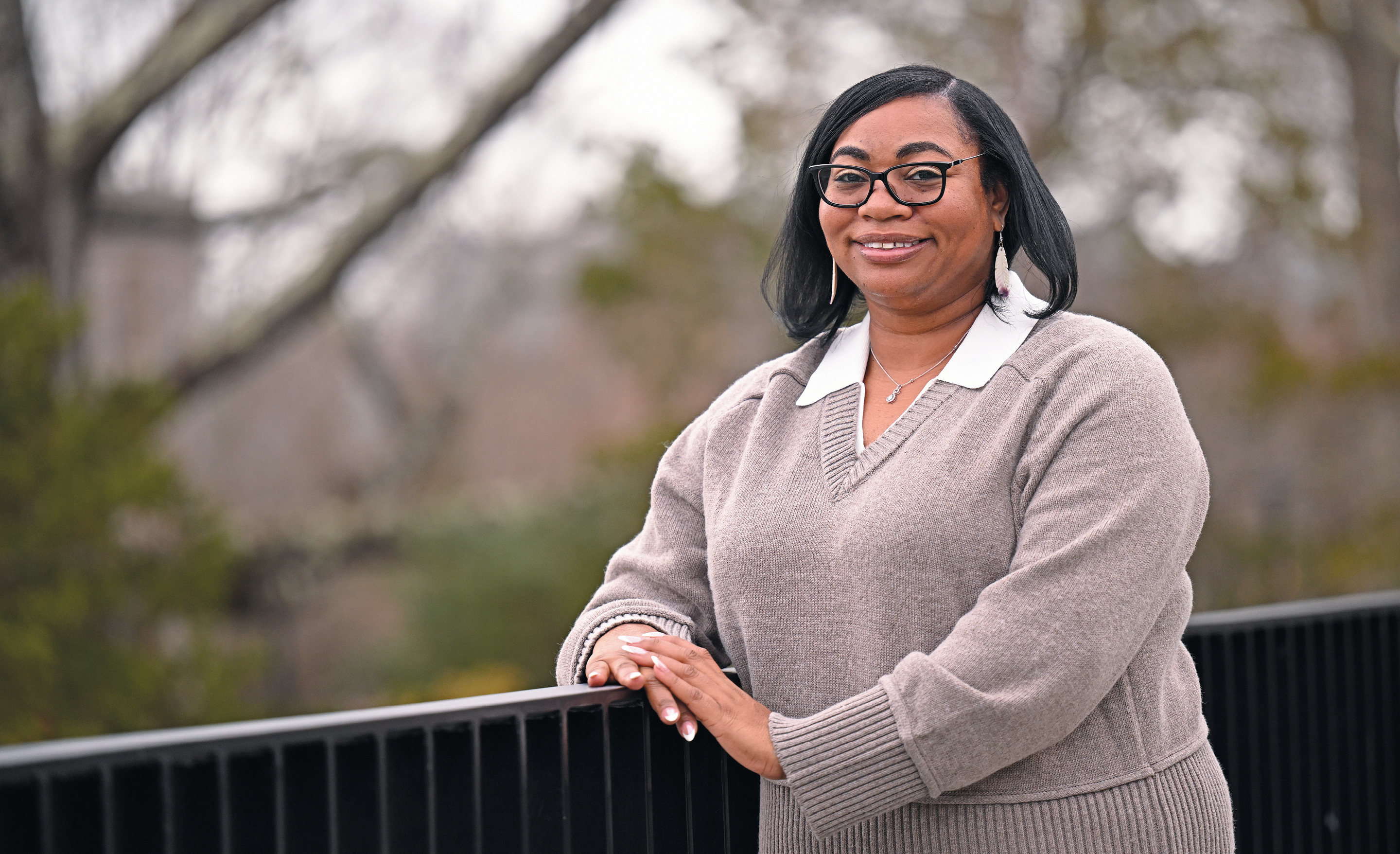
Eastern Pequot Tribal Nation council member Kiana Scruggs ’02 continues the fight for federal recognition.
History is a staple in every American school. But growing up in Connecticut, Kiana Scruggs ’02, a member of the Eastern Pequot Tribal Nation, noticed some glaring omissions.
“I learned about Christopher Columbus and his three ships. I didn’t hear about my own people,” she says.
Four hundred years ago, thousands of Pequots lived in the coastal areas along Long Island Sound, including on the land that is now home to Connecticut College. They had thriving political, social and business networks. They grew “the three sisters” (corn, beans and squash), strawberries and grapes and produced wampum—beads made from various types of shells—creating elaborate beadwork and jewelry that they initially traded amicably with the newly arrived Europeans. But tensions rose after the Pequot Sachem was kidnapped for ransom by Europeans and subsequently murdered—after the ransom had been paid—in 1634. Eventually, the Europeans declared war on the Pequots, which culminated in the 1637 massacre of hundreds of Pequot men, women and children in a single day. Only two small groups of Pequots survived; Scruggs descends from the group that retreated to the east.
She and her classmates learned none of that in school.
“My mom instilled our Pequot history in us, because it wasn’t in the history books. I did not understand that as a child: I had to learn European history and a lot of other histories, but no one had to learn ours? My education about my people came from my parents, from my people and from going to tribal events like our traditional powwows.”
Today, Scruggs is in the midst of her second three-year term as an elected council member for the Eastern Pequot Tribal Nation. Established in 1683, the tribe’s reservation, located about 15 miles northeast of Conn’s campus, is one of the oldest in the United States and has been continuously occupied since the 1670s. But unlike the Mashantucket Pequots—descendants of the other group of surviving Pequots—and the neighboring Mohegan tribes, the Eastern Pequots lack the federal recognition needed for tribal sovereignty and access to federal benefits and protections, including aid for economic development, education, healthcare and housing.
Scruggs is a vocal advocate in her people’s “archaic and long and arduous” fight for federal recognition, which began in 1978. They briefly won—federal recognition was granted to the Eastern Pequots in 2002, only to have it revoked in 2005 amid political fear they would build a third casino in the region. It was a devastating blow, as tribes denied federal recognition are banned from repetitioning, but a limited exception to the ban is in discussion as of 2025.
Scruggs has also gladly taken on the shared duty of helping to educate the public, especially about the Eastern Pequots and the two other area tribes lacking federal recognition: Schaghticoke and Golden Hill Paugussett.
“I have the responsibility and the privilege to share our story and tell people about my bloodline, because I’m very proud of it. They tried to eradicate us, but we are still here,” she says.
A Long Line of Helpers
A self-proclaimed “talker,” Scruggs was born into a legacy of helpers that reaches back for many generations. Her late mother, Brenda, constantly encouraged Scruggs and her sister, Shonda, to help others. “Volunteering is a part of our DNA,” Scruggs says.
As kids, the sisters were candy stripers, volunteering in Lawrence + Memorial Hospital’s coffee shop and daycare. As a student at The Williams School, Scruggs co-chaired a community service committee. The windows of her high school classrooms overlooked Conn’s 750-acre campus, where her father, Willie, worked as a maintenance supervisor. While she was initially tempted to pursue college farther from home, she ultimately decided to become a Camel—a decision she is grateful for every day. “There’s a lot to Conn’s approach to education that has been really helpful in my journey,” she says.
She continued to help others as an undergrad, working with the Holleran Center’s Office of Community Partnerships, and as a reading tutor at the Interdistrict School for Arts and Communication (ISAAC) in New London.
She had a lot of fun, too, she says. She spent a lot of time at Unity House and with Conn’s vivacious but short-lived cheerleading team in 1998, which she helped keep going until she graduated. “Shout out to the Camel cheerleaders!” she says with a smile. “They know who they are.”
As for her studies, Scruggs originally planned to follow the pre-med track. “I wanted to be a pediatrician because I love kids and I love helping. So, my freshman year, I took biology and chemistry, and learned that what I didn’t love was science,” she recalls with a laugh. “But what’s great about Conn is it’s the liberal arts, so they’re going to expose you to all of the disciplines.”
Taking “Introduction to Psychology” as an elective with Professor Audrey Zakriski changed the course of her life and her studies, Scruggs says, especially as a Black and Native American woman raised by her mother to be proud of her dual heritage and strong in the face of adversity and oppression. “Psychology helped me understand people and myself. I learned there are other ways to process trauma, and we don’t always have to be strong,” she explains.
Scruggs changed her major and graduated with her psychology degree in 2002. She soon found a position at Reliance House (now Reliance Health), working with clients who had been de-institutionalized from Norwich State Hospital. The process involved moving patients to a group home, which Scruggs describes as “a necessary but traumatic and difficult transition” for the four women she was assigned to assist. “I called them my Golden Girls,” she recalls fondly.
Meanwhile, faraway horizons still beckoned, so Scruggs moved with a friend to Las Vegas on a whim in 2004 and stayed for 14 years, working at a Nevada state agency for clients with developmental disabilities. “I fell in love with that population and found my niche there.”
Ever the helper, she moved back home in 2018 when her parents developed health issues. She found similar work, starting out as a case manager for the Connecticut Department of Developmental Services (DDS). She earned her Master of Public Administration in 2021 and now supervises 11 DDS case managers supporting more than 400 clients of all ages throughout southeastern Connecticut.
Despite her packed schedule, Scruggs stays connected to Conn. Last spring, she participated in a meeting of the [Un]Freedom Colloquium, a series hosted on campus that focuses on inequalities in New London. The March event was titled “[Un]Freedom in Tribal Nations: The Politics of Food and Housing Security.” And by invitation of the College as it expands its partnership with the tribe, the Eastern Pequot Tribal Council meets on campus every Tuesday at Unity House until the tribe’s community center construction is finished, likely by the end of 2026.
“The [Un]Freedom Colloquium was such a great opportunity to interact with members of the college community and greater New London and share my lived experience as a member of both communities,” Scruggs says.
At the same time, she continues to work for the legacy and future of her people.
“We think in terms of the seven generations yet unborn,” she says, referring to the Indigenous wisdom that decisions should be made in consideration of the impact on descendants far into the future.
“The important part is to never stop fighting. Those seven generations are coming. We owe it to them to leave them something better.”