CONNECTICUT COLLEGE
CONNECTICUT COLLEGE
  • Current Issue
  • Past Issues
    • 2026 Issues
    • 2025 Issues
    • 2024 Issues
    • 2023 Issues
    • 2022 Issues
    • 2021 Issues
    • 2020 Issues
    • 2019 Issues
    • 2018 Issues
    • 2017 Issues
    • 2016 Issues
    • 2015 Issues
    • 2014 Issues
  • Older Issues
  • Letters to the Editor
  • Update Your Address
  • Alumni Association
  • News & Media Hub
  • Make a Gift
  • College Home Page

Contact Us

Connecticut College
Office of Communications
270 Mohegan Avenue
New London, CT 06320

Amy Martin
Editor, CC Magazine
asulliva@conncoll.edu
860-439-2526

CC Magazine welcomes your Class Notes submissions. Please include your name, class year, email, and physical address for verification purposes. Please note that CC Magazine reserves the right to edit for space and clarity. Thank you.

Submit Class Notes

Carburetor Queen

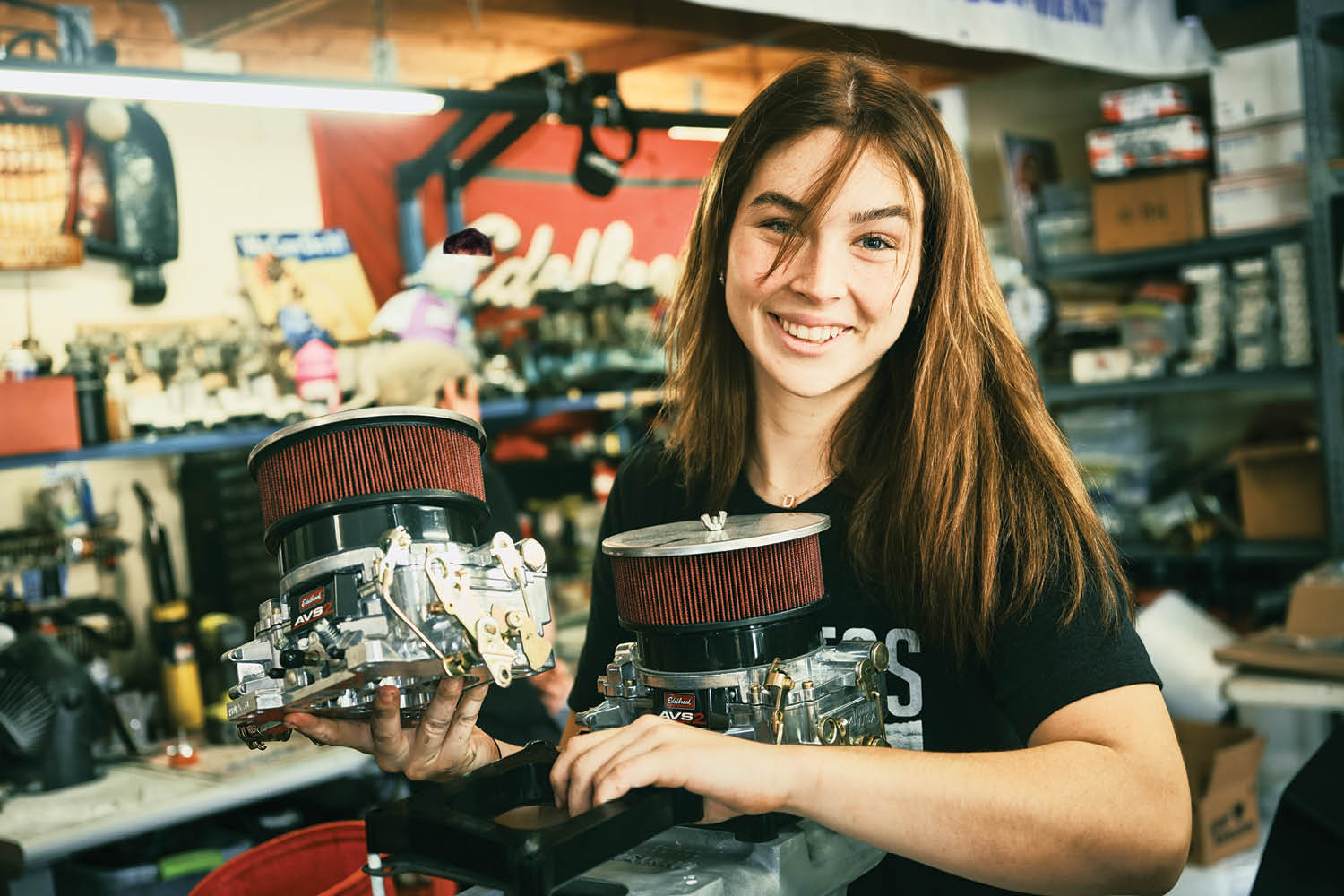
Riley Schlick-Trask ’27 holding engine parts in a garage

Carburetor Queen

Riley Schlick-Trask ’27 inspires a new generation of gearheads and classic car enthusiasts.

By Tim Stevens ’03

W

hen Riley Schlick-Trask ’27 was just 13—still years away from a driver’s license—she told her dad she wanted her own car. 

Schlick-Trask had grown up watching (and occasionally helping) her dad work on his classic cars in their home garage in Bradenton, Florida. So, Dane Trask didn’t discourage his daughter, but he did point out a pesky reality. “He reminded me that I didn’t have any money,” Schlick-Trask recalls. “In Florida you can’t work until you are 14, and even then I’d only earn minimum wage—$8.25 an hour at the time. My dad always had these car projects in the garage, so he said, ‘Go pick something out, finish it up, clean it up and flip it.’”

On the shelves, Schlick-Trask was thrilled to find an old carburetor, a device that controls the mix of air and fuel entering a gasoline internal combustion engine. While largely replaced in cars and trucks during the 1990s by fuel injectors, they remain a popular way for burgeoning gearheads to practice the skills of classic car repair—and there’s a market for refurbished ones online. With some guidance from her father, Schlick-Trask rebuilt the carburetor and sold it online.

She was hooked. 

“I was on the travel soccer team and we’d play all over Florida, Georgia, into the upper states,” she says. “Wherever we went, I’d go pick up carburetors from Facebook Marketplace. Within the first year, I made enough money to buy my first car, a 1995 YJ—the Jurassic Park Jeep. That was just as COVID hit, so my dad and I put all this time into it and it was ready to drive before I was even able to start learning with my learner’s permit.”

By this point, Schlick-Trask had bought up all the local carburetors she could find, so, as Gen Zers often do, she turned to social media. Her post requesting old “carbs” went viral, and soon she had more to refurbish than she could handle herself. At 14, she officially launched her own business, Riley’s Rebuilds, and recruited and trained four other teen girls to help. 

Six years later, Riley’s Rebuilds is still going strong, with the team flipping 750 carburetors last year and averaging over a dozen a week in the Florida shop—all while Schlick-Trask balances running a company with full-time studies at Conn. 
I have 100,000 grandfathers and followers who want to see me succeed.

­— Riley Schlick-Trask ’27

Carbs to Conn

While it may have made sense for Schlick-Trask to stick close to home for college, the young entrepreneur had other ideas. She was eager to experience a new region and political environment, and she found her place at Conn after attending an overnight scouting soccer camp on campus. 

“I loved it. I loved [Head Women’s Soccer] Coach Norm Riker. I loved Assistant Coach Mia Hernandez ’20.”

Importantly, Schlick-Trask says she was looking for a community that wouldn’t make her choose among her studies, her sport and her business.   

“Riley’s Rebuilds was really starting to take off. And Coach promised, ‘We’ll figure it out. We’ll get you a spot in a building so you can keep it up.’ After that, it just felt so natural to choose here,” she says. 

Now in her junior year, Schlick-Trask is majoring in physics with a minor in mathematics and participating in the Washington University in St. Louis Dual Degree Program in mechanical engineering. Through the partnership, students complete three or four years of study at Conn followed by two years of study at Washington University, with the goal of graduating “liberally educated engineers” with strong communication and problem-solving skills, a broad background in the humanities and social sciences, and a high-quality technical education.

Schlick-Trask says she has loved exploring the liberal arts, enjoys Conn’s low student-to-professor ratio and appreciates the support she receives as a student with dyslexia and ADHD.

“I’ve made really great friends; I have a really great community here. So far, this has been my best year here yet.”

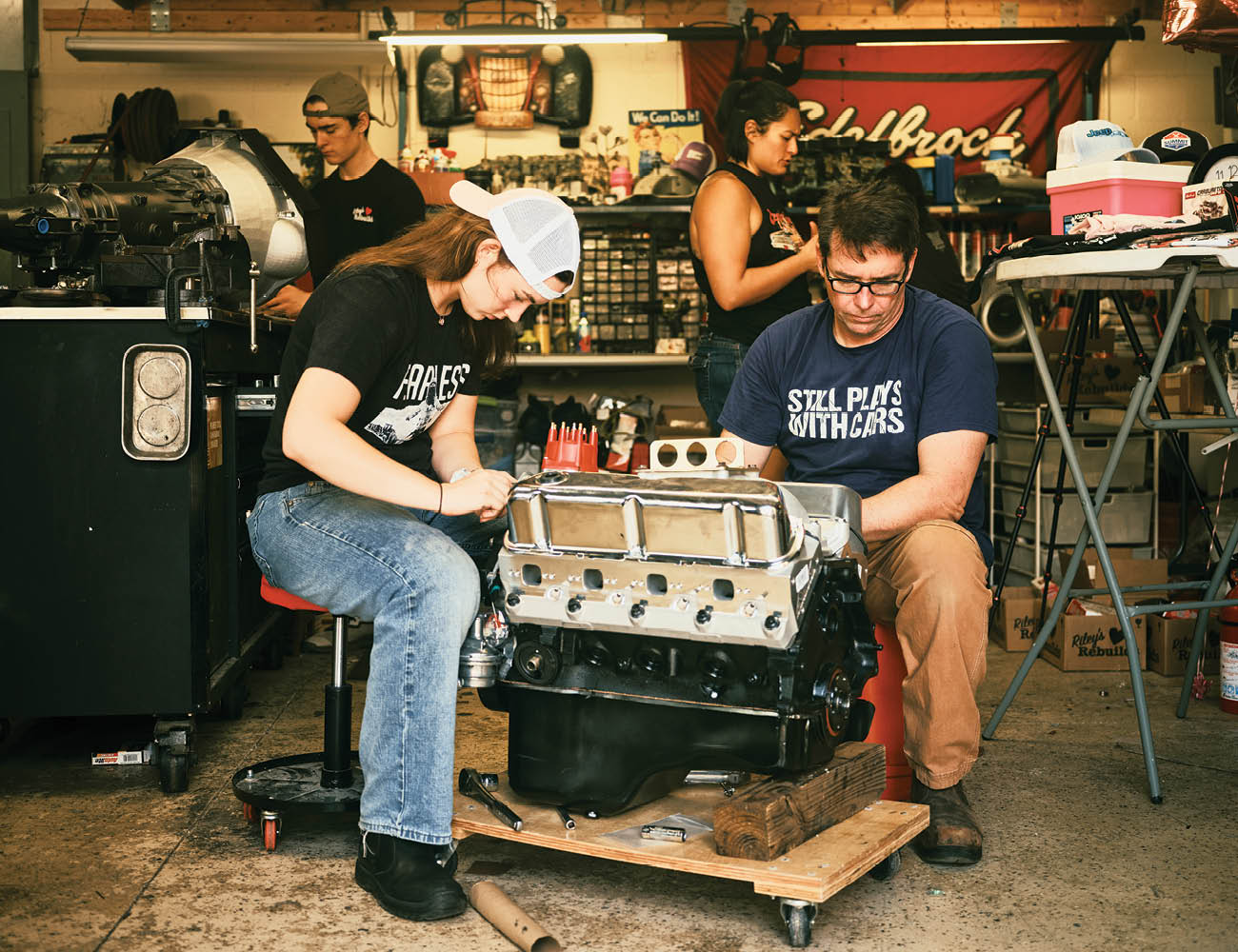
Riley Schlick-Trask ’27 and her father, Dane Trask, work on a Ford small-block V8 engine.
Riley Schlick-Trask ’27 and her father, Dane Trask, work on a Ford small-block V-8 while other members of the Riley’s Rebuilds team tackle other projects.

Rebuilds, Restorations and Races

At the same time, Riley’s Rebuilds continues to grow and expand, with Schlick-Trask managing from afar. 

“When my friends and I left for college, I recruited high schoolers from my town and surrounding towns to work on the business,” she says. “My brother, who’s 16, is the floor manager. He took over a lot of the carb grab, carb delivery and carb cleaning process, and I run supplies, customer service and social media from here.”

In the old days, Schlick-Trask had to track down carburetors to rebuild and flip. Now, customers send them directly to the business—from all around the world—to be fixed and returned. Additionally, the company has attracted multiple collaborations and often features sponsored parts in their social posts and videos.  

The team has also branched out into classic car rebuilds, recently restoring a 1957 Chevrolet “Showmad,” a modified Nomad show car that Chevy had once displayed at car shows in major cities. And with the success of her social media channels, Schlick-Trask has become a spokesperson for a new generation of classic car enthusiasts. She’s traveled across the country to speak at high schools, trade schools and industry events, and, in 2023, she was honored with the SEMA Businesswomen’s Network’s Jessi Combs Rising Star Award, which recognizes a woman under the age of 30 who is making significant strides in the advancement of her automotive aftermarket career. She and her dad also partnered with Hemmings Motor News for a “Repair 2 Rev” video series, and she is the spokesperson for the manufacturing division of the Great Race, an annual controlled-speed endurance road rally for pre-1974 vintage and collector cars. 

Over the summer, Schlick-Trask competed in the Great Race for the first time, traveling more than 2,300 miles across seven states and finishing second in the Rookie Division. 

“It’s a time and speed precision rally on open roads. You have no digital anything. You have to stay precisely to the speed limit that your paper instructs for these 10-hour days. But you also then have to calculate your acceleration, your deceleration. It’s a lot of fun,” she says. “Last year during the race, I invited 12 automotive influencer women to join us as I drove a corporate-sponsored Corvette. We had over nine million interactions in nine days. It was the most engagement that the race had had online since they started.” 

Schlick-Trask will participate in the race again this summer, after completing a semester of study abroad in New Zealand this spring. 

I would like to morph Riley’s Rebuilds toward teaching young women and younger people the craft, creating that environment of encouragement.

­— Riley Schlick-Trask ’27

“I have this 1966 Ford Fairlane I’ll be finishing up just before I leave for New Zealand, and the race will happen right after I get back,” she says. In the meantime, she’s working on an ambitious publicity plan.

“There can be an Edelbrock car or a Summit Racing car, for example, and they pick their own influencers to run the race,” she explains. “It allows the sponsors and influencers to work together in various ways. It’s been a huge project for me to pull together.”

She also has another race on the horizon, Summit Racing’s Drag & Drive speed event. She is hoping to build a nine-second car (a street-legal vehicle built to run a quarter mile in less than 10 seconds), which would put her near the “top-notch Mustangs or Dodge Challengers.” 

While she continues to make her mark in a decidedly male-dominated world, Schlick-Trask says she has largely been welcomed with open arms. 

“Being a young woman in the classic car industry would seem like a minefield, but it is not,” she told SEMA Businesswomen’s Network. “I have 100,000 grandfathers and followers who want to see me succeed.”

And what does success look like for the trailblazing automotive enthusiast? Schlick-Trask is keeping her options open.

“I’ve been offered positions with car companies already,” she says. “But I would always want to have Riley’s Rebuilds. Is it in its final form now? Definitely not. I think I would like to morph it toward teaching young women and younger people the craft, creating that environment of encouragement. That’s my goal, and I’m ready to do whatever gets me there.”

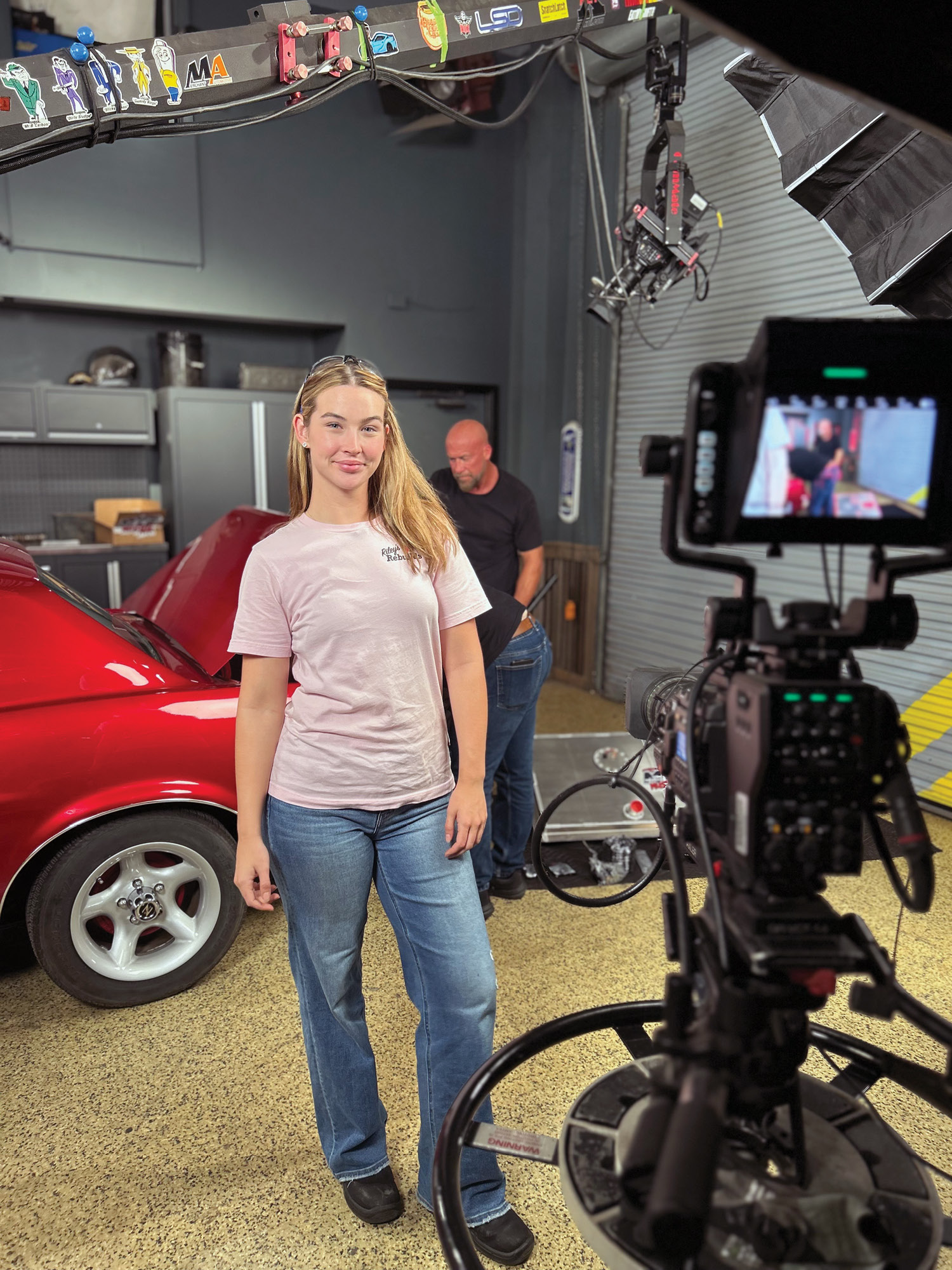
Riley Schlick-Trask ’27 in front of a television camera

Being a young woman in the classic car industry would seem like a minefield, but it is not.

­— Riley Schlick-Trask ’27


  • Make a Gift
  • Contact Us
  • Alumni Association
  • News & Media Hub
  • Update Your Address