Ghost in the iPhone
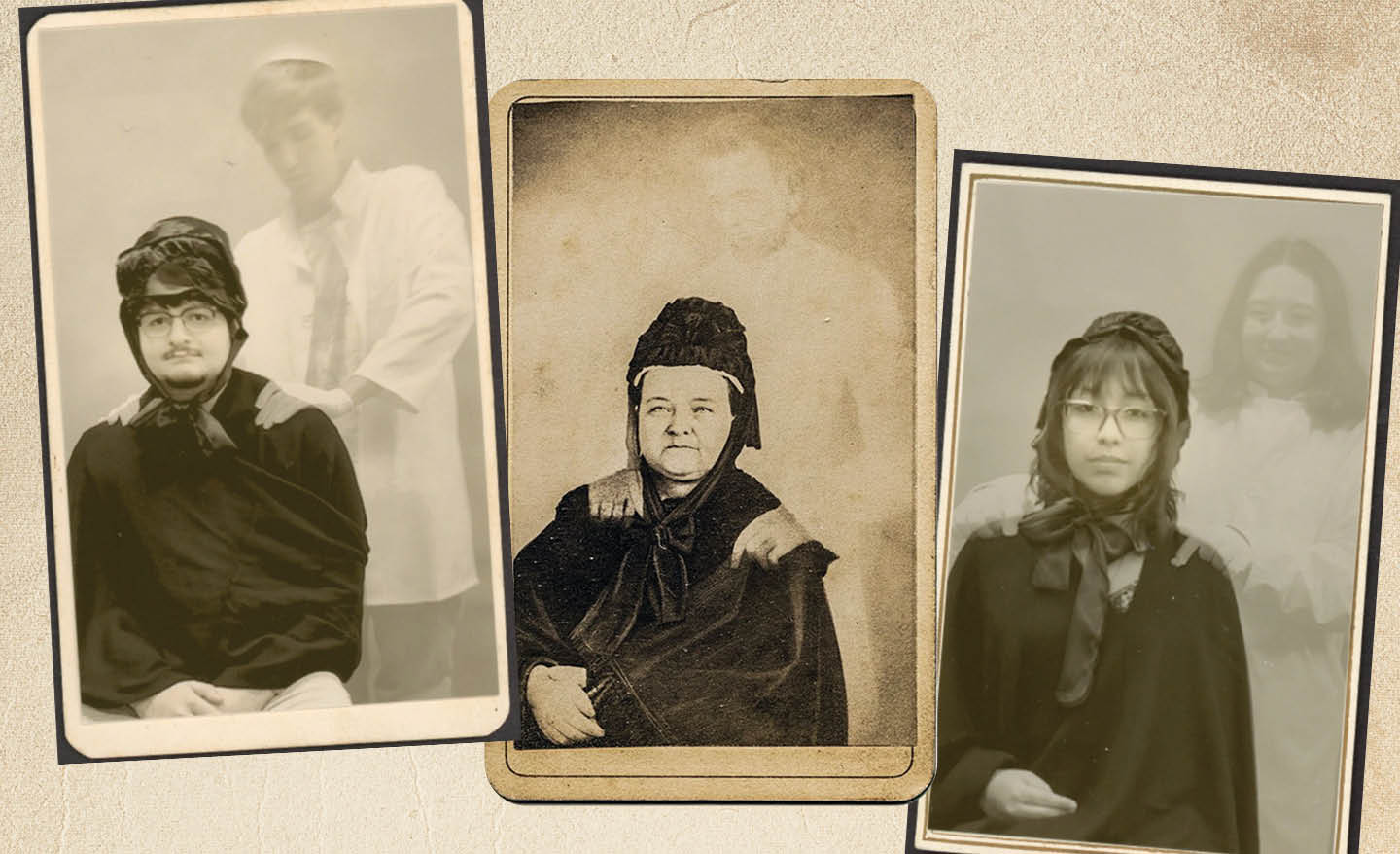
Photography students use modern technology to recreate a famous historic photograph.
In the 1860s, an American photographer named William H. Mumler (1832–1884) became known for his so-called “spirit photographs”—portraits that appeared to show faint, ghostly images of deceased loved ones hovering beside or behind the living sitters.
Mumler began as a Boston jewelry engraver and amateur photographer. Around 1861, while experimenting with a self-portrait, he “accidentally” produced a second, faint image on the same glass plate. Believing (or claiming) that this was the spirit of a dead cousin, he showed the image to friends and colleagues, and soon word spread that Mumler could photograph the dead. At the time, the U.S. was entering the Civil War and American spiritualism was rapidly growing. Mumler’s Boston studio quickly filled with grieving clients hoping for a last glimpse to reconnect with lost relatives.
Skeptics accused Mumler of perpetuating a fraud or hoax, and in 1869 he was tried in New York City for “obtaining money under false pretenses.” Expert witnesses, including showman P.T. Barnum, testified that Mumler’s effects could be easily faked. After a sensational trial that grabbed daily headlines in the New York tabloids, the judge ruled that although there was significant suspicion, the prosecution had failed to meet the burden of proof. Mumler was acquitted largely because there was insufficient evidence to demonstrate which exact method of photographic trickery he may have used to produce the spirit photographs.
According to Mark Osterman, a photographic process historian at the George Eastman Museum, Mumler most likely created the spirit photos by inserting a second glass negative during the printing process. Like most portrait photographers at the time, Mumler printed his photos on albumen—a specially treated paper that, when placed against a glass negative in a printing box and exposed to light, results in a positive print. Osterman believes that after passing the original negative around to show witnesses there was no trickery, with a bit of sleight-of-hand Mumler could have slipped the ghost negative underneath the portrait negative. Assuming this is how it was done, Mumler would likely have had a collection of already-made “spirit” negatives, and could line up the sitter with a “ghost” that matched the general appearance of their lost loved one.
In February 1872, while still mourning the death of her husband, Abraham Lincoln, who had been assassinated seven years earlier, Mary Todd Lincoln paid a visit to Mumler’s Boston studio. Despite being a lifelong Christian, Mary Todd Lincoln turned to Spiritualism after the tragic death of her son, William, in 1862. When she posed for her portrait by Mumler, she had full knowledge of his prosecution in 1869. But she still firmly believed in the validity of his photographs, and she hoped his photograph would reveal the ghost of her dead husband.
According to the story, Mary Todd Lincoln visited Mumler in disguise, wearing a black veil and using a fake name. The resulting photograph showed a faint, white figure who looked like Abraham Lincoln standing behind her with his hands on her shoulders. Mumler claimed that it wasn’t until after the photograph had been developed and printed that he became aware that his subject was the widow of the assassinated president.
In the fall of 2025, Connecticut College students in my “Perspectives on Photography” course had an opportunity to recreate the visual effect Mumler used for his famous photograph—using only an iPhone.
After some trial and error, I settled on using Spectre, a long-exposure camera app developed by Lux Optics Incorporated and launched for iPhone in 2019. The app does not keep the camera’s shutter open continuously, like a traditional long exposure on a film camera, but instead simulates the effect of a long exposure by using AI to determine how much each pixel should contribute to the final long-exposure blend.
The app captures hundreds of short-exposure frames over several seconds. To recreate the spirit photograph, the person representing Mary Todd Lincoln sat motionless for 30 seconds; while the “ghost” remained in the frame for only 10 seconds, and then moved quickly out. To enhance the effect, “Mary Todd Lincoln” wore a black shawl and a hat approximating the appearance of the original, and the “ghost” wore a white lab coat and white cotton gloves.
Once the sequence is aligned, the app blends the frames using a temporal averaging algorithm. Pixels that stay in the same place across frames (in this case the motionless figure of “Mary Todd Lincoln”) is reinforced (or fully exposed), while pixels that change position over time (the “ghost”) are less exposed and slightly blurred. Thus, the result is a single composite image that mimics the look of a long shutter exposure: Moving objects disappear or turn into light streaks, while static ones remain crisp and clear.
Mumler, of course, did not use a long-exposure technique to create his spirit photographs. Since the whole point of spirit photography was to trick the portrait sitter into believing that the photograph had unwittingly captured a ghostly presence invisible to the unaided eye, having a person walk into the frame for 10 seconds would have immediately revealed the trickery and deceit.
But the use of long exposures to create ghostly effects in photographic images was already prevalent in the 1850s, when photographers became aware that long exposure times and movement during exposure sometimes caused faint, ghost-like images to appear unintentionally in photographs. Sir David Brewster, a Scottish physicist, inventor and writer, was among the early scientists to recognize and comment on how such optical artifacts could produce spirit images. The effect came to be known as “Sir David Brewster’s Ghost.” In 1896, Walter Woodbury described the technique in detail in his book Photographic Amusements, Including a Description of a Number of Novel Effects Obtainable with a Camera.
“It is a very simple matter to make quite convincing ghost pictures … We must first prepare our ‘ghost’ by dressing someone in a white sheet. Then we pose the sitter and the ghost in appropriate attitudes and give part of the required exposure. Then, leaving everything else just as it is, we remove the ghost and complete the exposure. On developing the film, we find the sitter and the background properly exposed and only a rather faint image of the ghost, with objects behind it showing through on account of the double exposure,” wrote Woodbury.
By restaging Mumler’s spirit portrait of Mary Todd Lincoln and the ghost of her deceased husband, students in “Perspectives on Photography” engaged in an innovative embodied learning experience with both physical and sensory awareness. The project offered an opportunity to enter the mindset of 19th-century sitters and photographers: the ritualized poses, the slow exposure, the aura of solemnity and spectacle. And by using a modern technological tool to simulate 19th-century spirit photography, students gained a better understanding of the continuity between Victorian photographic trickery and today’s digital manipulation.