Plucked From the Archives
A collection of instructive books for women donated by Pamela Mendelsohn ’66 is on display.
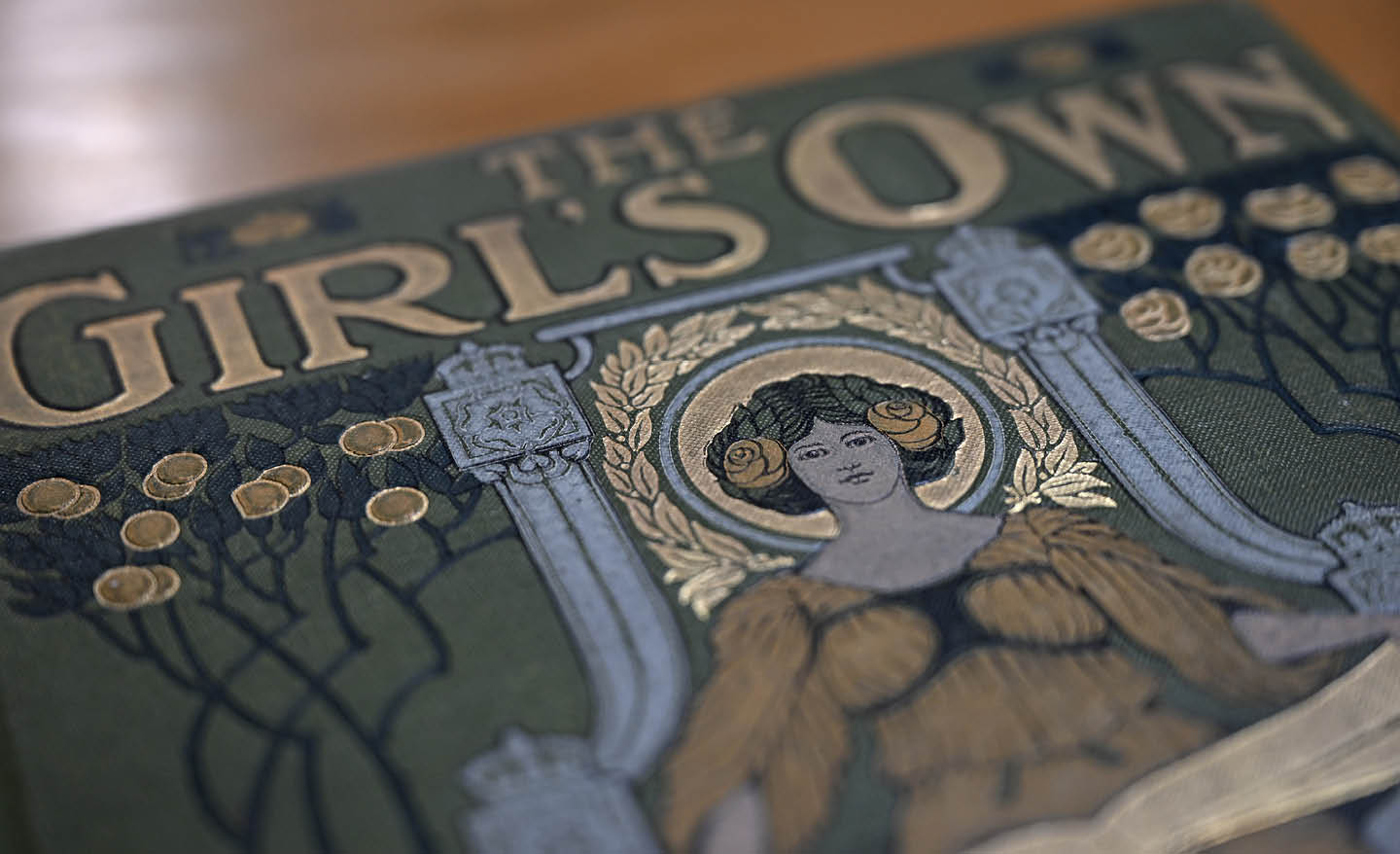
In 2023, Pamela Mendelsohn ’66 donated a collection of instruction books for women to the Linda Lear Center for Special Collections & Archives in memory of her life partner, Peter E. Palmquist, and her mother, Stella Levine Mendelsohn, a member of the Class of 1925. The collection, which will be on display in the Charles E. Shain Library from late April through the end of May, includes 317 volumes published between 1790 and 1950, with the bulk of the collection dating from the Victorian Era.
One book, Live Alone and Like It by Marjorie Hillis, opens with a chapter titled “Solitary Refinement.” Hillis sets expectations from the first sentence: “This book is no brief in favor of living alone. Five out of ten of the people who do so can’t help themselves and at least three of the others are irritatingly selfish. But,” she acknowledges, “the chances are that at some time in your life, possibly only now and then between husbands, you will find yourself settling down to a solitary existence.”
When the book was published in 1936, an increasing number of women were starting to live alone by choice. Marriage rates declined by almost 22% in the decade following the stock market crash of 1929 as severe economic hardship meant many men couldn’t support a family and lots of women had to look for work, according to the Center for Disease Control’s National Center for Health Statistics.
But in 1874, singlehood wasn’t much of an option for women. The 1870 U.S. census reports that only 13% to 16% of women age 10 or older were part of the paid labor force. In The Ugly-Girl Papers, published that year, Susan Dunning Power tells women how to improve their appearance through methods like using a mix of tar and olive oil on their faces to appear younger. “The skin comes out, after several applications, soft, moist, and tinted like a baby’s.” The content began as a series of advice columns in the monthly women’s fashion magazine Harper’s Bazaar, which is still in print today.
Catching a man’s eye in 1918 wasn’t quite as crucial. During World War I, which ended that year, marriage rates declined and women’s employment surged as many men fought overseas. In Physical Beauty: How to Keep It, Annette Kellerman, a professional swimmer who hated corsets, explores being beautiful from the inside out through strength and physical fitness, qualities that were not associated with women of the Victorian Era, which had just ended.
Kellerman writes, “The more intellectual women of today recognize that they can no longer make pretty clothes and nicely powdered noses take the place of genuine bodily beauty. … [They] must possess that invisible inward beauty of health that is the basis of all visible outward beauty of face and form.”
Even today, fashion magazines like Vogue, which has been around since 1892, and Seventeen, first published in 1944, offer up beauty and fitness tips for their female readers. But mass guidance like this dates back to the Middle Ages.
“Instructional texts have been used in the ideal formation of girls and women since the late 13th century,” says Bailey Rodgers, the Linda Lear special collections librarian at Conn. “Written from various perspectives, topics include nearly every aspect of a woman’s physical, social, emotional and personal life. What may come across today as nonsensical was often highly valued advice when these books were published and circulated. The opinions expressed reflect the cultural attitudes of the general public and provide insight to the ubiquitous challenges that women have faced throughout history.”