Ink
The latest alumni and faculty books in print.
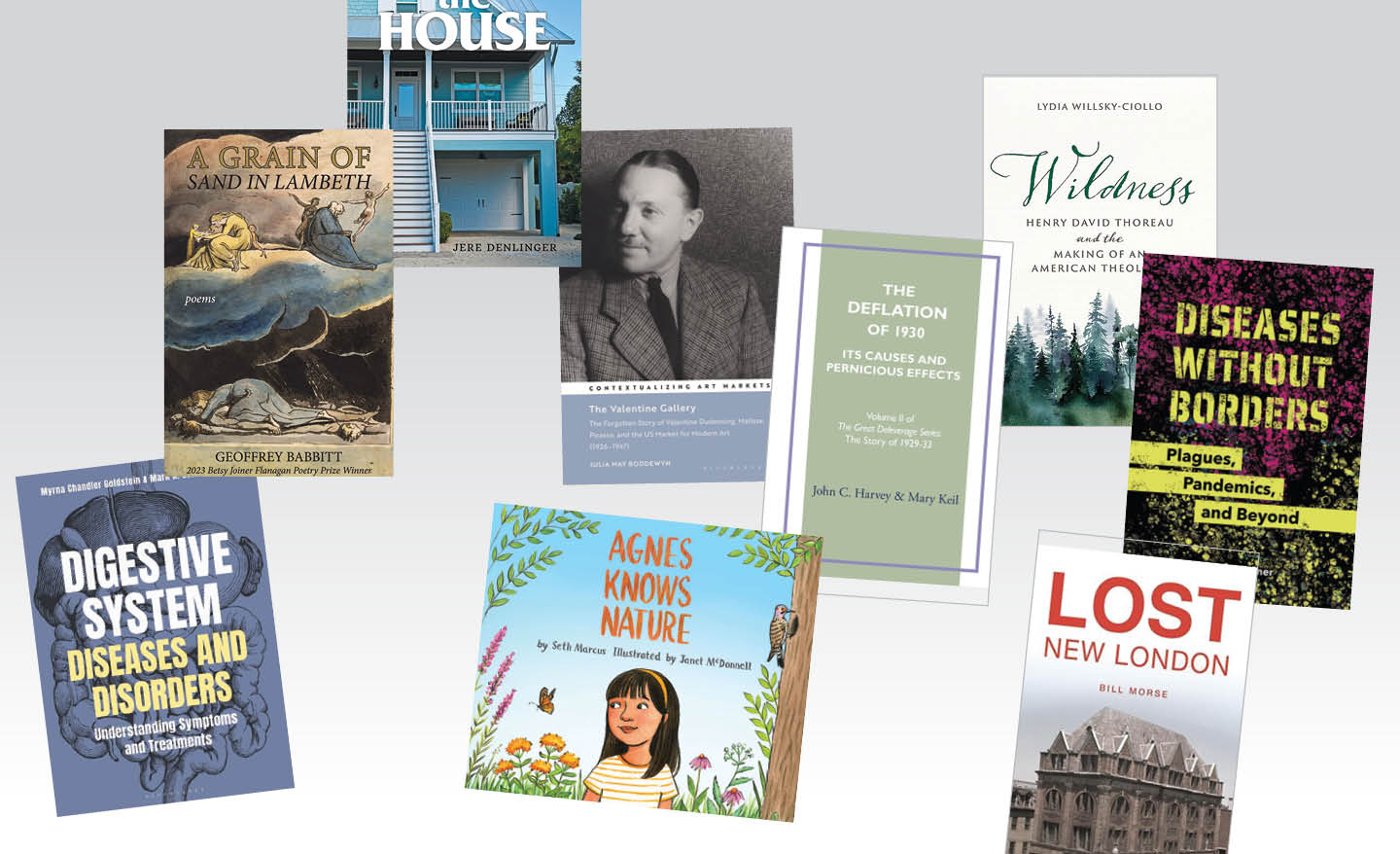
A Grain of Sand in Lambeth
By Geoffrey Babbitt ’03
In this collection, poetry becomes a lens through which to explore the complex, visionary world of William Blake. Drawing on Blake’s own rejection of tradition and his relentless quest to challenge the boundaries of art, Babbitt confronts the tensions between genius and convention, life and death, light and dark. From his visionary watercolors to his provocative views on oil painting, these poems draw readers into Blake’s world, where reality and the unseen converge in prismatic intensity.
The Valentine Gallery: The Forgotten Story of Valentine Dudensing, Matisse, Picasso, and the US Market for Modern Art (1926–1947)
By Julia May Boddewyn ’86
Drawing on a wealth of primary source materials, including long-lost sales records, The Valentine Gallery unearths the story of this preeminent forum for modern art, revealing how pioneering New York gallerist Valentine Dudensing (1892-1967) brought the School of Paris to eminence in the U.S. and ultimately changed the country’s artistic taste forever. Despite its preeminent reputation as a leading center for modern art for over two decades, the Valentine Gallery name has been lost to history; this is the first book to examine the key role Dudensing played in shaping the canon of modern art in America.
Digestive System Diseases and Disorders: Understanding Symptoms and Treatments
By Myrna Chandler Goldstein ’70 and Mark A. Goldstein
This book explores 30 serious conditions affecting the digestive system, including autoimmune disorders such as celiac disease and ulcerative colitis, cancers, chronic conditions like irritable bowel syndrome (IBS), stomach flu and other infections, and more. Utilizing a standardized structure, each entry discusses a particular condition’s causes, prevalence, symptoms, potential complications, diagnosis and treatment options. Summaries of key research studies are included to help readers better understand the scientific community’s findings about each condition.
Building the House
By Jere Denlinger ’75
A family therapist is in the storm of his life with home, work and health crises, including job loss and marital strain, when he meets a young woman at an Arby’s drive-through. They begin a complex friendship that threatens to further derail his life. The book explores themes of faith, family and relationships through the protagonist’s struggles with his career, his marriage and his unexpected mentorship of a troubled young friend.
The Deflation of 1930: Its Causes and Pernicious Effects
By John C. Harvey and Mary Keil ’70
The second volume of The Great Deleverage Series explores in depth the economic events of a year that was the quintessential example from U.S. history when deflationary forces became unleashed. Deflation, the authors argue, is not inflation in reverse, but rather its own powerfully damaging force that erases wealth in large gulps. The year 1930 was not only eventful but pivotal, as the dynamic of the Great Depression, with its accompanying deflation, took hold in the imagination of the American psyche and dramatically changed economic behavior. This work exposes the potentially catastrophic effects of deflation allowed to continue unabated.
Agnes Knows Nature
By Seth Marcus ’80
Join Agnes and her mother on a nature walk as she discovers the captivating sights and sounds of a vibrant prairie wetland. Generally intended for children 4 to 8 years old, this delightful picture book can be enjoyed by all ages. The story ends with a fun “search and find” scene featuring all of the plants and animals Agnes met on her walk, followed by a brief guide with photos and fun facts about the species.
Lost New London
By William “Bill” Morse ’80
On April 30, 1962, voters in the port city of New London, Connecticut, approved by a large margin a bulldozer approach to urban renewal in an area along Main Street stretching from downtown State Street to Hodges Square by Interstate 95, roughly one mile to the north. The plan required the relocation of more than two thousand people and the demolition of nearly five hundred structures, some dating back to the 1750s. Among the losses were the Neptune Building, the Victory Theater along the Parade, sea captains’ homes on and off Main Street, settlement houses, family-run businesses, the colonial homes of slave traders and the newer homes of freed slaves. A New London native and old-house enthusiast, Morse shares the images and stories from these events that changed a community forever.
Wildness: Henry David Thoreau and the Making of an American Theology
By Lydia Willsky-Ciollo ’05
In and through his experience of nature, Henry David Thoreau imagined and developed a distinctly American theology of the wild. During Thoreau’s post-college years and his time at Walden Pond, he evolved from hopeful writer to observant theologian whose primary work as a surveyor enabled his theological vocation. Willsky-Ciollo skillfully guides readers through Thoreau’s writings and life as his theology emerges and evolves. The focus of Thoreau’s theology—wildness itself—centers on the divinity extant in every person and in every molecule of creation.
Diseases Without Borders: Plagues, Pandemics and Beyond
By Marc Zimmer, Jean C. Tempel ’65 Professor of Chemistry
From the infamous Black Death to the 1918 flu to COVID-19, disease outbreaks have always marked human history. But where they spread, how they spread, and how fast they move have all changed. In this book, written for students in grades 6-12, readers will explore several major diseases that have crossed international borders throughout time, including their causes, symptoms, treatments, modern status, and what major factors contributed to their spread.
Publish a book? Send Ink submissions to ccmag@conncoll.edu.