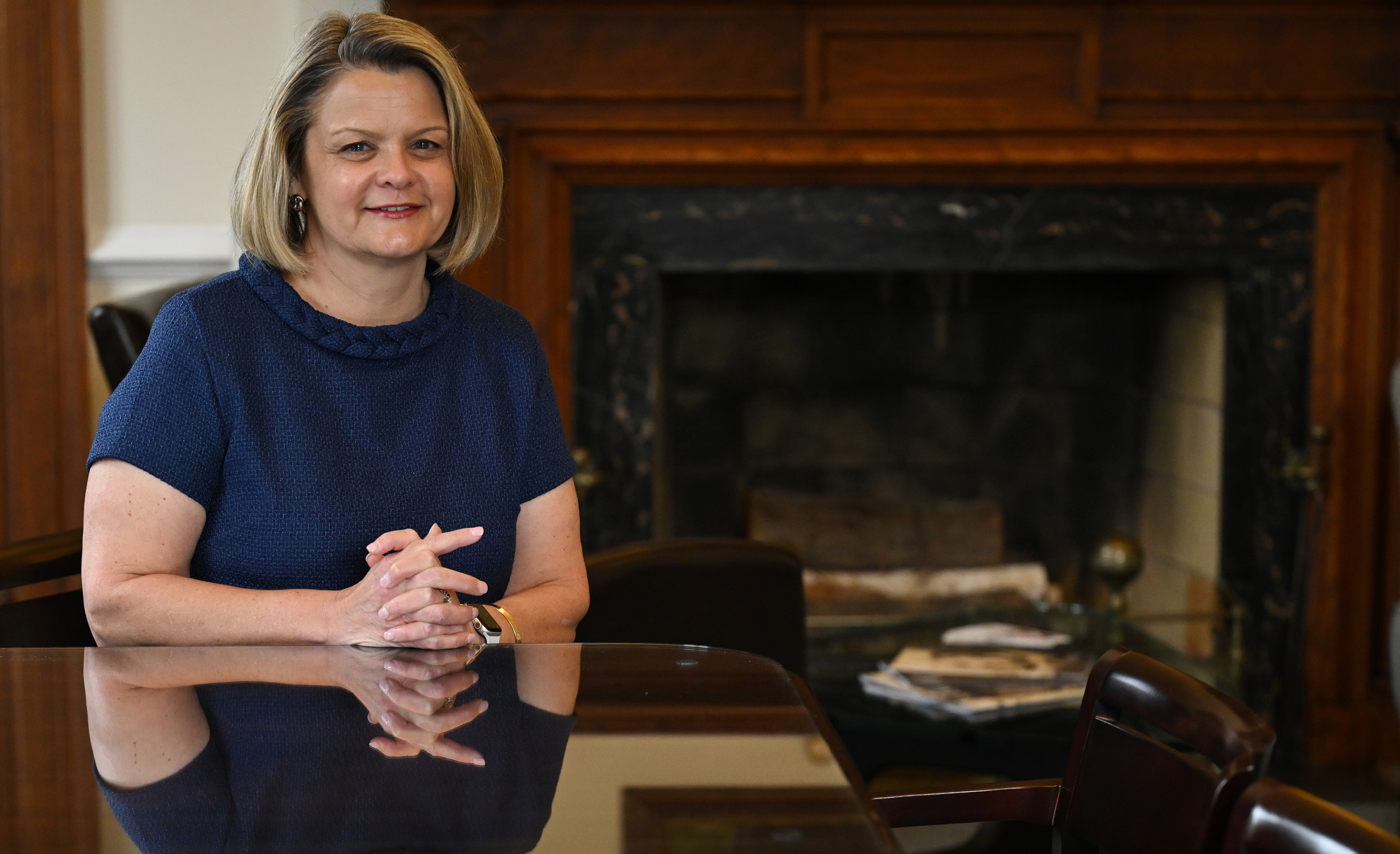
From the President
A letter from President Andrea E. Chapdelaine, Ph.D.
This issue of CC Magazine offers a panoramic view of what a Connecticut College education makes possible, not only in the classroom, but across a lifetime. It also marks an important anniversary. Ten years ago, Conn’s faculty launched Connections, a reimagining of the liberal arts curriculum grounded in the College’s mission and built around a simple but powerful idea: Students learn best when they are the authors of their own education.
In many ways, Connections captures what has always been at the core of a Conn education. During your time at Conn, if you found yourself pursuing a question you hadn’t expected to ask, or discovered an area of study you hadn’t anticipated, you already know the possibilities revealed through Connections.
Connections allows students to chart an educational course through a curriculum that is uniquely their own. Students do not simply move through a set of requirements. Their own interests and questions carry them across disciplines, into faculty-mentored research, global service and internships, and toward an integrative project that demonstrates not just what they have learned, but how they think. Research consistently shows that personalized, experiential, interdisciplinary education, grounded in a liberal arts foundation and anchored by strong mentoring relationships, results in deep and holistic learning that leads to a lifetime of professional success and personal growth and fulfillment. The recent graduates in “Learn What You Love” powerfully demonstrate that.
I’m excited for you to meet Roman Perrotto ’26, who arrived studying Spanish and left having conducted original research, in Japanese, on intergenerational trauma among atomic bomb survivors in Hiroshima; Anna Taylor ’26, who turned a hesitation about Classics into a thesis on how political extremists weaponize ancient history; and Rita D’Agostino ’26 and Declan Hunter ’26, whose paths wound through courtrooms, endangered rivers and communities they felt called to serve.
As the stories in these pages illuminate, Conn has long been a place where unexpected connections become defining ones, unlocking passions, potential and purpose. In “Fresh Pours,” you’ll see how Adam Romanow ’07, Rose Schweikhart ’04, Conor Quilty ’15 and Ayla Bystrom-Williams ’07 have forged creative and entrepreneurial careers in industries that reward experimentation and resilience, each following a road no one could have predicted from their first days on campus. In “Down the Rabbit Hole,” Patty Reilly ’75 reminds us how a life of consequence can keep evolving, from immunology research at Yale and Harvard to establishing a wildlife rehabilitation center and leading a 475-member statewide organization dedicated to protecting the animals that share our ecosystem.
You will also read about alumni and faculty who are shaping communities, advancing knowledge and challenging assumptions, reflecting lives of engagement and impact.
Connections is not only about academic excellence, although that foundation is essential. It fundamentally prepares students to live and work with intention, to integrate knowledge, adapt to change and contribute substantively in whatever direction they choose, wherever it may lead.
For many of you, the moment of discovery—when a question led somewhere unexpected and an unimagined alternative suddenly came into focus—happened organically. Connections is designed to ensure it happens intentionally, for every student who walks through our doors.
In 2016, Connections was a bold and innovative reimagining of the curriculum by Conn faculty to put the liberal arts into action. Now, we envision expanding access to this level of dynamic learning for all students. Whether it be serving as a mentor, offering an internship or contributing resources that support our students as they chart their own Connections course, we invite your engagement and support.
Thank you for your continued engagement. It is a reminder that a Conn education doesn’t end with graduation, and neither do the connections it creates.
Warmly,
Andrea E. Chapdelaine, Ph.D.
Spring 2026