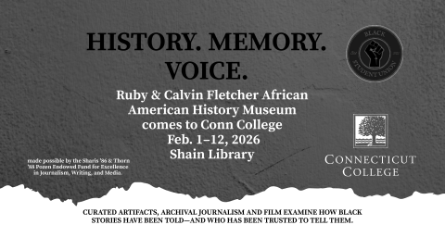
NEW LONDON, Conn. — Connecticut College will host a two-week installation from the Ruby & Calvin Fletcher African American History Museum, Connecticut’s first and only African American history museum, from Feb. 1–12, 2026. The exhibition is presented in partnership with Connecticut College’s Black Student Union (BSU) and made possible by the Sharis ’86 & Thorn ’88 Pozen Endowed Fund for Excellence in Journalism, Writing, and Media.
The installation features curated artifacts, archival journalism and film that examine how Black stories have been told—and who has been trusted to tell them. From preserved objects to powerful media moments, the exhibit invites visitors to slow down, look closely, and reflect on representation, memory and voice.
“This is more than a display. It’s an opportunity for our community to engage with how stories are preserved, whose voices are amplified, and what it means when history is told by those who lived it,” said Kyaira Hall, co-president of the Black Student Union.
Opening Reception and Special Documentary Screening
The exhibition opens with a public reception on Monday, Feb. 2, at 4 p.m. in the Chu Room, located in Shain Library.
The event includes a screening of a rare 45-minute documentary featuring never-before-seen footage of Dr. Martin Luther King Jr., chronicling his life from his early involvement in the Civil Rights Movement through his final year.
The footage was discovered in a film canister marked only with the initials “MLK” and has no formal title, credits or music. The uncut documentary is narrated by a photojournalist who chronicled Dr. King’s life in real time, offering an intimate, unfiltered perspective on one of history’s most documented figures.
Jeffrey Fletcher, founder and owner of the Ruby & Calvin Fletcher African American History Museum, will present the screening and provide context and remarks.
Public Conversation With Journalists
The exhibition also anchors a public conversation hosted by the Black Student Union on Wednesday, Feb. 11, beginning at 4 p.m. in the Chu Room.
Titled “Telling Our Stories: A Conversation with Journalists,” the event brings together award-winning journalists Eric Sellers of ESPN, Richard Washington III of CBS News, Jason Frazer of Drizzle Weather and Romney Smith of NBC 4 New York.
The conversation will explore reporting, media ethics, representation and the responsibility that comes with telling Black stories in today’s media landscape, building on the exhibition’s focus on journalism, storytelling and voice through lived experience and professional practice. Jeff Strabone, coordinator of the Media, Rhetoric and Communications pathway, will help moderate the discussion.
About the Museum and Support
The Ruby & Calvin Fletcher African American History Museum is dedicated to preserving and presenting African American history and culture. Its collection includes artifacts, documents, photographs and media that chronicle the Black experience in Connecticut and beyond.
The Sharis ’86 & Thorn ’88 Pozen Endowed Fund for Excellence in Journalism, Writing, and Media supports creative writing, journalism, media and journalistic ethics at Connecticut College.
The exhibition and related events are free and open to the public.
Exhibition details:
Location: Charles E. Shain Library, Entry Level Lobby Foyer
Hours: 8:30 a.m.–5 p.m.