

Connecticut College
  • About Connecticut College
  • Academics
  • Admission & Financial Aid
  • Alumni & Life After Conn
  • Athletics
  • Campus & Community
  • Career Preparation
  • Human Resources
  • Student Experience
  • Calendar
  • News
  • Directory
  • Libraries & Technology
  • CC Magazine
  • Site Map
CamelWeb

Media, Rhetoric and Communication

Mathematics-Department

Media, Rhetoric and Communication

Connections

View All Pathways

Pathway Requirements

Majors and Minors

  • Home 
  • Home 
  • Slides 
  • Media Pathway mockup

Explore how the presentation of information is used to protect and challenge institutions of power.

In today's world of social media and 24-hour news cycles, more information is available to more people than ever before. Yet, in many ways, analyzing this barrage of information to make informed conclusions has never been more difficult, or more important.

In this Pathway, students will learn to think critically about media, rhetoric, communication, information and visual culture, and learn to communicate ethically and effectively through a variety of media. This Pathway poses important questions about how we collect, analyze and disseminate information, including: How does one recognize when information is being used to advance narrow interests? How does ownership of media affect the interpretation and framing of controversy? How do particular technologies impact access to information? How have advertising, marketing and branding affected our perceptions and choices? How does one participate in public conversations to achieve desired policy goals?

While students construct their own animating questions, some possible examples include:

  • How does one recognize when information is being used to advance narrow interests?
  • How does ownership of information media affect the interpretation and framing of controversy?
  • How do particular media technologies impact access to and dissemination of information?
  • What influence do media technologies have on our perception of reality, and what are the consequences of altered and multiple realities?
  • How have advertising, marketing, and branding affected our perceptions and choices?
  • More personally, how does one intervene in public conversations to achieve desired policy goals?
Headshot of Meredith Harper, Class of

Meredith Harper

A human development and English double major, Meredith joined the Media, Rhetoric and Communications Pathway to sharpen her writing and communications skills and learn more about the influence of media.

Originally from Austin, Texas, Meredith was studying abroad in Italy last spring while the country was in the midst of privacy debates concerning TikTok and ChatGPT regulations.

“After observing Italy’s take on the topic, I was interested in comparing and contrasting the U.S. regulations on privacy and how this affects people on an individual level,” she said.

“I believe the stories we tell are the stories that define us. They will extend past us, and contribute to the ones before us. To share a narrative is to learn deeply about people. But what happens when these narratives get convoluted by public influence and misinformation? What’s the cost of having the media curate your life for you? While we love the benefit of the pop-up ads on our Instagram immediately following a conversation that briefly mentioned that Starbucks latte, is convenience worth the cost of our privacy? What is the limit of this curation, and what power do I have as the consumer? How can I control my life and narrative with Big Brother watching?”

The winner of the Pozen Prize for Excellence in Journalism, Meredith completed a research and administrative internship at the Center of Resiliency at Dell Children’s Hospital. On campus, she is a barista at Coffee Grounds, a member of and social chair for Women’s Club Soccer, a senior Admissions fellow, and a writing Tutor for the Roth Writing Center.

At the Symposium, Meredith will present a PowerPoint presentation about how public influence molds and shapes private narratives. After graduation, she plans to move to Spain to teach English at an Elementary school before pursuing a graduate degree in public health.


Pathway Requirements


Global/Local Engagement

Connecticut College offers several study-away programs designed to focus on media, rhetoric and communication, including opportunities in theater at the National Theater Institute, in film studies and film production through CET and in Prague, in journalism at American University, in creative writing at Ashesi University in Ghana, and in media studies and communication at several universities in New Zealand and Australia. In addition, there are several established study-away locations with coursework and field study opportunities ideally suited for projects in media, rhetoric and communication.

The College also has an extensive network of alumni in communications and media all over the world, and we partner with these alumni to provide students College-sponsored internships in communications, journalism, social media and outreach.

On campus and in the local community, there are numerous opportunities for student involvement in communication, media outreach and rhetorical presentations, including student publications, moot court competitions, student government, student advisory boards and club athletics, and partnerships with Story Matters, the Eugene O’Neill Theater, Spark Makerspace and New London Main Street.

Thematic Inquiry

In this course, students will study classical to contemporary theories and uses of rhetoric, narrative and metaphor; media power, privilege, access and exclusion; the history of media; mass media ownership; and the academy as a knowledge-producer and communicator. Students will compare competing accounts of the same news event from different sources, track and analyze personal media usage across platforms, assess the impact of media technologies on the environment, and identify matters of public concern that do not get addressed in mass media, and create a portfolio of information on a single issue of interest to make comparative observations about the accumulated information and produce a version of how the student thinks the issue should be represented.

Senior Reflection

In this two-credit seminar, students will share the responses to their animating questions, prepare to present at the All-College Symposium and receive constructive criticism on information presentation and public performance.


Pathway Courses

All students in the Pathway will complete at least three Pathway courses, based on their specific interests and animating questions.

Example Courses


All-College Symposium


This major student conference highlighted students’ integrative learning in Connections, the College’s reinvention of the liberal arts. 

Through talks, panels and poster sessions, students who participated in the College’s Centers for interdisciplinary scholarship or the Integrative Pathways showcased how their coursework and experiences informed their studies and learning over four years.

All-College Symposium

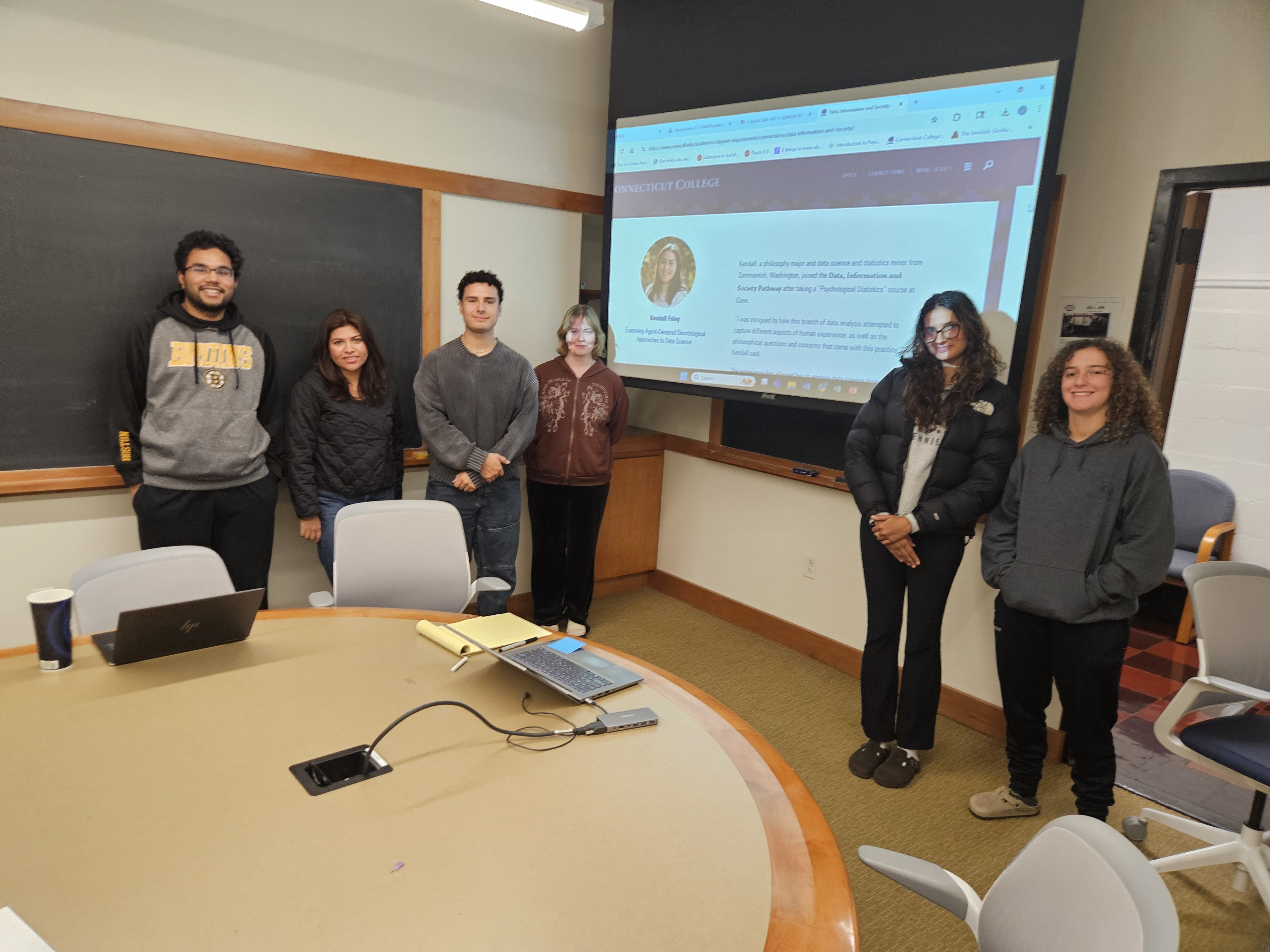
Data Pathway Seniors 2026 Group Photo


Pathway Coordinator


Jeff Strabone, Assistant Professor of Literatures in English

Jeff Strabone

Media, Rhetoric, and Communication Pathway Coordinator, Associate Professor of English

Jeff Strabone works primarily in the British eighteenth century and Romantic era. His research focuses on the rise of cultural nationalisms within the United Kingdom, poetics and literary form, media theory, and problems of race, nation, and empire on a global scale.

Core Faculty & Staff

Connections

P: 860-439-2899 E: eofri@conncoll.edu

Mailing Address

Connecticut College
Fanning 206
270 Mohegan Ave.
New London, CT 06320

Contact

Libby Friedman ’80
Assistant Dean of the College for Connections

Office

Fanning Hall 206


Connecticut College
270 Mohegan Avenue
New London, CT 06320
admission@conncoll.edu
1 (860) 447-1911
Web Privacy Policy Web Accessibility Notice
  • Facebook
  • Twitter
  • Instagram
  • YouTube
  • LinkedIn
  • TikTok
  • CC Mobile CC Mobile

NOTICE OF NONDISCRIMINATORY POLICY AS TO STUDENTS

Connecticut College admits students of any race, color, national and ethnic origin to all the rights, privileges, programs, and activities generally accorded or made available to all students at the college. It does not discriminate on the basis of race, color, national and ethnic origin in administration of its educational policies, admission policies, scholarship and loan programs, and athletic and other college administered programs.