
Professor wins grant to continue research on effects of Deepwater Horizon oil spill
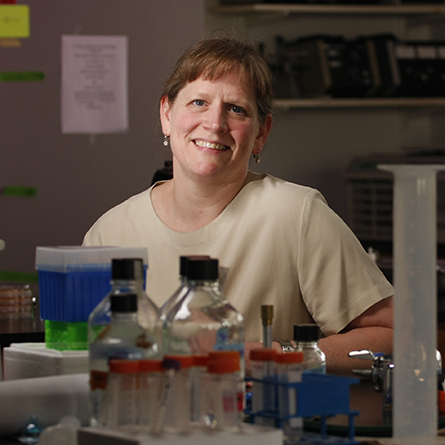
Professor of Biology Anne Bernhard has been awarded a two-year, $120,555 grant from the Gulf of Mexico Research Initiative to continue her work investigating the effects of the 2010 Deepwater Horizon oil spill on the salt marshes of Louisiana.
Bernhard is part of a group of researchers, led by the Louisiana Universities Marine Consortium, who are examining the effects of the spill on coastal ecosystems. The grant is Bernhard’s third from the Gulf of Mexico Research Initiative Research Board, an independent body established by BP to administer the company’s 10-year, $500 million commitment to research the effects of the oil spill. She was previously awarded $301,956 in 2015 and $202,902 in 2012.
Since 2012, Bernhard and a team of student researchers have been collecting and analyzing microbial samples from salt marshes in Louisiana that were impacted by the 2010 oil spill.
“We have now accumulated five years of data, and our results show that the abundance and diversity of these microbes are much more variable compared to similar microbes in New England marshes, and they appear to be more efficient at processing nitrogen,” Bernhard said. “These comparisons provide us with important insights into how nitrogen is processed in these marshes and—since nitrogen is usually what controls plant growth—how the whole ecosystem might be affected.”
Bernhard said her work suggests that there may be long-term impacts on the microbes from the oil spill, but more research is needed to determine if they are being directly impacted by oil toxicity or if they are responding to broader changes in the marsh ecosystem brought about by the oil or other stressors.
With the new grant, Bernhard and her team will focus on an experimental system to more directly test the effects of oil on the marsh microbes and sediment processes. They are creating a dozen mesocosms to simulate natural marshes and analyze the immediate impact of oil. The team also hopes to secure future funding to maintain these mesocosms for several years to study the longer-term effects.
The grant also provides funding for stipends for two Connecticut College student researchers to work with Bernhard this summer. Since the initial grant in 2012, 15 summer research students have worked with Berhnard on the project and four more have completed independent research projects during the academic year. Two of the student researchers, Khushbu Pandya ’16 and Carmen Zazueta-Ramirez ’13, were co-authors on a poster presentation at the American Society for Microbiology General Meeting in 2014.
Bernhard, a professor at Connecticut College since 2004, specializes in the microbial ecology of estuaries and salt marshes. She has also received research grants from the National Science Foundation and the Connecticut Department of Energy and Environmental Protection Long Island Sound Fund.