African American museum exhibit, Black History Month programs offered at Conn
Conn hosts African American museum exhibit and Black History Month programs
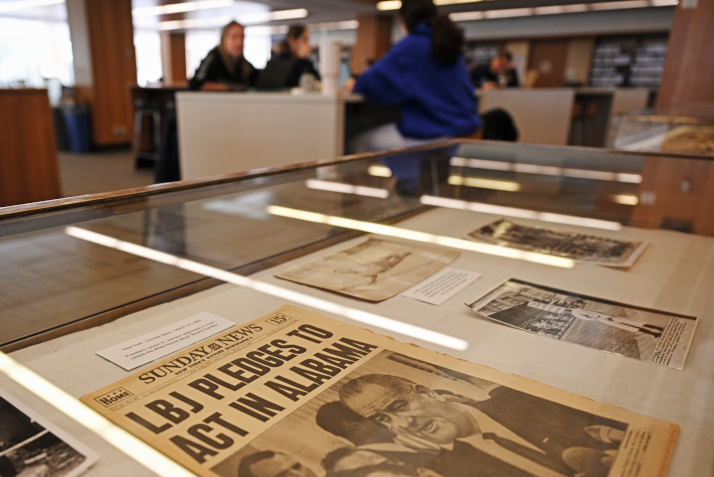
Connecticut College is hosting an installation from the Ruby & Calvin Fletcher African American History Museum, the state’s first and only museum of its kind, at the Charles E. Shain Library throughout the month of February. The installation is presented in partnership with Conn’s Black Student Union (BSU) and made possible by the Sharis ’86 & Thorn ’88 Pozen Endowed Fund for Excellence in Journalism, Writing, and Media.
The museum, which opened in 2021 and is located in Stratford, is dedicated to preserving and presenting African American history and culture. Its collection includes artifacts, documents, photographs and media that chronicle the Black experience in Connecticut and beyond. Its chronological setup guides visitors through the start of the trans-Atlantic slave trade in 1619, which is believed to have forcibly displaced more than 12 million Africans, to the Montgomery bus boycott of 1956 that sparked the Civil Rights Movement in the decade that followed.
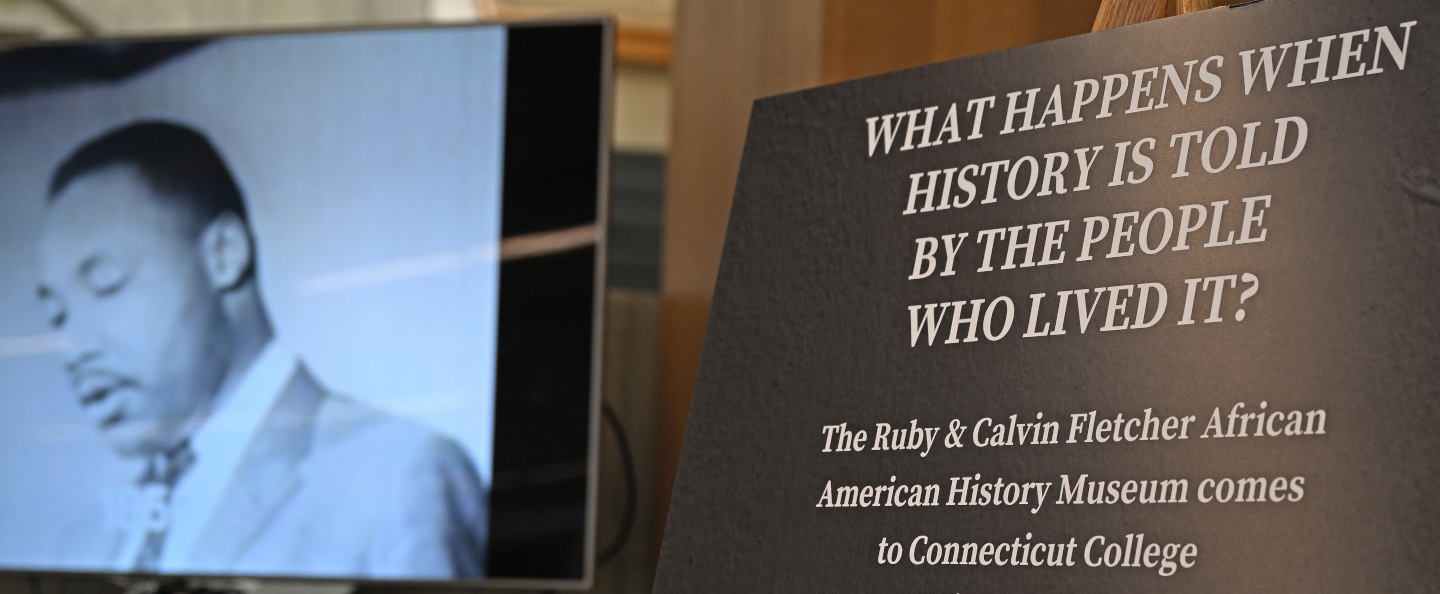
A Feb. 2 opening reception included an abridged screening of a rare 45-minute documentary featuring never-before-seen footage of Dr. Martin Luther King Jr., chronicling his life from his early involvement in the Civil Rights Movement through his final year.
‘Ruby got tired of Jim Crow’
Museum Founder and Executive Director Jeffrey Fletcher, Ruby and Calvin Fletcher’s son, presented the screening. In his remarks, he said the museum features more than 160,000 objects and was inspired by his mother, who left South Carolina in the 1940s.
“Ruby got tired of Jim Crow. She got tired of living in segregation. She had the presence of mind one day to get on a bus with what little bit of trinkets and clothing that she had, and came north, and she ended up in Colchester, Connecticut, not knowing who was going to be there.” She had hoped to see people who looked like her, Fletcher said, but the residents were mostly white. Instead, the town’s Jewish community took her in as an equal. “They gave her their education, their religion, their culture. But one thing they told her is this: ‘Never forget who you are and where you came from.’”
When Ruby died in 2006, Fletcher learned she had left him about 500 artifacts related to African American culture that she had collected over her lifetime. Many of these objects are now featured in the museum they inspired. Fletcher admitted he initially dismissed his mother’s collection as “junk” when he was younger but grew to appreciate her reasons for accumulating it. “She would say, ‘Everything is of value.’ And I realized it wasn't about money—it was about what she felt would be inspiring or educational and could be passed on,” he said.
The Shain installation examines how Black stories have been told and who has been trusted to tell them. From preserved objects to powerful media moments, the exhibit invites visitors to slow down, look closely and reflect on representation, memory and voice.
BSU Co-President Kyaira Hall ’26, a self-designed digital design marketing major and Africana studies and dance double minor and scholar in the Entrepreneurship pathway, from Harlem, New York, said, “This is more than a display. It’s an opportunity for our community to engage with how stories are preserved, whose voices are amplified, and what it means when history is told by those who lived it.”
Bringing Black History to Conn
Associate Professor of Psychology Kendell Coker, who is on the museum’s board, brought a group of Conn students, including Hall, there for a tour in 2023. Hall was blown away and wanted more students to experience the museum, explained Director of Media Relations Christina Flowers, who is the BSU’s staff adviser. “I said, ‘What if we bring the museum to the students?’”
As part of the installation, the Dr. King documentary will play continuously on a loop. The footage was discovered at an estate sale in a film canister marked only with the initials “MLK” and has no formal title, credits or music. The uncut documentary is narrated by a photojournalist who chronicled Dr. King’s life in real time, offering an intimate, unfiltered perspective on one of history’s most documented figures.
“You'll see some footage in there that you have never seen,” Fletcher explained. “You'll see Dr. King speaking to a jail cell full of young Black men who were arrested in Montgomery, and you'll see him after he was assaulted at one of his book signings, speaking from his hospital bed as the surgeons were trying to figure out how to remove the knife in his chest.”
‘Telling Our Stories’
The exhibition also anchors a public conversation to be hosted by the BSU on Wednesday, Feb. 11, beginning at 4 p.m. in the Chu Room. “Telling Our Stories: A Conversation with Journalists” brings together award-winning journalists Eric Sellers of ESPN, Richard Washington III of CBS News, Jason Frazer of Drizzle Weather and Romney Smith of NBC 4 New York.
“Telling Our Stories” will explore reporting, media ethics, representation and the responsibility that comes with telling Black stories in today’s media landscape, building on the exhibition’s focus on journalism, storytelling and voice through lived experience and professional practice. Associate Professor of English Jeff Strabone, coordinator of the Media, Rhetoric and Communications pathway, will help moderate the discussion.
“The exhibit is about how communication and journalism played a significant part in African American history and in our lives,” Fletcher said.