
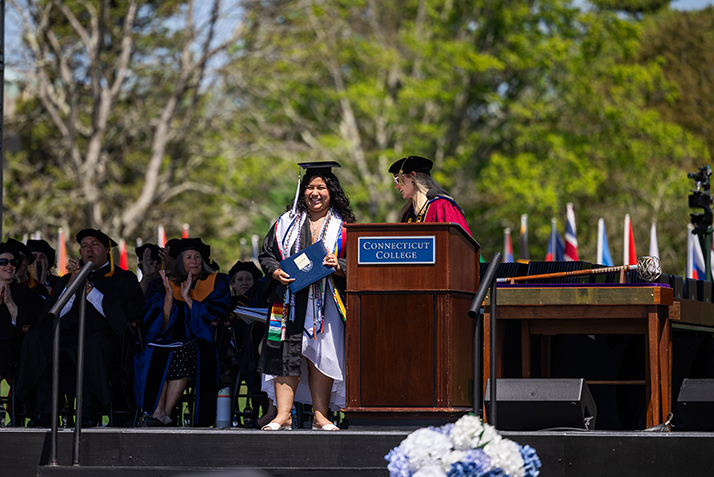


Class of 2026 graduates told to ‘be diamonds on the path of life’
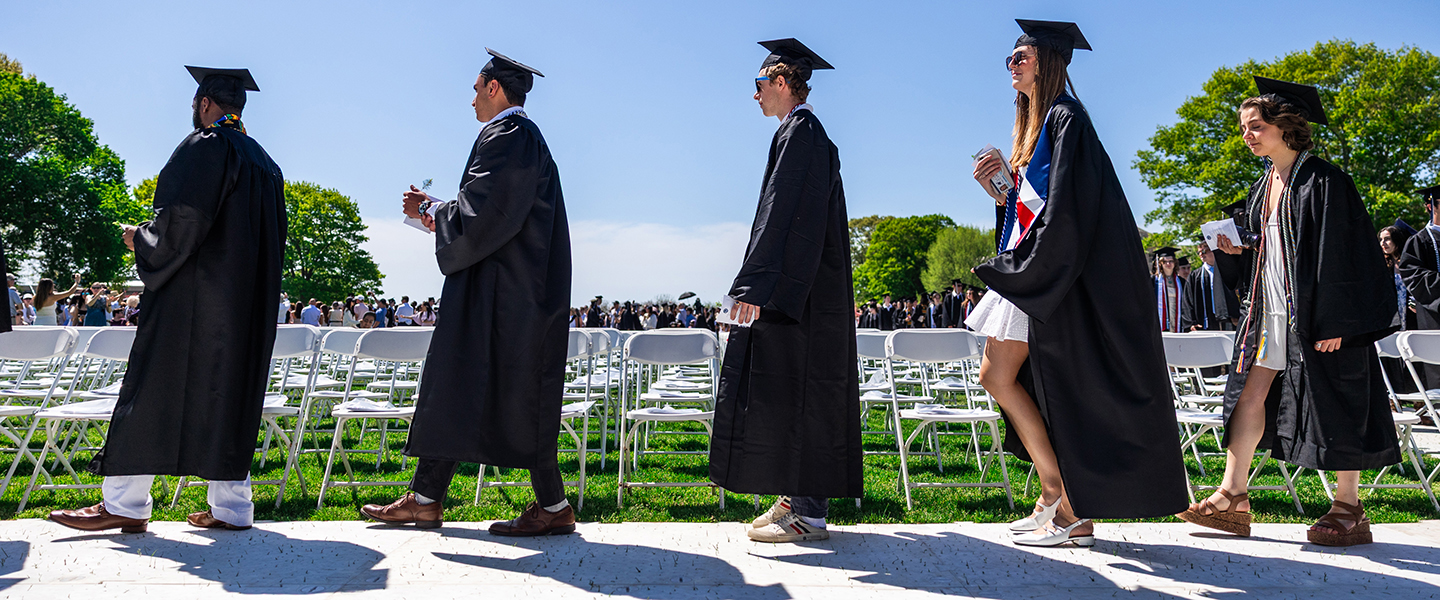
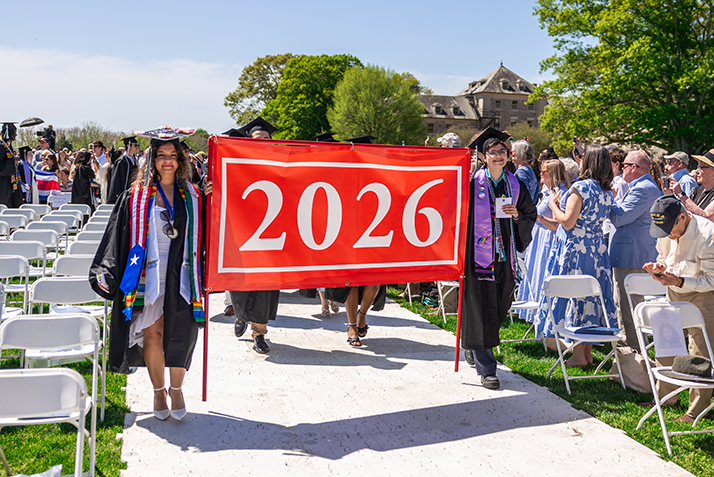
Connecticut College celebrates the largest graduating class in its 115-year history
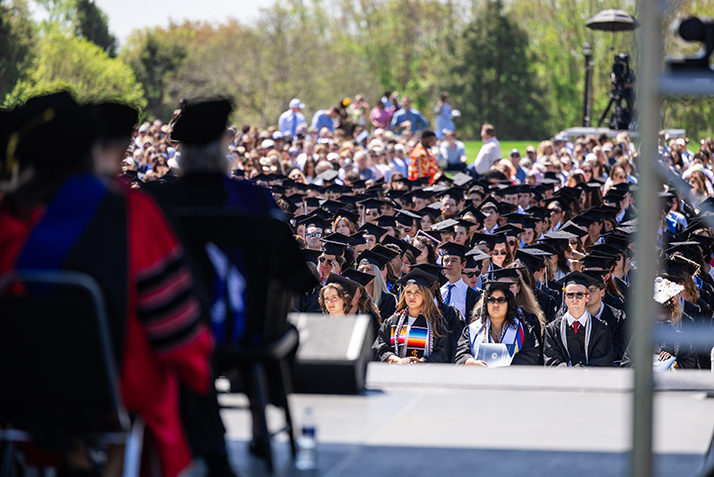
Chief Mutáwi Mutáhash (Many Hearts) Marilynn Malerba, the 18th chief of the Mohegan tribe and the first Native American to serve as treasurer of the United States, told the 512 members of Connecticut College’s Class of 2026 that her life didn’t follow the path she thought it would when she was young—and she hopes theirs won’t, either.
“My career has had twists and turns—unexpected, but, oh such an adventure! There is an old Yiddish saying, ‘Man plans, God laughs.’ So it has been with me,” said Malerba, the keynote speaker at Conn’s 108th Commencement on Sunday, May 17.
“But that is what I wish for you, graduates: that you not look at the last page of the book you are writing for yourselves, that you allow yourselves the freedom and flexibility to say yes to opportunities that you could not have imagined for yourselves. ... Give yourself the grace to always be in the act of becoming. You will be richer for it, and so will we, your community.”
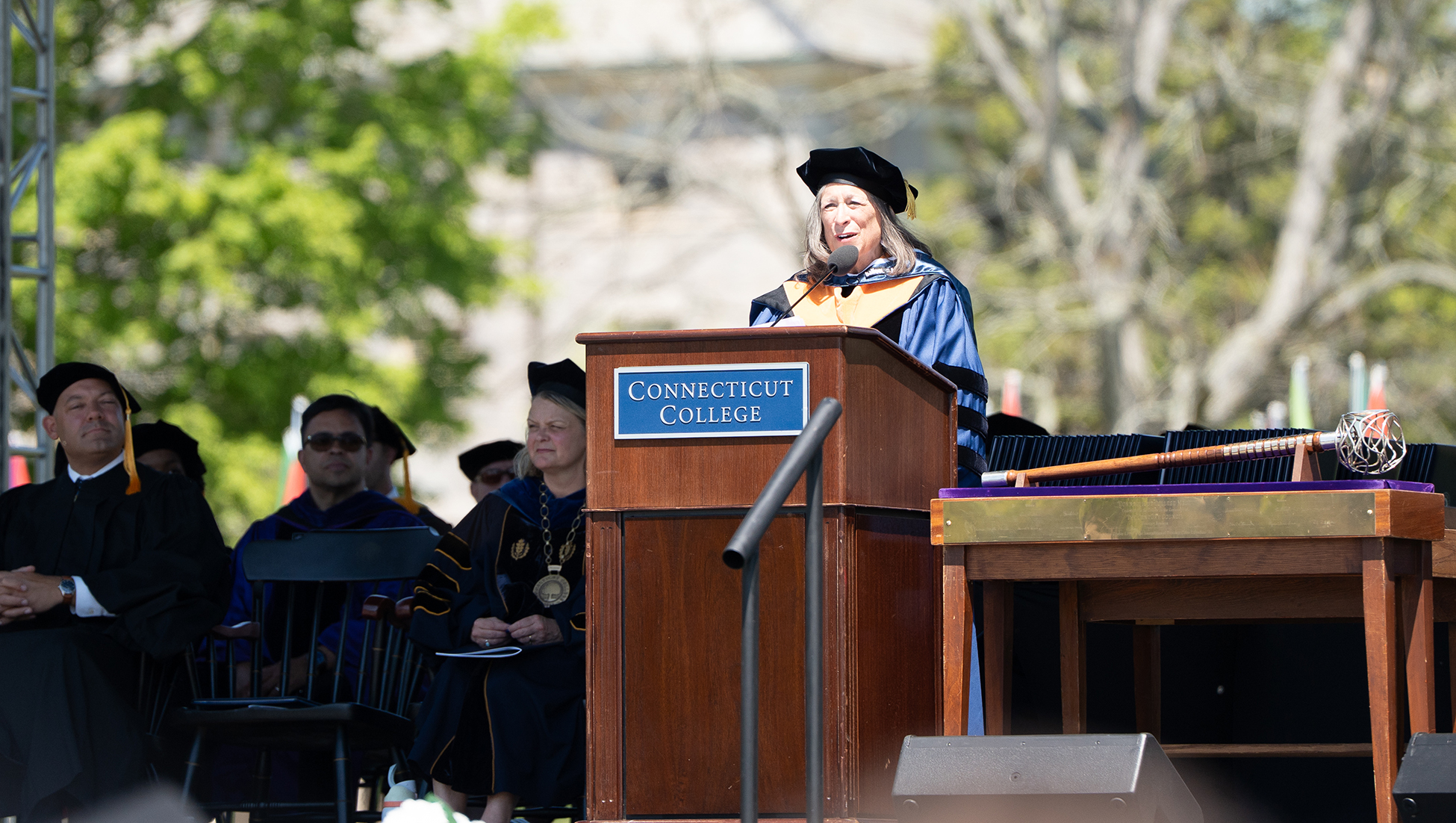
No matter where their paths may lead, Malerba urged the graduates to “find the good medicines that will nurture” and sustain them and their “fellow travelers.”
“Diamonds in Mohegan connote good medicine. I ask that you all be diamonds on the path of life, that you be good medicine, honoring the ancestors as you follow in their footsteps, lighting the way for not only your generation but for those you have yet to meet, so they may find their way easily,” she said. “Be brave along the path. Be bold as you lift your voice in advocating always for the good. Understand that your unique voice is the only one that can impart your vision for change.
“Your generation will chart a new course, and I will be cheering you on every step of the way. I have every confidence that you will chart a course that will be healing for our society.”
Prior to the keynote address and in honor of her trailblazing leadership, cultural stewardship and extraordinary record of public service, Malerba was awarded a doctor of humane letters honoris causa by President Andrea E. Chapdelaine.
During her remarks, Chapdelaine told the grads that they—as Camels—are uniquely prepared for success in an uncertain future. “The camel is one of the most perfectly engineered survivors on Earth,” she said, noting that the desert-dwelling dromedary that serves as Conn’s mascot descends from an Arctic ancestor.
“The same features that helped them navigate blizzards—wide hooves for rough terrain, long lashes to protect their vision and a gel pack on their back for when resources run scarce—turned out to also be perfectly suited for rocky deserts and sandstorms. When their iceberg melted, literally, camels adapted,” she continued.
Likewise, she told the grads, “Your degree has prepared you for a life full of changes that you cannot predict, challenges that you cannot anticipate, and opportunities that will require knowledge, curiosity and flexibility.”

The graduates were also addressed by senior speaker Zoe Patricia Watts ’26, a government major, finance and Africana studies double minor and Posse Scholar from Chicago, Illinois.
“Today, we celebrate not just what we have achieved at Connecticut College, but how we have grown since the moment we were planted here,” Watts told her fellow graduates. “The growing process is unpredictable. When you plant a seed, you do not know what it will look like in full bloom. You do not know how tall it will grow, how deep its roots will stretch, or what storms it will survive. Growth depends on sunlight, soil, care and timing. In many ways, our four years at Connecticut College have mirrored this process.
“We did not arrive with the same goals. We are from different states, different countries, and have different ambitions,” she continued. “Nevertheless, in this shared soil, we each found our own path to receiving our degree today. And just as we have grown, so has this place. We represent the old and the new. The campus we arrived at is not the same one we leave and neither are we.”
Watts reminded her classmates that some of their most powerful growth happened when the path felt the hardest. “But roots grow strongest in the dark,” she said. “Like the plants in the Arboretum, we did not grow by becoming identical. We grew through diversity and through each other. We are beautiful symbols of growth.”
During the ceremony, the Oakes and Louise Ames Prize for most outstanding honors thesis was awarded to Emily Christine Brankman ’26, a dance and history double major, Classics minor and Peace and Conflict Pathway scholar from West Newbury, Massachusetts. Her thesis, “one, and other, one another, another (again): A Historical and Embodied, Kinetic and Theoretical Investigation of Otherization,” is an intricate and highly original exploration of otherization and its use as a tool for power through theoretical, historical and movement-based investigations. Over the course of the academic year, Brankman worked with a group of nine dancers to develop and choreograph a nearly 30-minute performance piece, incorporating theories and presentations of otherness by philosophers, artists and activists into her process. After examining othering across disciplines and time, Brankman powerfully asserts that otherization can be countered only through intentional acknowledgment and accountability.
The College awarded the Claire Gaudiani ’66 Prize for Excellence in the Senior Integrative Project to Jenifer Alvarado Rivadeneira ’26, an English, Latin American studies and sociology triple major and Toor Cummings Center for International Studies and the Liberal Arts scholar from New York, New York. Her honors thesis and senior integrative project, “Civil Disillusionment: Citizens’ Perceptions of Governance in Guayaquil,” examines political perceptions in the Pacific community of Guayaquil, Ecuador, where she served for two summers as a legal intern in a local attorney’s office. Using a mixed methodological approach, Alvarado Rivadeneira integrates quantitative survey data on civic knowledge, institutional trust and personal experience with a qualitative analysis of anonymous political street art to reveal civic disillusionment as a defining feature of contemporary civic life in Guayaquil.
The 2026 Anna Lord Strauss Medal for outstanding work in public or community service was awarded to advocate and changemaker Olivia Grace McDonald ’26, a government major, economics minor and Holleran Center for Community Action and Public Policy scholar from Guilford, Connecticut. At the local, state and national levels, McDonald has demonstrated a strong commitment to academic and community engagement, particularly at the intersection of law, economics, politics and social justice. In addition to serving in many capacities on campus, she contributed to scholarship on federalism and housing advocacy by conducting original research on responses to the landmark 2005 Supreme Court case on eminent domain, Kelo v. City of New London. Off campus, she has translated her passions and scholarship into impact through six legal and civic engagement internships, most recently conducting comprehensive legal research and drafting case briefs supporting antitrust enforcement for the Office of the Connecticut Attorney General.
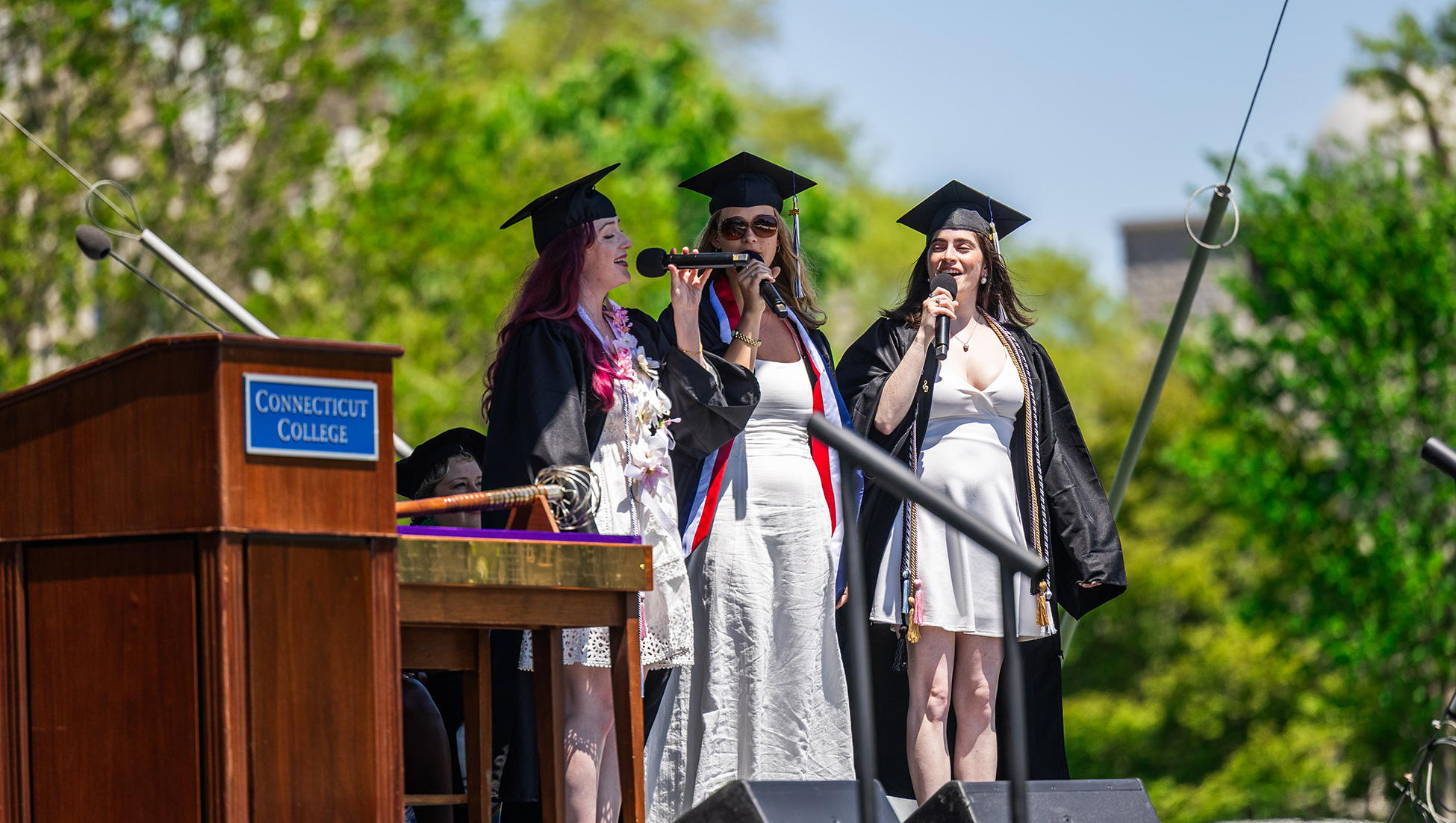
At the conclusion of the ceremony, Sophia Rose Okun Ethington ’26, Alexa Madison Warren ’26 and Sophia Joan Wulsin ’26 sang the Alma Mater, with musical accompaniment by the Sean Nelson Jazz Orchestra.
Commencement events began earlier in the weekend with the induction of 50 graduating seniors into Phi Beta Kappa, the national academic honor society; a multifaith Baccalaureate service; certificate ceremonies for senior scholars in the College’s centers for interdisciplinary scholarship; a CCAC stoling ceremony; and special gatherings for student-athletes, international graduates, Posse scholars and first-generation graduates.
Now graduates, members of the Class of 2026 are headed around the world to pursue a range of opportunities. One received a $40,000 Watson Fellowship to explore urban forestry in Mexico, South Africa, France, Australia and Japan. Another received a Fulbright fellowship to teach English in Taiwan, and yet another was awarded a Mortimer Hays-Brandeis Traveling Fellowship to explore a multidisciplinary project in Valencia, Spain. Members of the class have been accepted to graduate programs at Yale, Brown, Columbia, UPenn, Duke, Georgetown, Oxford, NYU, Villanova, George Washington University, Johns Hopkins, Tufts, Boston University, University of Texas, University of Edinburgh, and University of California, Berkeley. Others have accepted positions at companies and organizations including Disney, Morgan Stanley, the National Park Service, Teach for America, SMBC, Granite Communications, Fidelity, Clubspot, Granite Telecommunications, Citizens Bank, The Washington Institute for Near East Policy, MUFG, FactSet and Northern Trust.
Class of 2026 By the Numbers
- 512 Bachelor of Arts degrees awarded
- 173 double majors
- 6 triple majors
- Graduates represent 32 states and 17 countries
- 69 are the first in their families to graduate from college
- 146 graduates earned Latin Honors (37 earned Summa Cum Laude; 51 earned Magna Cum Laude; 58 earned Cum Laude)
- 275 members of the class earned departmental honors
- 50 graduates were inducted into Phi Beta Kappa, the national academic honor society
512
Bachelor of Arts Degrees Awarded
173
Double Majors
6
Triple Majors
For full Commencement coverage, visit www.conncoll.edu/commencement.
May 17, 2026