
Conn holds screening of ‘Eva’s Promise’ with co-producer Susan Endel Kerner ’67 P’02
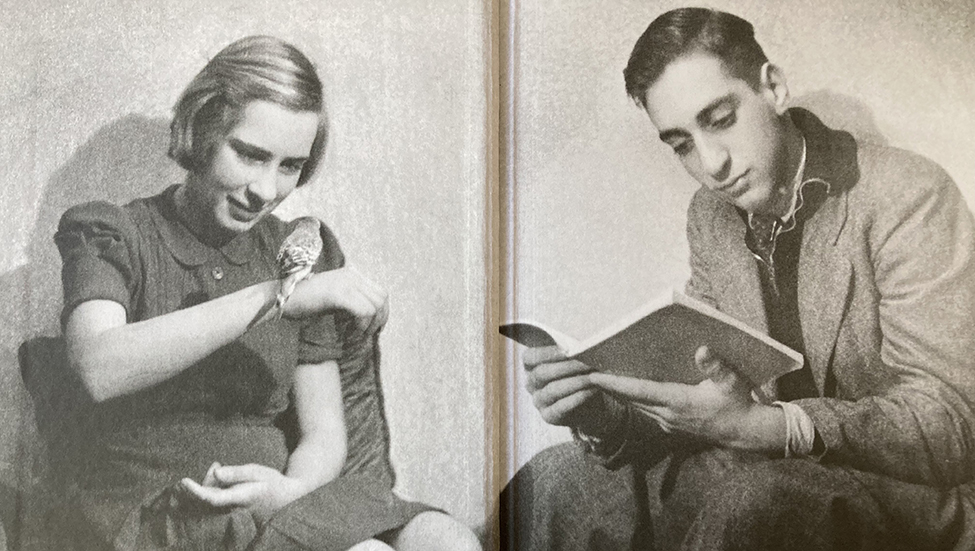
On a train bound for the Nazi transit camp Westerbork, a teenager named Eva made a promise to her older brother, Heinz. Packed into a cattle car with their parents, Erich and Fritzi, and other Jews in May of 1944, the siblings were scared. German soldiers had followed Eva and her mother during a visit to her father and brother hiding in a different house 10 minutes away. A nurse who had helped them hide turned out to be a double agent. The family was captured on May 11, Eva’s 15th birthday. They had no idea where the train was headed.
“[Heinz] told me that his paintings and his poems were hidden under the floorboard in the house where they were hiding,” Eva Geiringer Schloss recalled in an interview almost 80 years later. “’Please, Eva, please go and pick it up and show to the world what I had achieved in my short life.’ And I said, ‘Of course, you will survive. I survive, you survive, and we go together.’ He said, ‘But promise me that you will go even if I'm not there.’”
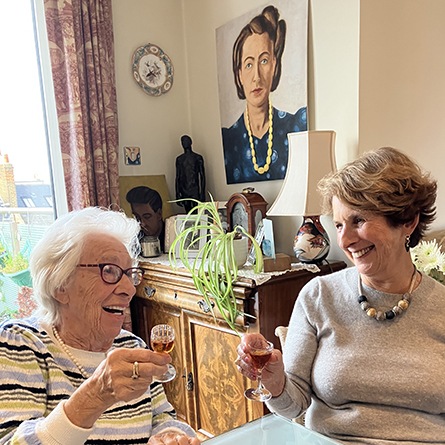
Schloss died last month in London at the age of 96. She was an Austrian Jew who lived across the street from Anne Frank in Amsterdam’s Merwedeplein neighborhood in the early 1940s. While much of the world knows the story of Anne Frank—thanks to the efforts of Frank’s father and Schloss’s mother, who married in 1953—Schloss tells her own family’s story in the hourlong documentary Eva’s Promise. The film was co-produced by Susan Endel Kerner ’67 P’02, professor emerita of theater at Montclair State University in New Jersey. She has directed in New York, London and Cambridge, Shanghai, and at theaters and universities throughout the United States.
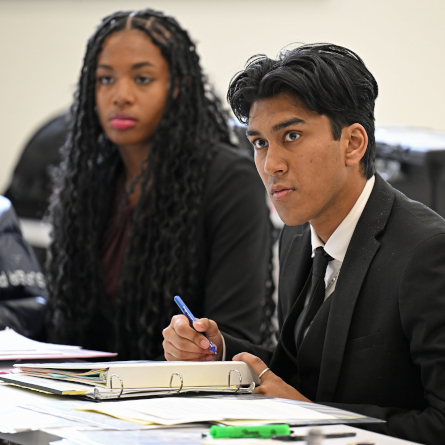
On Feb. 15, about 70 people from Connecticut College and the local community took in a screening of the film in the Cummings Arts Center’s Oliva Hall, followed by an in-person conversation with Kerner and the film’s director, Steve McCarthy. Moderating the discussion was Rabbi Jessica Goldberg, the new director of Zachs Hillel House and college chaplain.
The event was co-presented with the Jewish Federation of Eastern Connecticut and the Lyman Allyn Art Museum in conjunction with its pop-up exhibition Art in the Holocaust from the Yad Vashem Collection. The film came out in 2022, made the festival circuit, and began airing on PBS in 2024. It has now aired on 17 public television stations, and Kerner and McCarthy hope to get the film adopted into the Holocaust curricula in schools next, ensuring Eva’s promise continues to be fulfilled after her death.
In her introductory remarks, Connecticut College President Andrea E. Chapdelaine said, “At Conn, we are committed to the formation of thoughtful, ethical and engaged citizens. Films like Eva's Promise help us live out that mission. They ask us to examine the consequences of prejudice and injustice, to consider our own responsibilities in the face of intolerance, and to reflect on how history shapes the present moment.”
After the stop in Westerbork more than 80 years ago, the frightened Geiringers were sent to Auschwitz-Birkenau. Mother and daughter were separated from father and son for nearly a year. Schloss and Fritzi survived the Holocaust, but Heinz and Erich died in April 1945, just days before the camp was liberated. Two years later, determined to keep her promise, Schloss and her mother knocked on the door of her brother’s hiding place and, after the new owners reluctantly allowed them in, Schloss lifted a floorboard and retrieved the hidden treasures.
For more than four decades, the bereaved Schloss internalized her pain and moved on with her life. She married, had children and became a grandmother. But she realized there was more to keeping her promise than rescuing her brother’s art from beneath a dusty floorboard. Eventually she wrote three books about her family's experience during and after the Holocaust. “She toured Europe, Asia and the United States as a Holocaust educator,” Kerner explained in the film. “Her focus now is on the story of her brother and sharing his legacy with the world.”
Kerner met Schloss 30 years ago when Kerner directed the world premiere of the play And Then They Came for Me: Remembering the World of Anne Frank, which is about two surviving friends of Frank, Schloss and Ed Silverberg, who was Anne Frank's teenage boyfriend before the Frank family went into hiding in 1942. Schloss often participated in post-play discussions and wanted to tell the world about her brother. “Once she started speaking, she was dedicated to fighting discrimination and prejudice of all kinds,” Kerner said, adding, “Heinz Geiringer died at 18. He never married. He didn't have children. His legacy is a collection of beautiful paintings and deeply felt poems.”
Now, as Schloss vowed in Eva’s Promise, the world will know about her brother. “I have promised Heinz that he will not be forgotten. He will be remembered wherever I speak.”