Class visits Cuba to explore 'first-world education in a third-world economy'
Education professor Michael James knows the best way to teach his students about the power of a transformative education is to transform them. And a two-week trip to Cuba does just the trick.
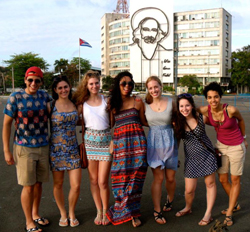
During the College's spring break, James took the nine students in his "Revolutionary Education in Latin America" course to Havana to witness Cuba's impressive education system first hand.
"In Cuba, everyone has a free education from preschool through university training," James said. "The students who went on this trip understand that education can be transformative, community-based and liberating. If they don't experience it, it's just a vague concept. But they've seen it on the ground, including its many contradictions."
The class, which examines education systems in Cuba, Mexico and Nicaragua, prepared for the trip by reading Paulo Freire's "Pedagogy of the Oppressed" and "A History of the Cuban Revolution," by Aviva Chomsky. Once in Cuba, the group attended a two-day workshop on popular education in the country, visited schools and universities, met with the leadership of the federation of Cuban women, toured health centers, and discussed everything from the Cuban economy to the history of the revolution to U.S.-Cuban relations with a series of Cuban scholars. Additionally, they had the opportunity to meet Chomsky and attend a lecture by her, speak with everyday Cubans on the street and meet Cuban politician Armando Hart Dávalos.
They also fit in time to enjoy Cuba's culture, visiting museums, learning to salsa and rumba, attending a Silvio Rodriguez concert (Cuba's "Bob Dylan," according to James), taking in a street opera and even soaking up the sun for a few hours on one of Cuba's beautiful beaches.
For history major Karina Hernandez '14, the trip was completely eye-opening.
"Everybody was educated - almost every person I met was more aware of what is going on in the world than the average American," she said. "Cuba truly offers a first-world education in a third world economy."
Freshman Sophia DeLevie-Orey said she became fascinated by Cuba after taking a first-year seminar, "Castro, Che Guevara and the Cuban Revolution," with Professor Leo Garofalo.
"Before I began to study Cuba, I had an unfortunately prevalent and ignorant impression of Cuba as a bad, disordered place run by a mean dictator," she said. "While the country still has a third-world feel to it, there were certain key signs of poverty missing."
James will lead Connecticut College students on an entire semester of study in Cuba in the spring of 2013, through the College's Study Away/ Teach Away (SATA) program. He is looking forward to teaching students in an environment radically different from what they are used to.
"The best kind of study away is when you go somewhere that doesn't affirm your identity, but challenges who you are," James said. "That's the type of student I relish working with - students who are excited about finding somewhere that can literally confuse them."
May 15, 2012