
Students create marketable AI solutions for real-world problems
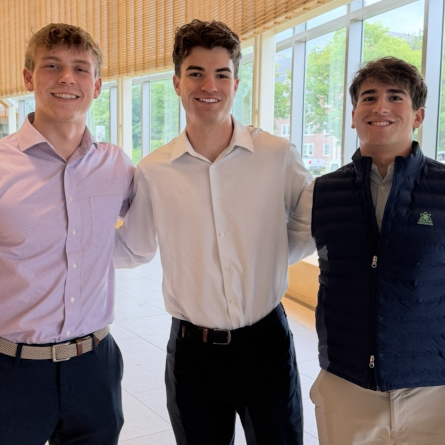
Liam Boukris ’28, Cole Craffey ’29 and Mikey Magyar ’28, three Connecticut College students in the Entrepreneurship, Social Innovation, Value and Change Pathway, spent eight weeks this summer exploring the possibilities and problems of artificial intelligence (AI) through the Interdisciplinary Summer Bridges Program at Colby College in Waterville, Maine.
The program demonstrates the core mission of the Davis Institute for Artificial Intelligence at Colby (DavisAI), which is “to lead human-centered AI innovation in the liberal arts through collaborative, interdisciplinary creation and responsible, ethical application.” DavisAI Director David Watts shared the opportunity with the Liberal Arts Collaborative for Emerging Tech (LACET). He and Conn’s Harold F. Wiley Generative AI Teaching and Learning Fellow, Susan Purrington, are two of LACET’s founding members.
At Colby, Boukris, Craffey and Magyar worked in groups with other students from across the United States and Germany to design and pitch an AI solution to a company problem. Entrepreneurship Pathway co-coordinator and Adjunct Assistant Professor of Economics Noel Garrett served as a faculty mentor to the three Camels throughout the process.
“The program connected directly with the Entrepreneurship Pathway by having us identify a problem, develop a solution and create a business model around it,” Craffey, an economics major, finance minor and Men’s Basketball player from Easton, Massachusetts, said. “It also allowed me to apply my interest in finance by creating a three-year financial forecast and thinking through how our startup could operate sustainably.”
Craffey worked with three Maine college students—two from Colby and one from nearby Thomas College—to brainstorm problems they had witnessed or experienced and select one they believed AI could realistically help address. They divided responsibilities based on each person’s strengths and made major decisions together, he said.
The team’s startup concept was an AI-powered platform designed to connect college students and campus organizations with volunteer opportunities and community projects offered by local nonprofits. The group’s final pitch won the program’s award for Best Presentation.
But the real win was the knowledge they gained. “I learned that applying AI in the real world starts with identifying a specific problem and then determining how AI can make the solution simpler or more effective,” Craffey reflected. “The program sparked my interest in using AI creatively to solve complex problems.”
Magyar, an economics and environmental studies double major and finance minor from Tampa, Florida, who is also on the Men’s Ice Hockey team, said his favorite part of the program was visiting Maine academic and research institutions like Allen Island, the Forks, and Jackson Laboratory (JAX), environments he said allowed him to reflect on AI and their projects. The excursions “gave me new insight into how AI can be applied in a professional field while staying at the forefront of modern research.”
Back on Colby’s campus, he noticed parallels to Conn, comparing the program to Conn’s 200-level “Thematic Inquiry” entrepreneurship course. Just like in that course, he said, “we learned how to use a new or existing AI idea to create a new and innovative product, as well as how to market, produce and pitch that product.”
Magyar’s team included three Colby students with different academic and personal backgrounds. “Our diversity enabled us to approach problems from different perspectives, helping us brainstorm ideas and develop solutions,” he said.
The group created a product to help college international student offices track, support and store info surrounding students' F-1 visa journeys. “The idea came from one of my teammates, who is from Turkey and had first-hand experience in the challenges students face throughout the process,” Magyar recalled. “We spoke to college admissions offices and international students to better understand their needs and tailor the product. Our team won an award for the Most Innovative Product Design, which we were thrilled to receive from the panel of judges.”
Purrington, whose role is a cornerstone of the College’s initiative AI@Conn, and Garrett collaborated to make it possible for Boukris, Craffey and Magyar to participate in the program. “I am always looking for experiences for faculty, staff and students to engage critically with AI,” Purrington said. “We agreed that students would be able to bring the knowledge back and share it with others. I think it is important to hear their ideas.”
The program culminated in project presentations at the Colby College Summer Research Symposium and in a final pitch competition in front of peers and industry leaders. Boukris, an economics major, finance minor and member of the sailing team from Huntington Beach, California, will join Craffey and Magyar as they share their experiences with the Conn community at the Summer Science Research Institute (SSRI) student presentation during Fall Weekend on Friday, Oct. 9, and at the AI and the Liberal Arts Symposium on Friday, Oct. 16.