The seventh annual All-College Symposium took place Nov. 6, 2025, in locations across campus.

This major student conference highlighted students’ integrative learning in Connections, the College’s reinvention of the liberal arts. 

Through talks, panels and poster sessions, students who participated in the College’s Centers for interdisciplinary scholarship or the Integrative Pathways showcased how their coursework and experiences informed their studies and learning over four years.


2025 All-College Symposium News

Meet some of the 2025 Symposium presenters:


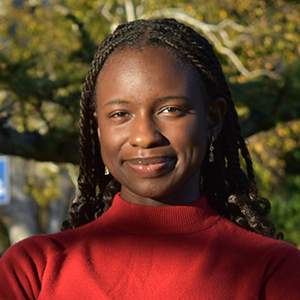
Headshot of Hope Kisakye, Class of ’26

Hope Kisakye

Bridging Tradition and Innovation: An Interdisciplinary Approach to Vernacular Architecture


Hope, who is from Kampala, Uganda, is passionate about architecture, sustainable design and environmental justice. An architectural studies and environmental studies double major who is minoring in Hispanic studies, Hope is a scholar in the Toor Cummings Center for International Studies and the Liberal Arts (CISLA) pursuing research on African and Latin American vernacular architecture. Her CISLA foundation course, “Perspectives in Modern Global Societies,” taught her how to see and understand architecture through the lens of her positionality.

“Being an international student, but also being from a community-based culture, I was drawn to vernacular architecture because it captured the core values of community, harmony with the environment, and resourcefulness,” she says. Her CISLA support courses, “Hispanic Identities” and “South American Cultures and Environments,” delved into topics such as indigeneity, traditional practices among South American and Spanish-speaking groups, and political and environmental conflict, which all helped Hope understand building practices as they relate to Latin America.

The summer before her junior year, Hope earned a Bessell Fellowship to intern with The Sasamani Foundation, a nonprofit that builds education and employment programs to stop the cycle of poverty in Tanzania. And as a rising senior, CISLA funding allowed her to work as a sustainable architecture intern for El Terreno, a cultural exchange center in Ecuador with a mission to make a more meaningful, prosperous and sustainable world. While in Ecuador, Hope pursued an independent research project on vernacular adobe architecture in the Guaranda region, with a focus on integrating traditional building practices into local contemporary contexts.

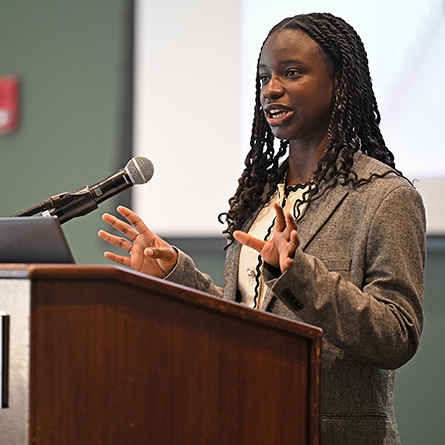
Hope’s internships and independent research informed her All-College Symposium presentation, “Bridging Tradition and Innovation: An Interdisciplinary Approach to Vernacular Architecture,” which explores how various traditional design approaches and principles reshape architecture to address pressing needs like sustainability and housing insecurities. During her time at Conn, Hope, who plays on the women’s club soccer team, has also served as president of the Conn Christian Fellowship, public relations chair of the International Students Association, co-president of the African Students Association, and social media chair for Model United Nations. After graduation, she hopes to attend graduate school to become a licensed architect. 
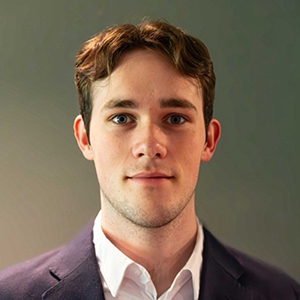
Headshot of Palmer Okai, Class of ’26

Palmer Okai

The Death of Human Thought? What AI Could Mean for Human Creativity


Palmer, a computer science major, architectural studies minor and scholar in the Creativity Pathway from Strafford, Vermont, has a keen interest in the intersection of arts and technology. He particularly wants to know if human creativity is at risk as AI gains prevalence in creative industries. He explores this question in his All-College Symposium project, “The Death of Human Thought? What AI Could Mean for Human Creativity.”

“I believe human creativity is at risk given the rise in generative AI. I think an attitude shift in how we view and utilize AI tools is necessary to mitigate this risk,” says Palmer, who worked with and learned about AI tools in his more technical Pathway courses and studied the human experience in his humanities classes. “Studying things humans create and understanding how intertwined they are with expression and identity while simultaneously studying and working with generative AI offered a juxtaposition that revealed how valuable I believe human thought and creation to be.”

A data operations internship with Precisely Software Incorporated rounded out Palmer’s research this past summer—he says he got the chance to put his creative problem solving to use in developing solutions to difficult open-ended problems. Another rich source of inspiration, a spring-semester study away program in Belfast, Northern Ireland, added some balance. “I had the chance to engage with a culture with a deep appreciation for art, music and many other creative disciplines,” Palmer says. “In contrast, my academics were greatly focused on utilizing artificial intelligence. Immersing myself in both at the same time helped me to develop my animating question.”

During his time as a Camel, the senior has served as founder and president of the Connecticut College Squash Club, a member of a band through MOBROC, a computer science teaching assistant, and an athletics event statistician. He also won the Sophomore Computer Science Award for excellence in research, academics and service and the Junior Computer Science Award for distinction in computer science. 

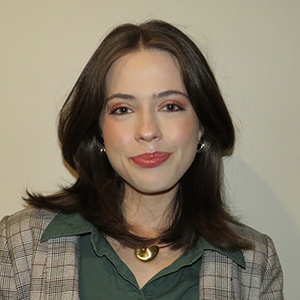
Headshot of Rachel Letts, Class of

Rachel Letts

How Does Ethnicity Impact Hispanic Communities in Our Global Capitalist System?


For Rachel, an economics and Hispanic studies double major from Swarthmore, Pennsylvania, the journey to the All-College Symposium didn’t begin at Connecticut College.

“I actually started my college career at Penn State University,” she explains. “When I was completing transfer applications, I really felt that what was missing from my college experience was a way to combine my majors in a meaningful way. I knew Connecticut College was where I was meant to be as soon as I heard about the Connections program.”

At Conn, she found her place in the Global Capitalism Pathway and began conducting research in the local community. “I realized New London has a large Hispanic population that is disproportionately low income and homeless. After completing my sophomore Pathway seminar, I realized that the economic inequality I was exploring was systematically achieved and deeply ingrained in our capitalist system,” she says.

That realization shaped Rachel’s scholarly efforts and will culminate in her All-College Symposium presentation, “How Does Ethnicity Impact Hispanic Communities in Our Global Capitalist System?”

“Concentrating [all my work at Conn] into one presentation while thinking deeply about my takeaways, I realized for the first time that I had truly achieved my goal of doing something, independently, that was meaningful and impactful during my time in the classroom,” she enthuses. “I feel so excited for the Symposium to have the opportunity to share with friends, faculty and family all the work I've done during my time in College: What it has meant to me, what it has taught me, and how it has shaped me into the person I am today.”

Now, Rachel is hard at work on her honors thesis, an economic analysis exploring the labor market impacts of mass deportation. After graduation, she hopes to move to Boston to continue working with Hispanic communities or in immigration aid.


Sana Bhat '26

Data, Information and Society Pathway

Declan Hunter '26

Social Justice and Sustainability

Joe Gendron '26

Ammerman Center for Arts and Technology


Connections

Mailing Address

Connecticut College
Fanning 206
270 Mohegan Ave.
New London, CT 06320

Contact

Libby Friedman '80
Assistant Dean of the College for Connections

Office

Fanning Hall 206