Sababa, a Computer Science and Global Islamic Studies double major and art minor from Pabna, Bangladesh, says she knew she wanted to join Conn’s innovative Ammerman Center for Arts and Technology before she even arrived on campus.
“I’ve always wanted to work on the creative side of technology, where art and tech meet, and the Ammerman Center was the perfect place for that,” she said.
Her animating question and All-College Symposium presentation topic, “Can interactive technology help preserve South Asian arts and crafts?” was born largely out of frustration, she explains.
“I kept seeing the Western world adopt South Asian arts and crafts without giving credit to where they came from. One example is the ‘Scandinavian scarf,’ which is really our dupatta, but most people don’t know or care about its origins,” she said. “At the same time, I was watching traditional art forms from my home region disappear as lifestyles change. I want people to know the world these traditions come from, and I wanted to explore whether technology could help keep them alive.”
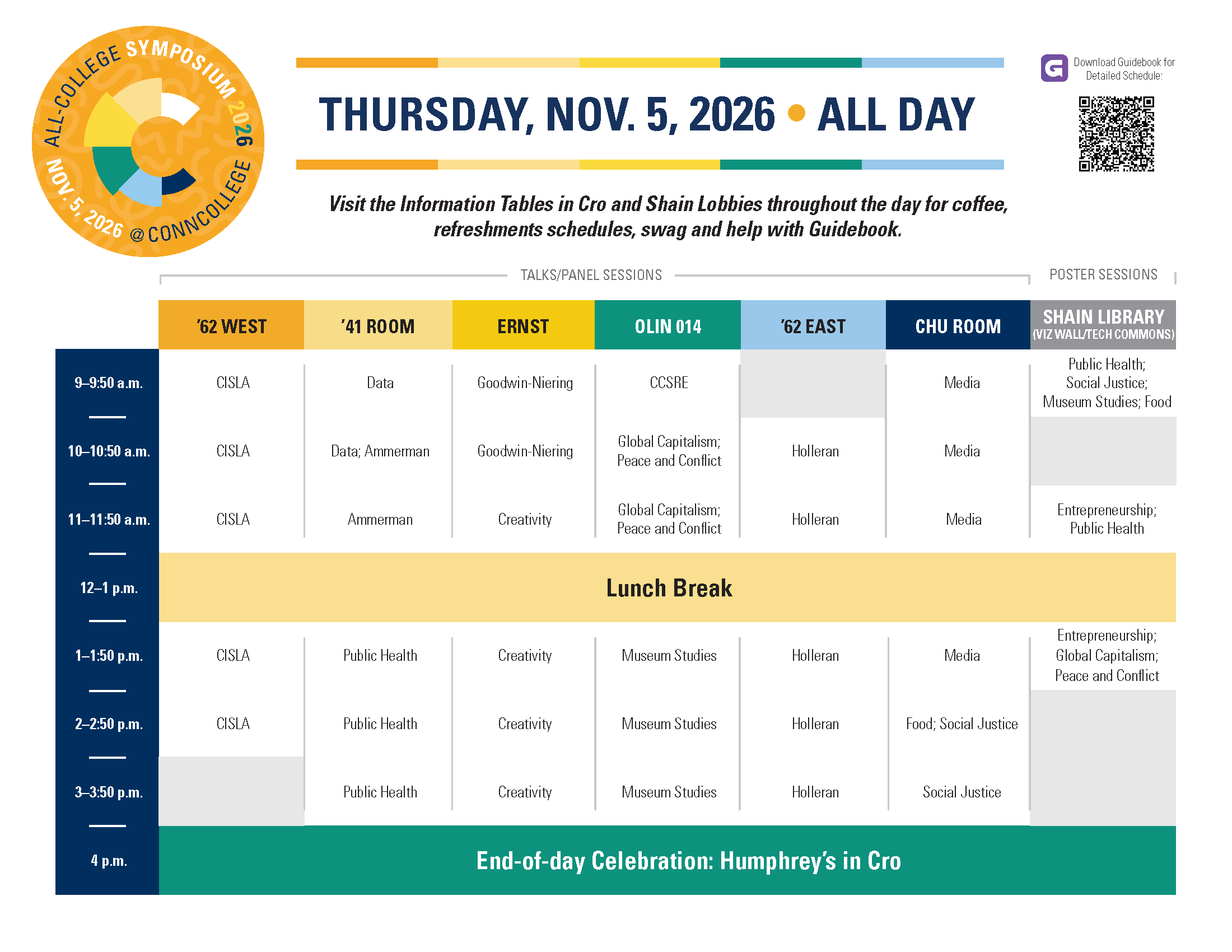
The presentation will explore the research and questions behind Sababa’s Senior Integrative Project, Pucca, an interactive installation about the mud-wall painting tradition of the Santal community in northern Bangladesh.
“Santal women paint the earthen walls of their homes with natural pigments and renew the paintings each year. Before Sohrai, the harvest festival, every home is freshly plastered and painted, and the whole village becomes a celebration. The paintings welcome prosperity into the home, and the knowledge is passed from mother to daughter. As families move to brick and tin houses, the walls disappear, and the tradition goes with them,” she explained.
“In my installation, visitors paint on a real mud-plastered wall using Santal motifs, guided by sound and storytelling. The work invites them to experience the tradition and reflect on what it means to preserve something that was always meant to be impermanent.”
During her time at Conn, Sababa participated in the Summer Science Research Institute and worked with Computer Science Professor James Lee on a project based on her original idea—developing a standalone smartwatch app that creates a personalized meditation plan based on the user’s health data and heart rate. She also completed a product design internship with Develop for Good, redesigning the website for LiberArte Inc., a New York-based arts nonprofit.
On campus, Sababa is a dedicated student leader. She serves as vice president of the Class of 2027, as a Senior Student Admission Fellow and as a Hale Center Career Fellow. She is also the founder and co-president of the Girls Who Code College Loop at Conn, and president of the Connecticut College Computer Science Student Advisory Board.
Sababa said she hopes her project and Symposium presentation will bring greater awareness of the origins of South Asian arts and crafts and their impact around the world.
“Many of these artists have no formal academic training—they learned their craft from their surroundings and from elders in their families. I want to bring attention to them and to the knowledge they carry,” she said.
After graduation, Sababa plans to launch a career as a design engineer working at the intersection of art and technology. “I hope to draw on South Asian arts and crafts techniques to make technology design more accessible,” she said.